
By Decent Cybersecurity, publisher of SynapseCommand®
What Is Command and Control (C2)? Military C2 Explained
Command and control, usually abbreviated C2, is how a military commander exercises authority and direction over assigned and attached forces to accomplish a mission. This guide explains what C2 means, what supports it, how command relationships and information quality shape it, and how NATO and U.S. Army approaches relate.
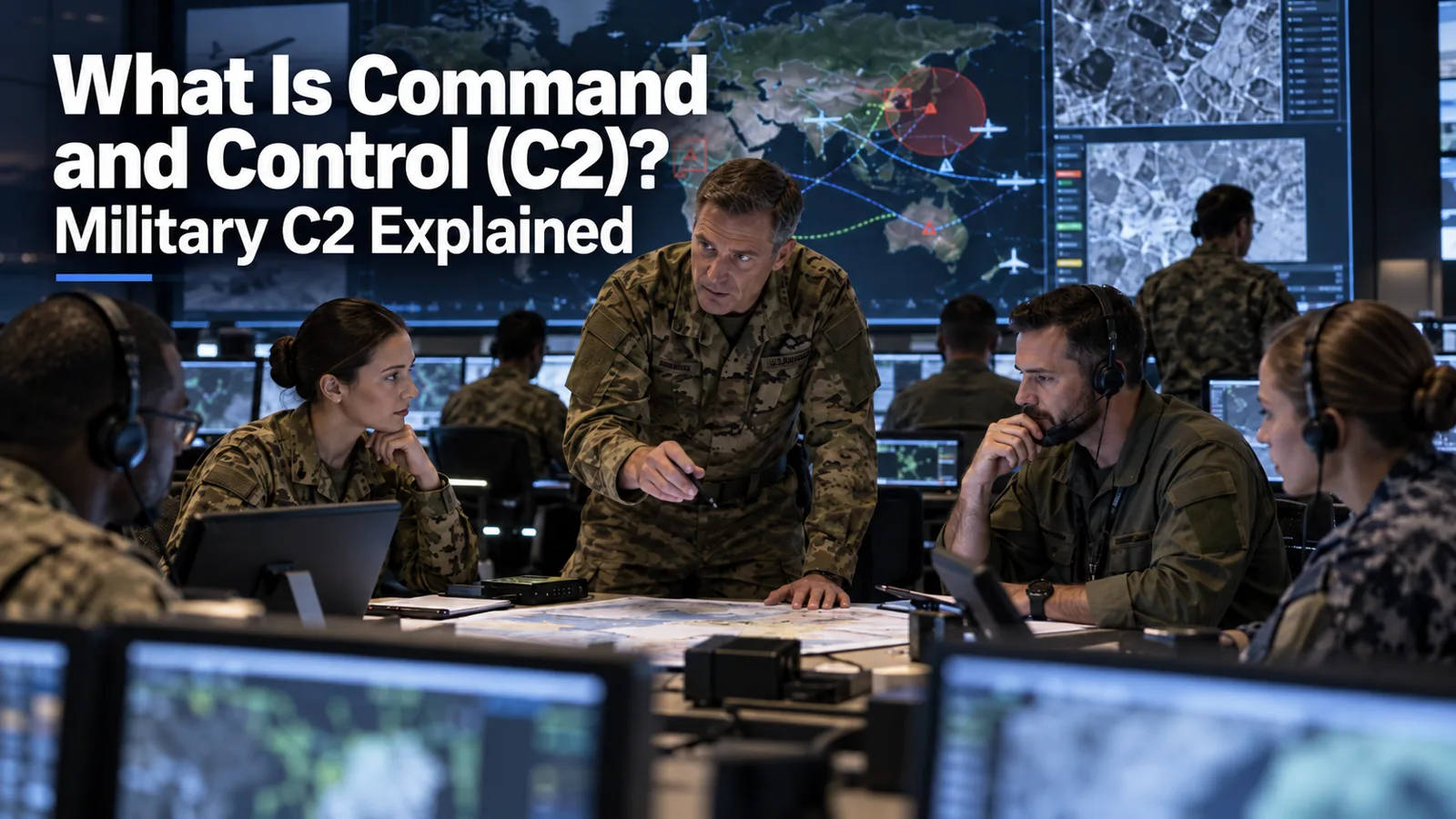
Command and control, usually abbreviated C2, is how a military commander exercises authority and direction over assigned and attached forces to accomplish a mission. U.S. Army doctrine uses that formulation explicitly in ADP 6-0, while NATO describes C2 as the leadership and direction given to a military organisation to accomplish its mission. U.S. Army ADP 6-0 NATO, Multinational Capability Delivery
In practice, C2 is how commanders and staffs turn intent, information and authority into coordinated action. It is not a software product, a command post, a radio network or a Common Operational Picture on its own. Those can support C2, but command remains a human responsibility exercised through people, processes, networks and headquarters arrangements.
At a glance
| Question | Answer |
|---|---|
| What does C2 stand for? | Command and Control |
| Core purpose | Enable a commander to understand, decide, direct, coordinate and adjust military activity toward mission accomplishment |
| Is C2 a software system? | No. Software can support C2, but C2 is fundamentally the exercise of authority and direction |
| Who exercises C2? | Properly designated commanders, supported by staffs, subordinate leaders and command-and-control systems |
| What supports C2? | People, processes, networks, command posts, communications, information, doctrine and procedures |
| Is C2 the same as C4ISR? | No. C2 concerns authority and direction; C4ISR is the wider command-and-information environment that can support C2 |
| Is C2 the same as a COP? | No. A Common Operational Picture supports shared understanding; it does not exercise command authority |
| Is C2 the same as mission command? | No. In U.S. Army doctrine, mission command is the Army's approach to C2, not a synonym for C2 itself |
| Why is C2 changing? | Multi-domain operations, coalition interoperability, contested communications, data-centric architectures and AI-assisted staff work are changing how C2 is supported |
What does command and control mean?
The shortest useful definition of C2 starts with authority, not technology.
U.S. Army doctrine defines command and control as the exercise of authority and direction by a properly designated commander over assigned and attached forces in the accomplishment of mission. Army Doctrine Publication 6-0 also makes the consequence explicit: C2 gives military activity purpose and direction by allowing commanders to coordinate otherwise separate actions toward a common objective. U.S. Army ADP 6-0
That doctrinal basis remains current in the Army's C2 portfolio. In 2026, the U.S. Army Combined Arms Doctrine Directorate still identifies ADP 6-0 and ADP 5-0 as keystone command-and-control doctrine. U.S. Army Combined Arms Center, Command and Control Division
NATO's public capability guidance uses the same human-centred starting point: C2 is the leadership and direction given to a military organisation to accomplish its mission. NATO's Joint Warfare Centre and the NATO Command and Control Centre of Excellence go further by treating C2 as a sociotechnical capability that depends on governance, people, processes and technology rather than on a single application or equipment purchase. NATO, Multinational Capability Delivery NATO Joint Warfare Centre NATO ACT on C2COE
That distinction matters because military organisations often use the term C2 system to describe a technical environment. A C2 application can display tracks, distribute orders, support planning or manage reports. None of those functions, by itself, equals command and control. The commander's lawful authority, judgement, intent and responsibility are not transferred to the screen.
Command
Command is the human and legal dimension of C2. It concerns authority, responsibility and the direction of forces. A commander interprets the mission, develops intent, makes decisions, allocates resources, gives direction and remains accountable for the exercise of command.
Command is therefore not reducible to selecting an option from a user interface. A digital tool may help a commander understand alternatives, but the act of command comes from properly vested authority.
Control
Control is inseparable from command but has a different emphasis. It is how military activity is directed, coordinated, monitored and adjusted so that the force continues to act in line with the mission and the commander's intent.
Information is central to control. Commanders and staffs need to receive information, build shared understanding, communicate decisions, monitor execution and adapt when the situation changes. Army doctrine specifically links control to the collection, processing, display, storage and dissemination of relevant information. U.S. Army ADP 6-0
The two ideas are therefore mutually dependent. Command without control can become intent without coordinated execution. Control without legitimate command authority becomes process without the authority to direct the force.
Command and control is not a software product
One of the most persistent misunderstandings in defence technology is the assumption that a C2 platform and C2 itself are the same thing.
They are not.
A military headquarters may use several applications at once: a battle-management system, a planning service, an intelligence application, a logistics system, a Common Operational Picture, chat, voice communications and specialist functional tools. Together they may support command and control. None automatically becomes the command authority.
This distinction is especially important in procurement and integration. A system can have excellent mapping, messaging and data-fusion functions and still support C2 poorly if it does not fit command relationships, staff processes, information requirements or the operating environment. Conversely, a headquarters can continue to exercise C2 when digital services are degraded if its people understand the mission, command relationships and fallback procedures.
That is why the useful question is not simply, “Which C2 software do you use?” A better set of questions is:
- Who has authority to decide?
- What does the commander need to understand?
- Which staff processes support that decision?
- What information must move between headquarters, components and partners?
- How are decisions communicated and acknowledged?
- How is execution monitored?
- What happens when networks, sensors or services are unavailable?
The technology exists to support those requirements.
The four parts of a C2 system
U.S. Army doctrine describes a command-and-control system as an arrangement of people, processes, networks and command posts that enables commanders to conduct operations. It also states that people are the most important component. U.S. Army ADP 6-0
People
Commanders do not exercise C2 alone. Staff officers, non-commissioned officers, liaison officers, watchkeepers, analysts, operators and subordinate leaders all contribute to the headquarters' ability to understand, plan, coordinate, communicate and assess.
The human element also carries context that a database does not. Staffs understand priorities, command relationships, political constraints, risk, uncertainty, timing and the practical limits of subordinate formations. Those factors shape how information becomes a decision.
Processes
Processes turn recurring work into disciplined staff activity. Planning, battle rhythm, reporting, information management, running estimates, orders production, assessment and coordination procedures help a headquarters transform many separate inputs into coherent action.
Processes matter because more data does not automatically create better C2. Without agreed ways to validate, prioritise, route and act on information, a headquarters can become slower as information volume increases.
For a deeper look at one major process, see the NATO Operational Planning Process.
Networks
Networks connect people, command posts, sensors, systems and subordinate formations. They carry voice, data, tracks, messages, plans, intelligence and orders.
But connectivity is not the same as interoperability. Two systems may be connected and still fail to exchange usable information because their data structures, semantics, security rules or operating procedures do not align. The distinction is central to defence data interoperability.
Command posts
Command posts provide the physical or distributed organisational environment in which command-and-control work is carried out. They bring together personnel, systems, communications and staff processes at the appropriate echelon.
Modern command posts are increasingly distributed, mobile or partially virtual, but the underlying problem remains unchanged: the commander and staff must maintain enough shared understanding and coordination to direct operations even when information and communications are imperfect.
How command and control works
There is no single universal C2 cycle that every NATO or national headquarters follows identically. Different services, echelons and missions use different planning and execution processes.
A useful analytical model, however, is to view C2 as a continuous relationship between understanding, decision, direction, execution and feedback. This is an editorial synthesis, not a replacement for formal doctrine.
| C2 activity | Practical question |
|---|---|
| Understand | What is happening, what matters and what is uncertain? |
| Decide | What should be done, by whom, under what authority and with what risk? |
| Direct | How is the decision expressed as intent, orders, priorities or control measures? |
| Coordinate | Which subordinate, supporting and partner activities must be aligned? |
| Execute | How do forces act within the commander's intent and delegated authority? |
| Assess | What changed, did the action achieve the intended effect and what requires adjustment? |
The point is not that headquarters should force every decision through a rigid sequence. Effective C2 is adaptive. Sometimes a commander makes a rapid decision based on incomplete information. At other times, a staff may spend hours or days developing options, coordinating authorities and assessing second-order effects.
The quality of C2 depends on whether the organisation can apply the right level of structure to the decision at hand without losing tempo or control.
Command relationships and authority
C2 only works when the force understands who can direct whom, for what purpose and within what limits.
Military organisations therefore establish command relationships and delegated authorities that define responsibility across formations and headquarters. NATO's current C2 transformation work stresses clear command relationships, flexibility, resilience and the ability to distribute C2 across domains and echelons as the mission requires. NATO ACT Next Generation C2 NATO capability development
The legal and doctrinal details vary by organisation and operation, so terms such as operational command, operational control, tactical command and tactical control should not be treated as interchangeable. The practical point is simpler: a digital architecture cannot repair an ambiguous command relationship. If two organisations do not agree on authority, responsibility and information-sharing rules, technical integration alone will not produce coherent C2.
This becomes particularly important in multinational operations, where national authorities, NATO command relationships, caveats, releasability and functional responsibilities can overlap.
Why information quality matters to C2
C2 depends on information, but the objective is not maximum information. It is usable understanding at the point of decision.
A commander may receive inputs from intelligence reporting, surveillance systems, reconnaissance, subordinate reports, logistics systems, air and maritime tracks, communications networks and external partners. The problem is not only collecting these inputs. The headquarters must know what they mean, how current they are, where they came from and how much confidence to place in them.
This is where the distinction between C2 and C4ISR becomes useful. C4ISR describes the wider environment of command, communications, computing, intelligence, surveillance and reconnaissance capabilities. C2 sits at the authority-and-direction core of that environment.
A Common Operational Picture can help users develop shared awareness by bringing relevant information into a common representation. The COP still does not make the decision. It is an information product that supports commanders and staffs.
Information quality therefore has several dimensions:
- Timeliness: is the information current enough for the decision?
- Provenance: where did it come from and how was it transformed?
- Confidence: how certain is the assessment?
- Consistency: are different systems referring to the same entity or event in compatible ways?
- Releasability: is the user authorised to receive and act on it?
- Context: does the information retain the meaning needed by the receiving staff?
A C2 environment that loses these properties may move data quickly while making decisions harder.
C2 interoperability in coalition operations
Coalition C2 is not achieved by connecting networks alone.
NATO's C3 Taxonomy exists partly to provide a common language across Consultation, Command and Control capability development, linking strategic requirements, capability planning and communications-and-information-system architecture. NATO C3 Taxonomy
In practice, interoperability has several layers:
- Technical interoperability: systems can establish connectivity and exchange information.
- Syntactic interoperability: the receiving system can parse the message or data structure.
- Semantic interoperability: both sides interpret the information consistently.
- Procedural interoperability: organisations use compatible workflows, reporting rules and decision processes.
- Operational interoperability: commanders and staffs can actually use the exchanged information to coordinate action.
This is why NATO continues to invest heavily in exercises and experimentation rather than assuming interface compliance equals operational interoperability. CWIX 2026 brought together more than 4,000 participants from 46 Allied and Partner nations to test and improve command-and-control capabilities and digital interoperability. NATO ACT on CWIX 2026
The same logic underpins Federated Mission Networking, which addresses the ability of mission partners to establish and operate interoperable mission networks rather than relying on one monolithic Alliance system.
For C2 architects, the practical lesson is that standards and interfaces are necessary but insufficient. The information also has to retain meaning, trust and operational relevance as it crosses national and system boundaries.
C2 in degraded and contested environments
A C2 architecture that works only with perfect connectivity is not resilient command and control.
Army doctrine explicitly addresses degraded environments and notes that disruption can come from hostile action, contested space and information environments, inadequate network coverage or physical conditions that affect communications. Its response is not simply “add more bandwidth”. It stresses training, alternative procedures and the ability to continue core staff work when digital services are degraded. U.S. Army ADP 6-0
NATO's current C2 transformation work makes the same broader point. Resilience, distribution and interoperability are increasingly treated as design requirements for C2 in contested environments. NATO Joint Warfare Centre NATO ACT Next Generation C2
This has several architectural consequences:
- command authority and intent must remain understandable when communications are intermittent;
- headquarters should avoid unnecessary dependence on a single technical node;
- critical data and decisions need appropriate provenance and persistence;
- systems should degrade gracefully rather than fail as an all-or-nothing stack;
- staffs must understand how to continue operating when automated services are unavailable.
Resilience is therefore organisational as well as technical.
C2 in multi-domain operations
Multi-Domain Operations increase the C2 problem because they increase the number of domains, actors, data sources, authorities and timescales that a headquarters may need to coordinate.
NATO Allied Command Transformation argues that traditional C2 approaches must evolve if the Alliance is to orchestrate activities across land, air, maritime, space and cyberspace while also coordinating with non-military actors. Its work on Next Generation C2 and Cross-Domain Command emphasises shared understanding, distributed decision-making, mission command, data availability and the ability to coordinate effects across domains. NATO ACT Next Generation C2 NATO ACT Multi-Domain Operations
Digital transformation is part of that change, but it is not the whole answer. NATO ACT's current work on data centricity treats trusted, discoverable, accessible and secure data as an enabler for Multi-Domain Operations. The objective is to make information usable across the enterprise so applications and staff processes can support faster, more coherent decisions. NATO ACT on data centricity
Artificial intelligence also enters here. AI can help correlate information, identify patterns, assist analysis and reduce staff workload. It does not resolve command relationships, replace lawful authority or eliminate uncertainty. A faster recommendation is useful only if the commander and staff can understand its basis, limitations and relevance to the decision.
For more on the wider operational concept, see What Is Multi-Domain Operations?.
NATO vs. U.S. Army
NATO and the U.S. Army use closely related C2 concepts, but they do not organise the subject in exactly the same way.
| Dimension | NATO | U.S. Army |
|---|---|---|
| Core C2 concern | Exercising command across Allied, joint and multinational forces while preserving clear authority, interoperability and resilient command relationships | Exercising authority and direction over assigned and attached forces to accomplish the mission |
| Organisational context | Alliance-wide, multinational and joint | Service doctrine nested within U.S. joint doctrine |
| Command philosophy | Current NATO transformation work increasingly emphasises mission command, distributed C2 and cross-domain orchestration | Mission command is explicitly the Army's approach to command and control |
| C2 enabling environment | Standardised procedures, interoperable CIS, command structures, federated networks and coalition processes | People, processes, networks and command posts |
| Current transformation pressure | Cross-domain command, multinational integration, MDO, resilient federation and Alliance digital transformation | Large-scale combat operations, distributed formations, mission command, contested communications and joint integration |
The U.S. Army is unusually explicit about the relationship between the terms: mission command is the Army's approach to command and control. The doctrine emphasises subordinate decision-making and decentralised execution appropriate to the situation, supported by competence, mutual trust, shared understanding, commander's intent, mission orders, disciplined initiative and risk acceptance. U.S. Army ADP 6-0
NATO cannot simply copy a single national service model because Alliance C2 has to work across nations, services, headquarters, political authorities and national caveats. Current NATO transformation work nevertheless points in a similar direction on several principles: greater distribution, empowered teams, shared understanding, mission command and cross-domain orchestration. NATO ACT Next Generation C2
The closest conclusion is therefore not that NATO C2 and U.S. Army mission command are the same. It is that both increasingly recognise the limits of highly centralised control in fast-moving, contested operations while preserving the commander's authority and responsibility.
C2 vs. C4ISR, COP and CJADC2
Several adjacent terms are routinely used as though they were interchangeable. They describe different things.
| Term | What it describes | Relationship to C2 |
|---|---|---|
| C2 | Command and Control | The core exercise of authority and direction |
| C4ISR | Command, Control, Communications, Computers, Intelligence, Surveillance and Reconnaissance | A broader capability environment that includes C2 and its information and technical enablers |
| COP | Common Operational Picture | A shared operational information picture that supports understanding and decision-making |
| CJADC2 | Combined Joint All-Domain Command and Control | A U.S. Department of Defense approach to connecting joint and partner capabilities for all-domain C2 |
The differences matter for requirements.
A procurement requirement for a COP is not automatically a requirement for an entire C2 capability. A requirement for C4ISR includes a much broader set of communications, computing and ISR concerns than command authority alone. And CJADC2 is a specific U.S. defence concept, not a universal replacement term for military C2.
Keeping these terms separate produces cleaner architectures, better interface requirements and less ambiguous procurement language.
What effective C2 requires
Effective C2 is not defined by the number of dashboards in a headquarters. Several conditions matter repeatedly across doctrine and current Alliance transformation work.
Clear authority
Everyone involved needs to understand command relationships, delegated authority, responsibilities and decision rights. Ambiguity at this level is an organisational problem, not a user-interface problem.
Shared understanding
A headquarters must build enough common understanding of mission, situation, intent and constraints for distributed actors to coordinate without waiting for constant detailed instruction.
Reliable information
Information should be timely, attributable, understandable and appropriate to the decision. More feeds are not automatically better.
Interoperability
People, processes and systems need to work across organisational and national boundaries. NATO identifies interoperability as a central requirement for effective C2 and continues to test it through exercises such as CWIX. NATO ACT on CWIX 2026
Resilience
The force should be able to continue exercising C2 when networks, services or parts of the headquarters are degraded. This includes technical redundancy, distributed architecture and trained procedural alternatives.
Appropriate control
More central control is not always better. The right level depends on mission, risk, competence, communications and the commander's intent. Current NATO Cross-Domain Command work and U.S. Army mission-command doctrine both reflect the need to push some decisions closer to where information and action meet. NATO ACT Next Generation C2 U.S. Army ADP 6-0
Common misconceptions about C2
“C2 means a command-and-control application”
A C2 application supports C2. It is not the command authority itself.
“A common operational picture is the C2 system”
A COP can be a central information service inside a C2 environment, but a picture cannot replace command relationships, staff processes, communications or authority.
“Better C2 means more central control”
Not necessarily. Excessive centralisation can slow decisions and overload senior headquarters. The appropriate balance depends on context, and both NATO and U.S. Army thinking place increasing emphasis on distribution, intent and subordinate initiative.
“AI can automate command”
AI can assist analysis and staff work. It does not automatically acquire lawful command authority, accountability or the contextual judgement associated with command.
“If systems share data, they are interoperable”
Connectivity is only the first layer. Information can cross an interface and still be misunderstood, misclassified, stale or operationally unusable.
Where SynapseCommand fits
SynapseCommand is designed to sit alongside existing C2 and mission systems, not to replace command authority or the established command-and-control environment. The live compatibility catalogue describes it as a decision layer added alongside existing command, battle-management, common-operating-picture and mission systems. Specific system-integration claims are stated separately by system and status rather than being implied by this general article.
Its interoperability architecture uses a canonical data model and published adapters for supported operational formats so that authorised information can be normalised before it reaches decision-support functions. The public integration layer is deliberately separate from the private decision runtime.
The conceptual position is narrow: existing C2 remains the environment in which command authority is exercised. SynapseCommand focuses on the interval between available operational information and the authorised decision, helping staff organise information, examine constraints, develop or compare courses of action and preserve decision provenance. The platform overview and reference architecture describe that separation in product terms.
That boundary is important. A decision-support layer should not use the language of C2 to imply that software has assumed the commander's authority.
Why C2 matters now
C2 has always been fundamental to military operations. What is changing is the environment in which it has to work.
NATO continues to treat command and control as a critical multinational capability. Its capability guidance, updated in September 2026, identifies C2 among the areas in which Allies cooperate to develop interoperable capabilities, and explicitly ties multinational cooperation to interoperability of equipment, training, doctrine and procedures. NATO, Multinational Capability Delivery NATO's broader capability-development guidance also places command-and-control structures among the mechanisms that connect political and military decisions to forces able to act. NATO capability development
At the same time, the Alliance is adapting C2 for Multi-Domain Operations, distributed command, digital transformation and a much more demanding interoperability problem. Allied Command Transformation is explicitly examining new approaches to Cross-Domain Command, while NATO exercises are testing how national and Alliance systems operate together in practice. NATO ACT Next Generation C2 NATO ACT on CWIX 2026
The technology will keep changing. The core test of C2 will not.
Can a military organisation establish clear authority, build shared understanding, make decisions, communicate intent, coordinate action and adapt faster than circumstances invalidate the plan?
That is the enduring command-and-control problem.
Key points
- C2 means Command and Control. It is the exercise of military authority and direction in the accomplishment of a mission.
- C2 is not a software product. Applications, networks and command posts support C2; they do not become the command authority.
- Command and control are distinct but inseparable. Command provides authority and direction; control helps coordinate, monitor and adjust activity.
- People remain central. U.S. Army doctrine identifies people as the most important component of the C2 system.
- Information quality matters as much as information volume. Timeliness, provenance, confidence, semantics and releasability all affect decision usefulness.
- Coalition C2 requires more than connectivity. Technical, semantic, procedural and operational interoperability all matter.
- Resilience is both technical and organisational. C2 must continue when communications and digital services are degraded.
- Mission command is not another name for C2. In U.S. Army doctrine it is the Army's approach to C2.
- C2 is broader than a COP but narrower than C4ISR. CJADC2 is a separate U.S. all-domain C2 concept.
- Modern C2 is becoming more distributed and cross-domain. NATO is adapting C2 for Multi-Domain Operations while retaining human command authority.
Frequently asked questions
What does C2 stand for in the military?
C2 stands for Command and Control. It describes how a properly designated commander exercises authority and direction over forces to accomplish a mission.
Is command and control a military software system?
No. A software system can support command and control, but C2 itself concerns authority, direction, coordination and decision-making. Army doctrine describes the supporting C2 system in terms of people, processes, networks and command posts.
What is the difference between command and control?
Command concerns the authority and responsibility of the commander. Control is the means by which activity is directed, coordinated, monitored and adjusted in accordance with the mission and commander's intent.
What is the difference between C2 and C4ISR?
C2 is the authority-and-direction core of military operations. C4ISR is a broader capability environment that also includes communications, computers, intelligence, surveillance and reconnaissance. See the dedicated [C4ISR explainer](/news/what-is-c4isr-military-explained).
What is mission command?
In U.S. Army doctrine, mission command is the Army's approach to C2. It seeks to enable subordinate decision-making and decentralised execution appropriate to the situation while preserving the commander's intent and responsibility.
Is a Common Operational Picture part of C2?
A COP can be an important information service inside a C2 environment because it helps commanders and staffs develop shared understanding. It is not C2 by itself. See [What Is a Common Operational Picture?](/news/common-operational-picture-cop-military).
Why is interoperability important to C2?
Military C2 frequently crosses service, national and system boundaries. Forces need more than physical connectivity: they must exchange information that remains understandable, trusted, authorised and operationally useful.
Primary sources
- U.S. Army
ADP 6-0: Mission Command, Command and Control of Army Forces
Keystone Army doctrine defining command and control, the C2 system of people, processes, networks and command posts, and mission command as the Army's approach to C2.
Read ADP 6-0 - U.S. Army Combined Arms Center
Command and Control Division
Combined Arms Doctrine Directorate page identifying ADP 6-0 and ADP 5-0 as keystone command-and-control doctrine.
Open the Command and Control Division page - NATO
Multinational Capability Delivery
NATO capability guidance describing C2 as the leadership and direction given to a military organisation to accomplish its mission.
Read the NATO capability guidance - NATO
C3 Taxonomy Perspective
Common reference language linking Consultation, Command and Control requirements, capability planning and communications-and-information-system architecture.
Open the NATO C3 Taxonomy page - NATO Allied Command Transformation
Next Generation Command and Control
Alliance transformation work on distributed C2, cross-domain command, resilience and clear command relationships.
Read the Next Generation C2 article - NATO Joint Warfare Centre
Strengthening NATO's Command and Control
Treatment of C2 as a sociotechnical capability dependent on governance, people, processes and technology.
Read the Joint Warfare Centre article - NATO Allied Command Transformation
Command and Control Centre of Excellence
Centre of Excellence work on command-and-control concepts, doctrine and capability development.
Read the C2 COE article - NATO Allied Command Transformation
Multi-Domain Operations
Alliance work on orchestrating activities across land, air, maritime, space and cyberspace.
Open the Multi-Domain Operations page - NATO Allied Command Transformation
Digital Transformation and Data Centricity
Work treating trusted, discoverable, accessible and secure data as an enabler for Multi-Domain Operations.
Read the data centricity article - NATO Allied Command Transformation
CWIX 2026
Interoperability exercise bringing together more than 4,000 participants from 46 Allied and Partner nations.
Read the CWIX 2026 report - NATO
NATO's Role in Capability Development
Guidance placing command-and-control structures among the mechanisms connecting political and military decisions to forces able to act.
Read the capability development page
SynapseCommand is developed by Decent Cybersecurity. This article explains a general military concept using official military and NATO sources. It does not imply NATO, U.S. Department of Defense or U.S. Army endorsement of SynapseCommand.