
By Decent Cybersecurity, publisher of SynapseCommand®
What Is a Common Operational Picture (COP)? Military C2 Explained
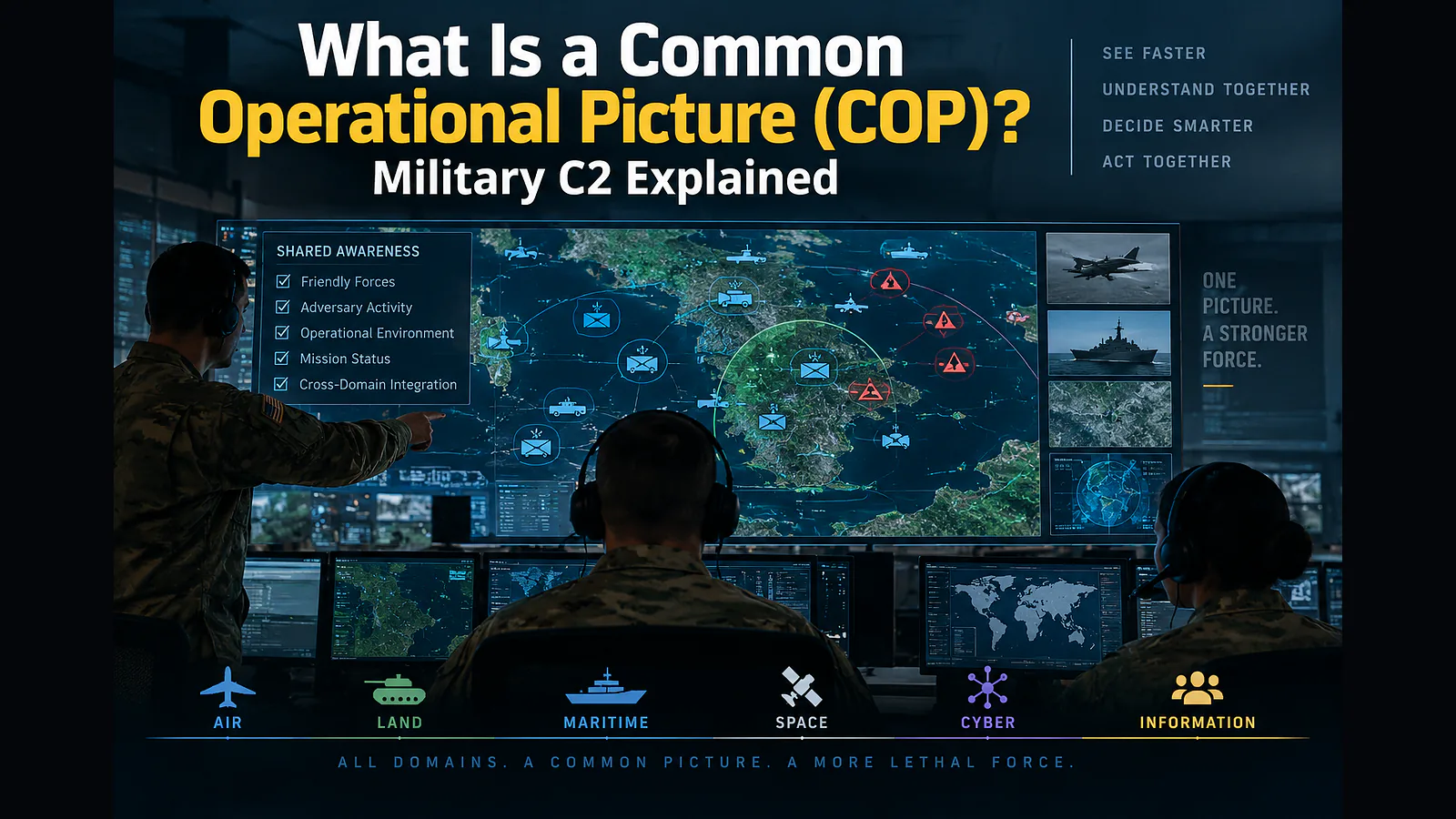
A Common Operational Picture, or COP, is a shared and dynamic representation of operational information that can be tailored to support situational awareness, collaborative planning and decision-making. In military command and control, a COP brings relevant information from multiple sources into a shared, mission-focused picture. It is not simply a digital map, and it is not necessarily a single software application.
Common Operational Picture at a glance
| Question | Answer |
|---|---|
| What does COP stand for? | Common Operational Picture |
| Main purpose | Shared operational understanding and decision support |
| Is it just a map? | No. Geospatial views are common, but a COP can include many types of operational information |
| Is it one software product? | Not necessarily |
| Where can data come from? | Sensors, C2 systems, intelligence, reporting, logistics, tracks and other authorised operational sources |
| Does every user see exactly the same picture? | Not necessarily. A COP may be tailored by mission, role and information requirement |
| Is a COP the same as situational awareness? | No. A COP supports situational awareness and understanding |
| Can specialised recognised pictures contribute? | Yes |
| Does NATO operate a specific COP capability? | Yes, NATO NCOP |
| Does a COP make command decisions? | No. It provides information that supports human command decisions |
The shortest accurate explanation: a Common Operational Picture brings relevant operational information into a shared, mission-tailored picture so commanders and staffs can understand the situation and make better-informed decisions.
What does Common Operational Picture mean?
The term is easier to use precisely when the three words are read separately.
Common
“Common” means the information supports shared understanding across users, staffs, headquarters or systems. Several parties work from a consistent representation of the same operational situation rather than from disconnected local views.
It does not mean a single identical screen for everyone. Current treatments of the concept, including the Canadian Army Journal analysis of the Common Operational Picture, describe the picture as dynamic and tailorable rather than fixed.
“A Common Operational Picture does not require every user to see an identical screen. A useful COP can be shared while still being tailored to mission, role and information requirements.”
Key point
Operational
“Operational” narrows the content to information relevant to the planning, execution or assessment of operations. Depending on the mission, that can include:
- friendly forces
- adversary activity
- tracks
- operational boundaries
- infrastructure
- logistics
- communications
- airspace
- fires
- intelligence
- mission status
- environmental information
No implementation carries every category. What belongs in the picture follows from the mission, the echelon and the information requirements of the staff using it.
Picture
“Picture” is broader than “map”. A shared operational picture may combine geospatial information, overlays, tracks, status data, readiness, alerts, reports, timelines and mission information. The map is often the most visible interface, not the substance of the capability.
Common Operational Picture vs Common Operating Picture
Both formulations are in circulation and both are abbreviated COP, which is a frequent source of confusion in search results, procurement documents and staff discussion.
Common Operational Picture is the preferred term and the one used consistently in this article. “Common Operating Picture” still appears in older documents, legacy system names and a good deal of web content, so readers will continue to encounter it. Treating the two as interchangeable is usually harmless in conversation, but it is worth keeping the preferred term in formal writing, requirements and interface documentation so that terminology remains traceable to current official usage.
What is the purpose of a Common Operational Picture?
A COP exists to support shared understanding and decision-making, not visualisation for its own sake. It is judged by the questions it helps a commander and staff answer:
- Where are friendly forces?
- What is happening?
- What has changed?
- What threats matter?
- What units or capabilities are available?
- Where are important movements occurring?
- Where are information gaps or inconsistencies?
- What requires command attention?
- What could require a later decision?
The working principle is not “more information on one screen”. It is the right operational information, organised well enough to support understanding and action.
What information can a military COP contain?
Content depends on mission and echelon. A divisional land picture, an air operations picture and a sustainment picture are all operational pictures, and they contain different things.
- Land: manoeuvre, fires, unit locations, boundaries, logistics.
- Air: tracks, airspace, missions, control measures.
- Maritime: vessels, maritime tracks, naval units.
- Sustainment: fuel, ammunition, transport, medical capacity, supply routes.
Sustainment is a useful corrective to the assumption that a COP is a manoeuvre map. The U.S. Army has described developing a Common Operational Picture for sustainment, where the operationally decisive information concerns supply, transport and capacity rather than contact.
A picture becomes less useful if it attempts to display everything simultaneously. The objective is relevance, not maximum data density.
How is a Common Operational Picture created?
Most implementations follow the same logical sequence:
- Sources
- Ingestion
- Correlation and harmonisation
- Mission-tailored operational picture
- Situational awareness and shared understanding
- Informed decisions
Sources
Information can originate in C2 systems, sensors, surveillance, intelligence, tactical reporting, aircraft tracks, maritime tracks, unmanned systems, logistics systems, national systems, coalition systems and manual reports.
Ingestion
Those sources differ in format, protocol and update rate. A track feed may arrive several times a second; a logistics return may arrive twice a day. Ingestion has to accept both without presenting them as though they carry equal currency.
Correlation and harmonisation
If several systems report apparently similar objects, the environment may need to determine whether they describe the same real-world entity. Doing that responsibly depends on contextual fields: source, timestamp, identity, location, classification, confidence, provenance, quality and update history.
Presentation
The result is presented through maps, overlays, status panels, alerts and supporting information, tailored to the mission and the role of the user.
Human interpretation
The COP does not remove the requirement for command judgement. It organises information so that judgement can be applied to a better-founded view of the situation.
Common Operational Picture vs situational awareness
The two terms are often used as synonyms. They are not.
A COP is an information representation. Situational awareness is the understanding a person develops about relevant elements of the operational environment. One is a product of systems and staff work; the other exists in the minds of the people commanding the operation.
The relationship runs in one direction: operational information feeds the Common Operational Picture, the picture supports situational awareness and shared understanding, and that understanding supports informed decisions.
This matters practically. A technically perfect display can still produce poor awareness if the information behind it is stale, incomplete, contradictory, incorrectly correlated, missing context or missing provenance. Display quality and understanding are different problems.
Common Operational Picture vs Common Intelligence Picture
The Common Intelligence Picture, or CIP, is focused on intelligence information and assessments. The Common Operational Picture is broader and supports the overall operational picture used for command and control.
Current U.S. Army intelligence doctrine in FM 2-0 distinguishes maintaining the Common Intelligence Picture from updating the intelligence portion of the Common Operational Picture. Intelligence therefore contributes to the COP without being identical to it.
| Aspect | Common Operational Picture | Common Intelligence Picture |
|---|---|---|
| Primary purpose | Broader operational understanding and C2 | Shared intelligence understanding |
| Scope | Multiple operational functions | Intelligence-focused |
| Contributors | Multiple staff functions and systems | Intelligence organisations and systems |
| Can information cross between them? | Yes | Yes |
The table describes the doctrinal distinction, not every national or coalition implementation.
COP vs recognised air, ground and maritime pictures
Domains also maintain their own specialised pictures. A Recognised Air Picture, RAP, represents the air situation. A Recognised Ground Picture, RGP, and a Recognised Maritime Picture, RMP, do the equivalent for their domains. Each is produced by specialists using domain sensors, procedures and identification rules.
Conceptually, domain-specific recognised pictures contribute information to a broader Common Operational Picture, which in turn supports situational understanding and decisions. That is a description of how the pieces relate, not a mandatory universal architecture: nations and commands differ in how recognised pictures are produced, released and combined.
Is a Common Operational Picture one software application?
Not necessarily, and the distinction matters commercially as well as technically.
The COP is an operational concept: a shared representation of operational information. A COP application is a technical implementation used to create, manage or display that representation. One organisation may achieve it through a single application; another may assemble it from several applications, services, data feeds, middleware, C2 systems, intelligence systems, sensor networks and manual reporting.
Treating “Common Operational Picture” as a single product category owned by one vendor tends to produce requirements that describe a screen rather than an information capability.
What makes a good Common Operational Picture?
Relevant
Start from operational information requirements rather than from every dataset that happens to be available.
Current
Timestamps and update freshness carry operational weight. A confidently drawn symbol with an old position is misleading rather than helpful.
Correlated
Duplicate or contradictory objects erode trust faster than missing objects.
Traceable
Source and provenance should survive into the picture, so staff can judge how much weight to place on an item.
Understandable
Shared information must retain its semantic meaning after it crosses a system boundary, including identity, classification and releasability.
Tailorable
Different users legitimately need different levels of detail. A logistics cell and a fires cell are not badly served by seeing different views of the same situation.
Resilient
Military command and control cannot assume perfect connectivity. Degraded, intermittent and disconnected operation is a design requirement, not an exception.
Why data quality matters more than the map
Consider a routine case. System A reports Aircraft A. System B reports Track 4738. Are these the same real-world object?
Answering that question requires more than two symbols on a display. The reports may differ in position, timestamp, source, confidence, identity, classification, releasability and provenance. Merge them wrongly and the picture loses an object or invents one. Leave them separate and the staff may plan against duplicates.
Interoperability is therefore not just moving data. Information has to remain understandable and trustworthy after crossing systems, which is the problem SynapseCommand's defence data interoperability work addresses at the format and provenance level.
Why COP interoperability is difficult in coalition operations
Inside one national force, most of the semantics are agreed in advance. In a coalition, they are not. Participants may use different C2 applications, data models, security architectures, classifications, releasability rules, identity systems, national networks and procedures.
The objective cannot always be to force every participant onto one identical application. A more realistic goal is to allow authorised information to move between heterogeneous systems while preserving enough meaning, provenance and trust for another participant to use it operationally.
That is the question NATO tests annually at CWIX, where national and NATO systems are connected and exercised to establish whether information can actually be used by the receiving party, not merely transmitted to it.
What is the NATO Common Operational Picture?
NATO operates a specific capability called the NATO Common Operational Picture, or NCOP. It should not be treated as a synonym for the generic military COP concept described in this article.
Public NCI Agency documentation describes NCOP as a capability that receives information from NATO and national sources, collates and harmonises it, and produces mission-tailored operational pictures for Alliance users. It exchanges data with other functional area services over service interfaces and supports broader command-and-control processes rather than standing alone.
For how SynapseCommand relates to that capability, including the current integration status and its qualifications, see SynapseCommand and the NATO Common Operational Picture. That page carries the detailed NCOP positioning; this article deliberately stays with the general concept.
COP vs decision support
An operational picture and a decision-support capability answer different questions.
A COP helps answer what is happening, where, what changed and what information is available. Decision-support capabilities then address what it means, what could happen next, what options exist, what constraints apply and what commanders might consider doing.
Neither displaces the other. The operational picture is foundational: analysis built on an unreliable picture inherits its errors. Equally, no analytical layer should be presented as making command decisions. Decisions remain with the commander.
Where SynapseCommand fits
SynapseCommand does not claim to replace the Common Operational Picture. It is designed as a decision-intelligence layer that can operate alongside existing command-and-control and operational-picture environments.
For NATO NCOP specifically, the published status is integration-ready. No implemented NCOP connector exists, no validated end-to-end NCOP integration is claimed, and no NATO certification or endorsement is implied.
The published interoperability architecture covers formats and sources including ASTERIX, STANAG 4607, STANAG 4676, STANAG 4609, STANAG 4586, TAK, ADS-B and AIS. Support levels are stated individually on each interoperability page and should be read there rather than generalised.
Conceptually the relationship runs from existing operational systems, through authorised operational information, into the COP or C2 environment, and then into decision analysis and course-of-action support. Nothing in that sequence requires all data to pass through SynapseCommand. The same logic is set out in more detail in the SynapseCommand architecture.
Common Operational Picture: the bottom line
A Common Operational Picture is a shared, dynamic and mission-tailored representation of operational information used to support situational awareness, collaborative planning and decision-making. It is more than a map. It is not necessarily one application. And “common” does not require every user to see an identical display.
The real value of a COP comes from making relevant operational information available, current, correlated, understandable, traceable and usable. The technical challenge is therefore not simply displaying more data. It is ensuring that information from different systems can be combined without losing the context that gives it operational meaning.
A successful Common Operational Picture helps a force move from data to shared understanding and, ultimately, better-informed decisions.
Frequently asked questions
What is a Common Operational Picture?
A Common Operational Picture, or COP, is a shared and dynamic representation of operational information that can be tailored to support situational awareness, collaborative planning and decision-making.
What does COP mean in the military?
COP stands for Common Operational Picture.
Is it Common Operational Picture or Common Operating Picture?
Common Operational Picture is the preferred terminology used in this article and in current official terminology sources. “Common Operating Picture” may still appear in older documents and online material, which is one reason the terms are sometimes confused.
Is a Common Operational Picture just a map?
No. Maps are common interfaces, but a COP can also include tracks, status information, overlays, reports, logistics information, alerts and other mission-relevant data.
Is a COP one software application?
Not necessarily. A COP is fundamentally a shared operational information representation. Different organisations may produce it through one application or through multiple connected C2 systems, services and data sources.
What is the difference between a COP and situational awareness?
A COP is an information representation that supports situational awareness. Situational awareness is the understanding a person develops about relevant elements of the operational environment.
What is the difference between a COP and a Common Intelligence Picture?
The Common Intelligence Picture is intelligence-focused. The Common Operational Picture is broader and supports overall operational command and situational understanding. Intelligence can contribute to the COP without being identical to the entire picture.
What is a Recognised Air Picture?
A Recognised Air Picture is a domain-specific representation of the air situation. Domain-specific recognised pictures can contribute to broader operational-picture environments.
What information can be included in a COP?
Depending on the mission, a COP may include friendly and adversary activity, tracks, units, operational boundaries, logistics, airspace, mission status, infrastructure and other relevant operational information.
Does NATO have a Common Operational Picture?
Yes. NATO operates a specific capability called NATO Common Operational Picture, or NCOP.
Is NATO NCOP the same as the generic concept of a COP?
No. COP is the general command-and-control concept. NATO NCOP is a specific NATO implementation and capability.
Why is interoperability important to a COP?
Because information can originate in many different systems and organisations. Moving the data is not enough; receiving systems and users must be able to interpret, trust and use it correctly.
Can artificial intelligence support a COP?
AI can support functions such as correlation, classification, anomaly detection and information prioritisation, but reliable operational pictures still depend on trustworthy source data, provenance, security, interoperability and human judgement.
Does SynapseCommand replace a Common Operational Picture?
No. SynapseCommand is positioned as a decision-intelligence layer that can operate alongside existing C2 and operational-picture environments.
Primary sources
- Canadian Army Journal2024
Proposing a Common Operational Picture for Joint Operational Practitioners
Canadian Army analysis of Common Operational Picture terminology, the difference between the picture and the understanding it supports, and what practitioners actually need from it.
Read the Canadian Army Journal analysis - U.S. Army
Developing a Common Operational Picture for Sustainment
Official U.S. Army article on building a sustainment-focused operational picture, showing that a COP is not limited to manoeuvre or geospatial display.
Read the U.S. Army sustainment COP article - U.S. Army Publishing Directorate
FM 2-0, Intelligence
Current U.S. Army intelligence doctrine, used here for the distinction between maintaining the Common Intelligence Picture and updating the intelligence portion of the Common Operational Picture.
Read FM 2-0, Intelligence - NATO Communications and Information Agency
NATO Communications and Information Agency
The NATO agency responsible for delivering and supporting Alliance command-and-control services, including the NATO Common Operational Picture capability.
Visit the NCI Agency - NATO Allied Command Transformation
Coalition Warrior Interoperability eXercise (CWIX)
NATO's annual interoperability exercise, where national and NATO systems test whether information can be exchanged and used, not merely transmitted.
Read about NATO CWIX
SynapseCommand® is developed by Decent Cybersecurity, a European defence deeptech specialising in sovereign AI, post-quantum cryptography and quantum-resistant blockchain. This article explains a general military concept using official government and NATO sources; it does not imply NATO, U.S. Department of Defense or U.S. Army endorsement of SynapseCommand. Download the capability brief.