
By Decent Cybersecurity, publisher of SynapseCommand®
What Is the NATO Operational Planning Process (OPP)?
The NATO Operational Planning Process, usually shortened to OPP, is the structured method used by NATO commanders and staffs to turn strategic direction into operational plans. This guide explains the planning logic, mission analysis, course of action development and comparison, plan production, and how AJP-5, COPD and TOPFAS relate to the process.
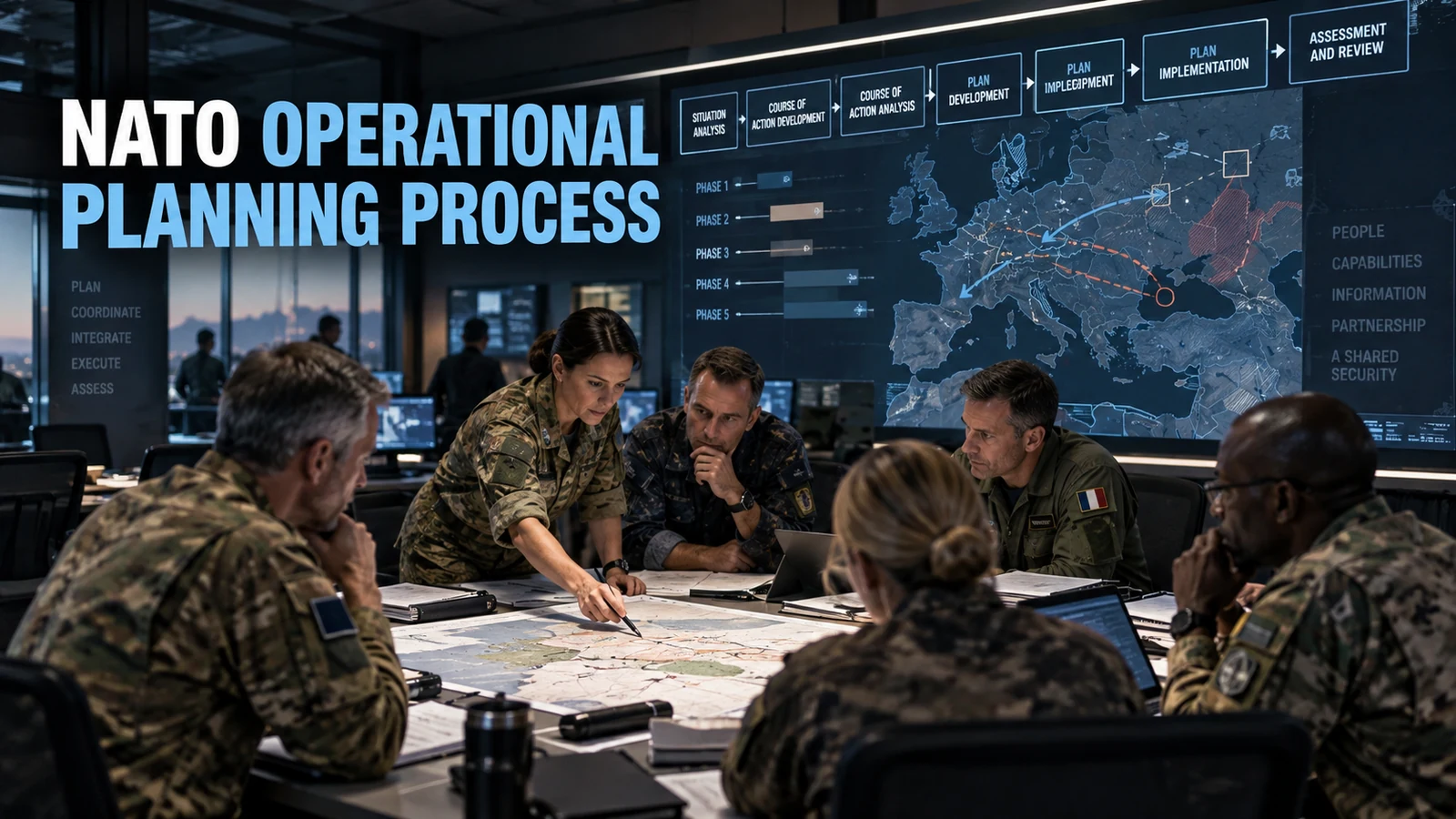
The NATO Operational Planning Process, usually shortened to OPP, is the structured method used by NATO commanders and staffs to turn strategic direction into operational plans. It provides a disciplined way to understand a problem, define the mission, develop and compare courses of action, produce a plan and keep that plan under review as the situation changes.
The process is associated with NATO operational planning doctrine, including Allied Joint Publication 5 and the Comprehensive Operations Planning Directive. It is not a software application and it is not identical to TOPFAS, although planning tools can support parts of the workflow.
What problem does the OPP solve?
Operational planning sits between broad strategic objectives and detailed execution. A headquarters must translate political and military direction into a coherent concept that forces can actually implement.
That requires more than writing an order. Staffs need to understand the environment, identify constraints, assess risks, define objectives, compare possible approaches, coordinate supporting functions and decide how progress will be measured.
The OPP gives that work a common structure so different headquarters, components and nations can collaborate around the same planning logic.
Main stages of operational planning
NATO planning publications describe an iterative process rather than a rigid one-way checklist. Terminology and phase labels can vary by level and publication, but the core logic includes initiation and orientation, analysis of the situation and mission, development of possible courses of action, analysis and comparison, command decision and concept development, detailed plan development, and implementation support, assessment and review.
The important point is not memorising a list. The process is designed to connect understanding, decision-making and executable planning products.
Mission analysis
Mission analysis is where the staff builds a shared understanding of what must be achieved and under what conditions. Typical work includes examining higher direction, identifying specified and implied tasks, reviewing constraints and restraints, analysing the operational environment, identifying assumptions, considering critical factors, and determining information requirements and risks.
The output should clarify the commander's problem and the decisions that later planning steps need to answer.
Course of action development
A course of action, or COA, is a possible approach for accomplishing the mission. During COA development, planners turn mission analysis into feasible alternatives. Each alternative should be sufficiently distinct to support a meaningful command decision.
A useful COA is not merely a diagram. It must be understandable, executable and capable of being analysed against likely conditions and constraints.
COA analysis and comparison
The staff then examines how each option might perform. This can include wargaming, functional analysis, risk assessment, logistics review, intelligence assessment and comparison against agreed criteria.
The purpose is not to produce a mathematically perfect answer. It is to expose trade-offs, dependencies and uncertainty so the commander can make an informed choice.
For product-specific functionality, see the SynapseCommand COA Analysis Agent. This article does not own that product intent.
From command decision to plan
Once a preferred approach is selected, planners develop it into a more detailed concept and plan. Depending on the situation and level of command, outputs can include an operation plan or operation order, annexes, supporting plans, synchronisation products, decision-support tools and assessment measures.
The planning process also identifies assumptions that must be monitored and decisions that may need to be revisited if conditions change. Operational planning is therefore continuous.
OPP, AJP-5 and COPD
AJP-5 provides NATO allied joint doctrine for operational-level planning. The Comprehensive Operations Planning Directive provides detailed planning guidance used by NATO command structures.
The two are related but should not be reduced to a single checklist. Doctrine explains principles and a common approach; directives and headquarters procedures provide more detailed process guidance.
Is TOPFAS the OPP?
No. TOPFAS is a NATO planning and assessment toolset that supports operational planning activities. The OPP is the planning process itself.
For the named-system integration intent, see NATO TOPFAS compatibility.
Where SynapseCommand fits
SynapseCommand's relevance is as decision support around planning and comparison, not as a replacement for NATO doctrine or command authority.
The Operational Planning Agent is the product owner for SynapseCommand-specific planning support. The COA Analysis Agent owns course-of-action analysis capability. Planning and wargaming use cases show where that support is applied. This article remains the generic educational owner for the NATO OPP concept.
Why the OPP matters
Complex operations involve many actors, assumptions and dependencies. A common planning process helps headquarters make reasoning explicit, compare alternatives and keep decisions linked to objectives.
Its value is disciplined collaboration and traceability from strategic direction to operational design, command decision and executable activity.
Frequently asked questions
What does OPP mean in NATO?
OPP means Operational Planning Process.
Is the NATO OPP the same as military decision-making in every nation?
No. National processes may differ, although many share comparable functions such as mission analysis, COA development and plan production.
What is AJP-5?
AJP-5 is NATO allied joint doctrine for operational-level planning.
What is COPD?
COPD is the Comprehensive Operations Planning Directive, which provides detailed planning guidance for NATO operational planning.
Is TOPFAS the NATO OPP?
No. TOPFAS is a planning and assessment toolset. The OPP is the underlying planning process.
Does SynapseCommand replace NATO operational planning doctrine?
No. SynapseCommand is positioned as decision support and does not replace NATO doctrine, staff processes or command authority.
Primary sources
- UK Ministry of Defence
Allied Joint Doctrine for the Planning of Operations (AJP-5)
Official publication page for AJP-5, the NATO and UK authoritative doctrine publication for planning joint operations.
Read the official AJP-5 publication page - UK Ministry of Defence
Allied Joint Publications (AJPs)
Official collection of Allied Joint Publications, showing how planning doctrine sits within the wider allied joint doctrine series.
Browse the Allied Joint Publications collection - NATO
Standardization
Official NATO topic page on standardization, including the role of Allied Publications and agreed standards in interoperability.
Read the NATO standardization topic page
SynapseCommand® is developed by Decent Cybersecurity. This article explains NATO operational planning concepts at a high level using publicly available descriptions and does not imply NATO endorsement or certification.