

By Decent Cybersecurity, publisher of SynapseCommand®
What Is Federated Mission Networking (FMN)? NATO Coalition Interoperability Explained
Federated Mission Networking, or FMN, is a NATO-led framework that helps nations and partner organisations establish interoperable mission networks for operations, exercises and other multinational activities. This guide explains what federation means, what Spiral Specifications are, and why FMN is a framework rather than one permanent network.
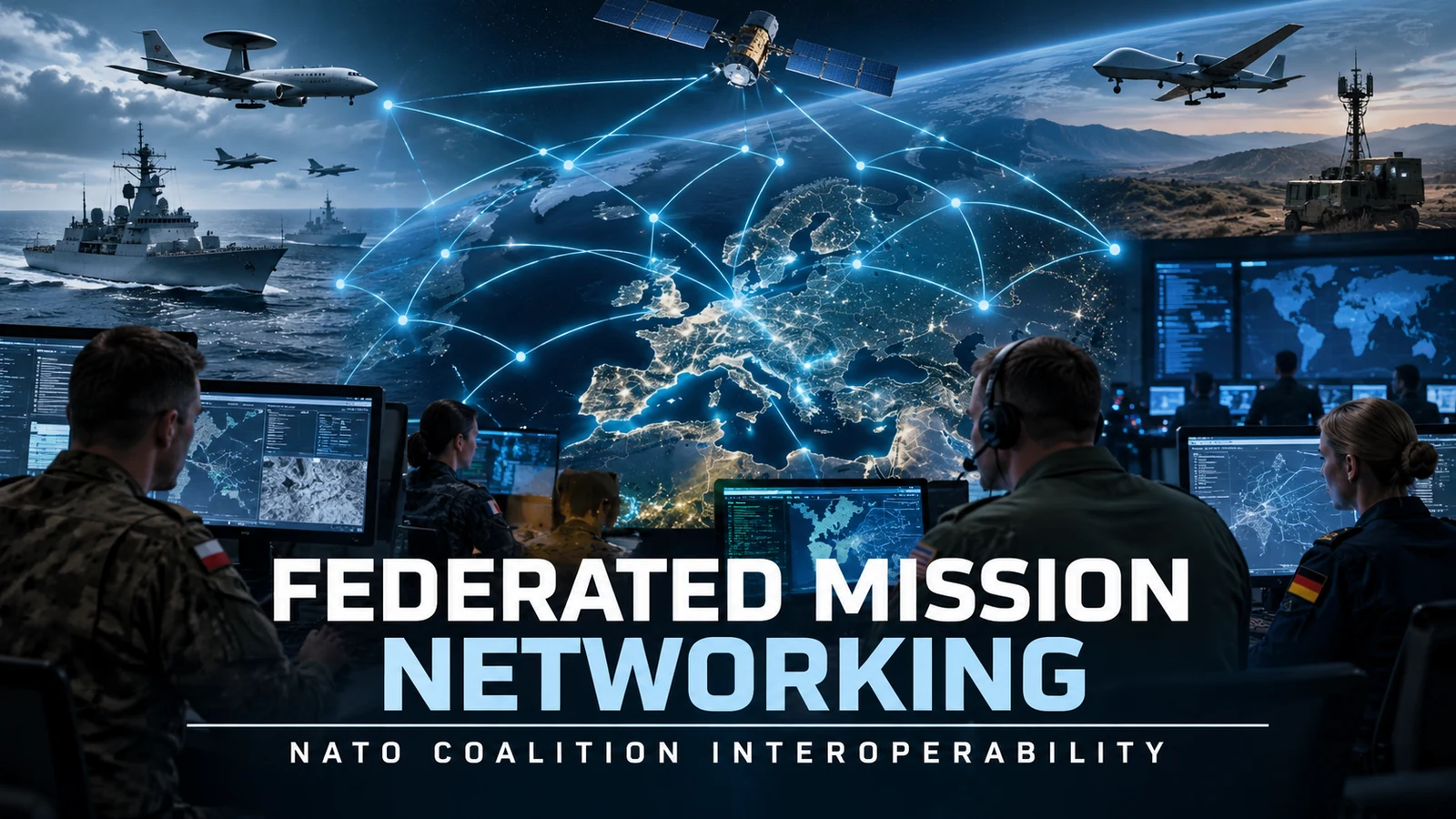
Federated Mission Networking, or FMN, is a NATO-led framework for helping nations and partner organisations establish interoperable mission networks for operations, exercises and other multinational activities. The core idea is federation: participants retain control of their own systems while agreeing on common technical, procedural and security arrangements that allow them to exchange information and services effectively.
FMN is therefore not one permanent NATO network and it is not a single commercial product. It is a framework for building mission-specific federations from national and NATO capabilities.
Why FMN exists
Coalition operations bring together organisations with different networks, security policies, applications and national architectures. Without a common framework, each mission can become a costly one-off integration project.
FMN addresses that problem by promoting reusable specifications, agreed implementation patterns and common processes. The aim is to improve mission partner interoperability and make multinational networking more predictable.
NATO Allied Command Transformation describes FMN as an initiative that supports effective information sharing and interoperability between NATO, Allies and partners in coalition operations.
What does federated mean?
Federated means that participating organisations connect their own mission-network capabilities into a shared operational federation instead of surrendering them to a single central owner.
Each participant remains responsible for its national or organisational systems. The federation works because members agree on the interfaces, services, identity arrangements, security rules, procedures and operational conventions needed to collaborate.
This model fits coalition reality. Different nations have different legal authorities, security architectures and sovereign infrastructure. Federation allows them to cooperate without pretending those differences do not exist.
FMN is not one network
It is common to hear FMN described loosely as the NATO mission network. That can be misleading.
FMN is better understood as a framework and set of agreed specifications for creating interoperable mission networks. A particular exercise or operation can instantiate a federation using the FMN framework, but the framework itself is not the deployed network.
This is an important distinction for procurement and architecture. A system can support FMN-relevant standards and services without becoming the FMN network.
What are FMN Spiral Specifications?
FMN develops capability in successive spirals. Each spiral groups agreed specifications and implementation guidance for a defined capability baseline.
The spiral approach allows the community to evolve networking requirements over time instead of freezing interoperability around one permanent technical stack. Nations can plan implementation against a known baseline while future spirals introduce updated capabilities and standards.
The exact content of a spiral can include communications, core enterprise services, information exchange, security, identity and other mission-network functions.
Because implementation status can vary by participant, it is important not to assume that every FMN affiliate or mission implements every spiral element identically.
FMN and interoperability
FMN addresses several layers of interoperability at once. Technical interoperability ensures systems can connect and exchange data. Semantic interoperability helps participants interpret the information consistently. Procedural interoperability aligns operating practices. Security interoperability enables authorised information sharing without ignoring national protection requirements.
That combination is why FMN matters to command and control. A network that passes packets but cannot preserve meaning, trust or access controls is not enough for coalition decision-making.
For SynapseCommand's standards and adapter layer, see Defence Data Interoperability.
FMN and Common Operational Pictures
A Common Operational Picture can be one consumer or producer of information inside a coalition mission network, but COP and FMN are not the same concept.
A COP is a shared representation of operational information. FMN is a federation framework that can help the organisations and systems behind that picture exchange information and services.
For the named NATO capability, see NATO NCOP compatibility.
FMN and sovereignty
Federation is especially relevant when nations need to cooperate while retaining sovereignty over infrastructure, data and policy.
A federated design can keep national systems under national control while exposing authorised services to mission partners through agreed interfaces. That does not eliminate trust or governance challenges. It creates a structure in which those challenges can be handled explicitly.
Where SynapseCommand fits
SynapseCommand does not claim to be FMN-certified, NATO-endorsed or a replacement for mission-network infrastructure.
Its relevance is as a decision-intelligence layer that can sit alongside existing command and information environments when authorised data is made available through supported interfaces. The product's interoperability architecture is the correct owner for implementation-specific claims.
The generic FMN concept remains separate: it explains how coalition networks are federated and why common specifications matter.
Why FMN matters
Coalition operations are temporary by nature, but interoperability cannot be improvised from zero every time.
FMN gives nations and NATO a reusable framework for mission networking. Its value is organisational as much as technical: participants can prepare capabilities before a mission, align around known specifications and reduce integration uncertainty when a coalition forms.
That makes FMN a foundational concept for anyone working on NATO coalition C2, mission partner environments, interoperable services or sovereign defence networks.
Frequently asked questions
What does FMN stand for?
FMN stands for Federated Mission Networking.
Is FMN one NATO network?
No. FMN is a framework for establishing interoperable mission networks from NATO, national and partner capabilities.
What is an FMN Spiral?
A spiral is a defined capability baseline containing specifications and implementation guidance that evolves over successive versions.
Is FMN the same as a Common Operational Picture?
No. FMN is a mission-network federation framework. A COP is an operational information picture that can use information exchanged through mission networks.
Does SynapseCommand claim FMN certification?
No. SynapseCommand does not claim FMN certification or NATO endorsement.
Primary sources
- NATO Allied Command Transformation
Federated Mission Networking
Official NATO ACT activity page describing Federated Mission Networking and its role in coalition information sharing and interoperability.
Read the NATO ACT Federated Mission Networking page - NATO Allied Command Transformation
FMN Factsheet
Official NATO factsheet describing the FMN initiative, its governance and the federation of NATO, national and partner capabilities.
Read the official FMN factsheet - NATO Communications and Information Agency
NATO Communications and Information Agency
Official site of the NATO agency responsible for delivering and supporting NATO communications and information capabilities.
Visit the NATO Communications and Information Agency
SynapseCommand® is developed by Decent Cybersecurity. This article explains publicly documented NATO FMN concepts and does not imply NATO endorsement, certification or affiliation.