

By Decent Cybersecurity, publisher of SynapseCommand®
What Are CCIRs? Commander's Critical Information Requirements, PIRs and FFIRs Explained
Commander's Critical Information Requirements, usually shortened to CCIRs, are the small set of information requirements a commander identifies as critical to timely decision-making. This guide explains how Priority Intelligence Requirements and Friendly Force Information Requirements differ, and how CCIRs connect information to decision points.
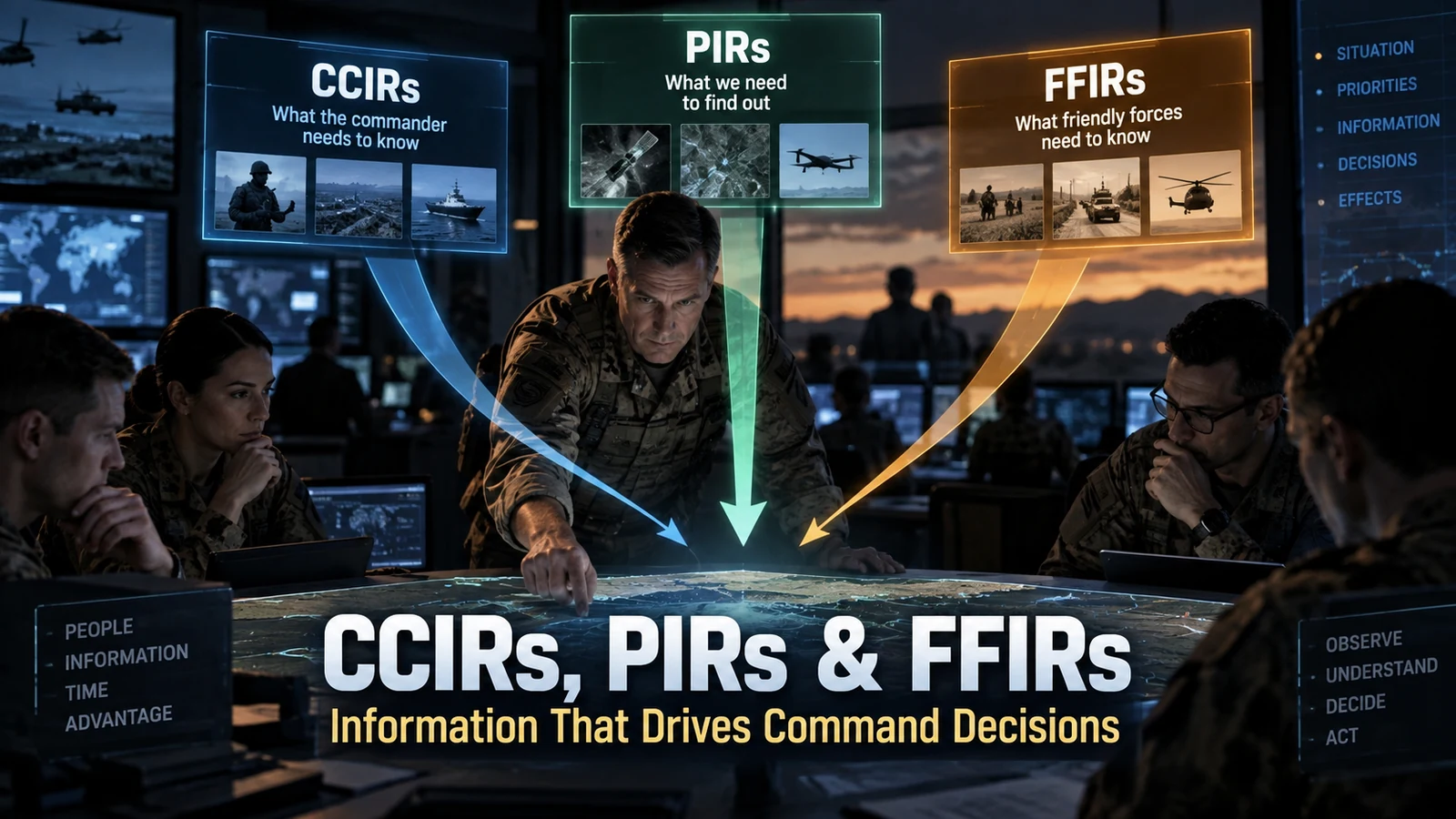
Commander's Critical Information Requirements, usually shortened to CCIRs, are the small set of information requirements a commander identifies as critical to timely decision-making. In U.S. joint and Army doctrine, CCIRs are built from two principal categories: Priority Intelligence Requirements, or PIRs, and Friendly Force Information Requirements, or FFIRs.
The purpose is prioritisation. A headquarters can collect enormous amounts of information, but only some of it changes a command decision. CCIRs focus the staff on the information the commander needs most urgently to understand the situation and act.
What does CCIR mean?
CCIR means Commander's Critical Information Requirement.
A CCIR is linked to a decision the commander expects to make. That connection is essential. An information requirement is not critical merely because the subject is interesting or important. It becomes a CCIR when the commander determines that receiving the information in time is essential to decision-making.
Doctrine therefore ties CCIR development to decision points, mission analysis, planning and assessment.
The two main categories: PIRs and FFIRs
CCIRs are generally organised into two categories.
A Priority Intelligence Requirement focuses on the adversary and the operational environment. It identifies intelligence the commander needs to understand conditions that affect a decision.
A Friendly Force Information Requirement focuses on the status and capabilities of friendly forces. It identifies information the commander needs about own-force readiness, resources, position, availability or other conditions relevant to a decision.
| Requirement | Main focus | Why it matters |
|---|---|---|
| CCIR | Critical information tied to command decisions | Focuses the headquarters on what the commander must know in time |
| PIR | Adversary and operational environment | Drives priority intelligence collection and analysis |
| FFIR | Friendly force status and capabilities | Helps the commander understand own-force conditions and constraints |
What is a PIR?
A Priority Intelligence Requirement is an intelligence requirement that the commander designates as a priority for decision-making.
PIRs commonly focus on the adversary, terrain, weather, civilian conditions or other aspects of the operational environment that can materially affect a decision. They help the intelligence staff prioritise collection, processing and analysis.
A PIR should be specific enough to support action. Very broad questions generate information but can fail to clarify what decision the commander is preparing to make.
What is an FFIR?
A Friendly Force Information Requirement concerns information about friendly forces that the commander needs for a decision.
Examples can include readiness, logistics, protection, force availability, mission status or the condition of supporting capabilities. The exact requirement depends on the mission and decision context.
FFIRs are important because commanders need to understand not only what the adversary may do, but also what their own force can actually achieve at a given moment.
CCIRs and decision points
The most useful CCIRs are linked to identifiable decisions.
A planning staff may define a decision point, identify the information that would trigger or inform the decision, assign responsibility for monitoring that information and determine how it will be reported.
This creates a chain from information to understanding to command action.
Without that connection, a headquarters can produce large dashboards and detailed reports without improving decision speed or quality.
CCIRs vs a Common Operational Picture
CCIRs and a Common Operational Picture are complementary, but they are not the same thing.
A Common Operational Picture is a shared representation of operational information. CCIRs identify which information is especially critical to command decisions.
The COP can help users see the situation. CCIRs help the staff determine what must be watched, escalated or reported because it matters to a decision.
This distinction is useful for modern C2 design. More information on a screen is not automatically better. Decision support should help commanders focus attention on the information that can change what they do next.
CCIRs in the planning process
CCIR development normally begins during planning and continues during execution.
As mission analysis identifies key decisions, uncertainties and risks, the staff can recommend PIRs and FFIRs. The commander approves the requirements that are critical enough to become CCIRs.
They are then reviewed as the operation evolves. A requirement may lose relevance after a decision is made, or a new decision may create a new requirement.
That makes CCIR management a continuous command-and-control activity rather than a one-time planning product.
What CCIRs are not
CCIRs are not a list of every information requirement in the headquarters.
They are not a substitute for normal reporting, intelligence collection or staff coordination.
They are also not static. If a requirement no longer supports an important decision, keeping it on the critical list can dilute attention.
A good CCIR set is therefore selective, decision-linked and actively maintained.
Where SynapseCommand fits
SynapseCommand's relevance is decision support, not doctrinal ownership.
The platform can organise authorised operational information, preserve provenance and support structured decision workflows, but it does not replace the commander's authority to define CCIRs or the staff responsibilities associated with PIRs and FFIRs.
The ISR Fusion Agent owns product-specific multi-source information fusion. The Logic and Planning Agent owns product-specific planning logic, and the operational use cases show where command decision support is applied. This article remains the generic educational owner for CCIR, PIR and FFIR concepts.
Why CCIRs matter
Modern headquarters do not usually suffer from a complete lack of data. They more often struggle with prioritisation, relevance, trust and timing.
CCIRs provide a doctrinal mechanism for focusing attention on what matters to command decisions. They connect collection and reporting priorities to concrete choices, helping staffs reduce the gap between seeing information and acting on it.
That is why CCIR design remains relevant even as command systems become more automated and data-rich.
Frequently asked questions
What does CCIR stand for?
Commander's Critical Information Requirement.
What are the two main categories of CCIR?
Priority Intelligence Requirements and Friendly Force Information Requirements.
What is the difference between a PIR and an FFIR?
A PIR focuses on the adversary and operational environment. An FFIR focuses on friendly force status and capabilities.
Are all intelligence requirements PIRs?
No. A PIR is an intelligence requirement given priority because it is critical to a command decision.
Is a CCIR the same as a COP?
No. A COP is a shared operational picture. CCIRs identify information that is especially critical to commander decision-making.
Does SynapseCommand define a commander's CCIRs?
No. CCIRs are command requirements. SynapseCommand may support authorised decision workflows but does not replace commander authority or doctrine.
Primary sources
- U.S. Army Publishing Directorate
Army Techniques Publications, including ATP 3-39.20
Official U.S. Army publications index. ATP 3-39.20 is among the publications that describe the relationship between CCIRs, priority intelligence requirements and friendly force information requirements.
Browse official Army Techniques Publications - U.S. Army Publishing Directorate
Official U.S. Army doctrine and training publications
Official source for current Army doctrine describing information requirements, decision points and their development during mission analysis.
Visit the Army Publishing Directorate - U.S. Joint Chiefs of Staff
Joint doctrine publications, including joint planning
Official joint doctrine library, the authoritative source for joint planning guidance referenced in CCIR development.
Browse official joint doctrine publications
SynapseCommand® is developed by Decent Cybersecurity. This article explains publicly documented military decision-support concepts and does not imply U.S. Department of Defense or NATO endorsement.