

By Decent Cybersecurity, publisher of SynapseCommand®
What Is CJADC2? Combined Joint All-Domain Command and Control Explained
CJADC2 is the U.S. Department of Defense approach to connecting data, sensors, command systems and decision-makers across military domains and with mission partners. Here is what it means, how it is evolving and why interoperability is central to it.
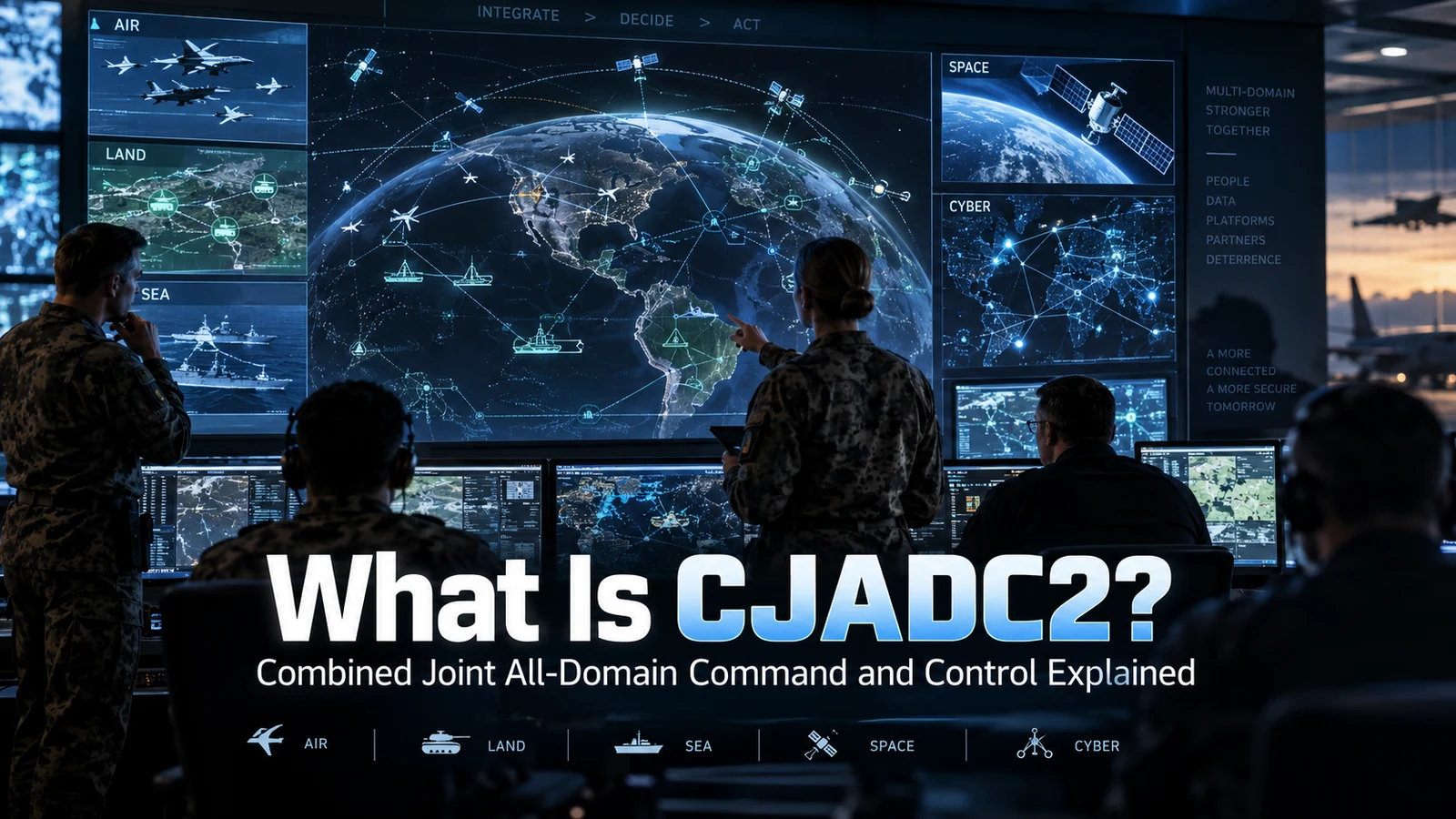
Modern military operations do not suffer from a shortage of data.
Radar tracks, intelligence reports, unmanned systems, satellites, tactical applications, maritime sensors, cyber information and other sources can generate more information than a headquarters can reasonably process by hand.
The harder problem is turning that information into a coherent operational picture, identifying what matters, developing options and getting the right information to the right decision-maker quickly enough to affect an operation.
That is the problem Combined Joint All-Domain Command and Control, or CJADC2, is intended to address.
Combined Joint All-Domain Command and Control, or CJADC2, is the U.S. Department of Defense concept for improving command and control by connecting relevant data, sensors, systems and decision-makers across military domains and with international partners.
It is important to understand what CJADC2 is not.
CJADC2 is not a single piece of software, a single network or one command-and-control platform.
The U.S. Government Accountability Office describes CJADC2 as a concept rather than a system. Its purpose is to improve how data and analytics are used to make and communicate battlefield decisions.
The objective is ultimately straightforward: help commanders and their staffs turn distributed information into better decisions at the speed required by modern operations.
| Attribute | CJADC2 |
|---|---|
| Meaning | Combined Joint All-Domain Command and Control |
| Authority | U.S. Department of Defense |
| Form | An evolving command-and-control concept, not a single system |
| Scope | Space, air, land, sea and cyberspace, with the electromagnetic spectrum across them |
| Core functions | Sense, make sense and act |
| Participants | U.S. military services and authorised international mission partners |
| Technical priority | Data and C2 interoperability across heterogeneous systems |
| Human role | Commanders and authorised operators retain decision authority |
What does CJADC2 stand for?
CJADC2 stands for Combined Joint All-Domain Command and Control.
Each part of the name matters.
Combined reflects the importance of operating with allies and international mission partners.
Joint refers to operations involving multiple U.S. military services.
All-Domain refers to command and control spanning land, sea, air, space and cyberspace, the operational environments discussed in Multi-Domain Operations (MDO), with the electromagnetic spectrum cutting across them.
Command and Control concerns the exercise of authority and direction over forces to accomplish a mission.
The concept evolved from JADC2, or Joint All-Domain Command and Control.
According to the U.S. Government Accountability Office, the Department of Defense expanded the terminology to CJADC2 in 2023 to reflect the importance of sharing information with international partners.
That additional letter is significant. Modern high-intensity operations are not merely a problem of connecting different U.S. services. They also require information to move appropriately across coalition and mission-partner boundaries.
JADC2 vs CJADC2: What Is the Difference?
JADC2 means Joint All-Domain Command and Control. CJADC2 means Combined Joint All-Domain Command and Control. The two terms describe the same underlying effort rather than two separate architectures or products.
The addition of Combined emphasises operations with allies, coalition partners and other mission partners. According to the U.S. Government Accountability Office, Department of Defense terminology evolved in 2023 to reflect that emphasis.
| Aspect | JADC2 | CJADC2 |
|---|---|---|
| Full name | Joint All-Domain Command and Control | Combined Joint All-Domain Command and Control |
| Primary emphasis | U.S. joint-force integration | Joint-force integration plus allies and mission partners |
| Scope | Cross-service, cross-domain command and control | Cross-service, cross-domain and coalition command and control |
| Relationship | Earlier and still common terminology | Expanded terminology emphasising combined operations |
The 2022 Department of Defense JADC2 Strategy summary already identified mission-partner information sharing as a major line of effort. The later terminology makes that coalition dimension explicit in the name itself.
Sense, make sense, act
The 2022 Department of Defense JADC2 Strategy organised the concept around three simple functions: Sense. Make sense. Act.
Sense means collecting relevant information. Make sense means turning that information into usable understanding. Act means translating decisions into operational action.
The simplicity of the phrase hides an extremely difficult technical and organisational problem. A modern force may have sensors, applications and information systems developed by different services, nations and suppliers, across different security domains and over many years. Each may describe the same operational environment differently.
The objective is therefore not merely to collect more information. The objective is to make information usable across boundaries quickly enough to create decision advantage.
Why CJADC2 exists
Military organisations already operate enormous numbers of digital systems. That is simultaneously an advantage and a problem.
An air-surveillance system may produce one type of track data. A ground-surveillance sensor may use another. Tactical users may exchange Cursor-on-Target information. Maritime systems may produce their own track formats. Intelligence products, logistics information and operational plans may reside inside separate applications.
Where these environments cannot exchange information effectively, personnel have to bridge the gaps manually. GAO describes one manifestation as "swivel chair" analysis: an analyst receives information from different systems and manually enters or moves it between them.
CJADC2 aims to move toward environments where relevant data can instead be integrated and used across systems and organisations. The goal is not to put every possible feed on one enormous screen. Nor is the goal literally to connect every sensor to every shooter.
GAO reported in 2025 that the earlier vision often described as "every sensor-to-every shooter" had increasingly been regarded inside the Department as unrealistic and unhelpful. The more useful objective is to connect the right information, systems and decision-makers at the scale, tempo and timing required by the mission.
CJADC2 is moving from concept toward capability
CJADC2 has been developing for several years. In February 2024, the Department of Defense announced delivery of an initial CJADC2 minimum viable capability.
The Pentagon described that initial iteration as combining software applications, data integration and cross-domain operational concepts intended to provide decision advantage to warfighters. That did not mean CJADC2 was finished.
CJADC2 has no simple final state comparable to the delivery of one conventional acquisition programme. GAO's 2025 assessment instead describes an evolving effort involving multiple military departments, organisations, modernisation activities and capability requirements.
The individual services have pursued important elements through Army Project Convergence, Navy Project Overmatch, the Department of the Air Force's battle-network work including the Advanced Battle Management System, and Marine Corps Project Dynamis.
Project Dynamis was formally established in 2025 to accelerate the Marine Corps contribution to CJADC2 in partnership with the Department of the Navy's Project Overmatch. Its stated priorities include assured command and control, joint data infrastructure, resilient networking and AI-enabled battle management.
The effort continues in 2026. A June 2026 U.S. Army article described CJADC2 as a data-centric framework supporting future command and control and emphasised the objective of providing commanders with information advantage for faster and better decisions.
CJADC2 should therefore be understood as an ongoing transformation in how military information and command-and-control capabilities work together, rather than as a single product waiting to be completed.
The scale of the investment
The broader command, control, communications, computers and intelligence investment environment is substantial.
The Department of Defense's FY2026 budget request identifies a $23.2 billion C4I systems portfolio. The same document states that the portfolio was approximately $2 billion higher than the FY2025 President's Budget request and attributes the increase to greater investment in emerging capabilities including CJADC2, tactical-edge computing and offensive cyber operations.
$23.2 billion is the overall FY2026 C4I portfolio. It is not the CJADC2 budget.
CJADC2 spans numerous programmes and activities, which is one reason assigning a single programme cost to it is difficult.
The central technical challenge: interoperability
The ambition behind CJADC2 sounds simple: connect information to decisions. Implementing that ambition is much harder.
Military organisations have accumulated systems over decades. Those systems come from different suppliers, countries, services and generations of technology. Replacing every existing platform with one universal command system would be impractical and, in many cases, undesirable.
CJADC2 therefore depends heavily on interoperability. A modern decision environment must be able to work with information originating from existing systems while preserving the attributes that make the information operationally meaningful. Those attributes can include source, timing, confidence, classification, identity, location and provenance.
The challenge becomes even more important in coalition operations. Different nations may use different systems, data models, security policies and release constraints while participating in the same mission.
Interoperability is therefore not a peripheral integration problem. It is one of the foundations of combined all-domain command and control.
Why data standards matter
One way to approach the interoperability problem is through explicit data standards and clearly defined integration contracts.
The 2022 JADC2 Strategy emphasised common data standards, architectures and resilient information-sharing infrastructure. In practical defence environments, that can mean working with established formats used for air surveillance, ground moving target information, unmanned-system information, tactical reporting, video metadata and maritime awareness.
The important architectural principle is not that every system must internally use the same format. It is that the meaning of information can be translated and exchanged without creating ambiguity about what the source reported.
This is particularly important when automation or AI is added above the integration layer. A decision-support system cannot reason reliably about operational information if it does not know what that information represents, when it was produced, where it came from or how confident the source was.
From connected data to decision advantage
Interoperability solves only the first part of the problem. Once information has been connected, commanders and staffs still have to understand it.
They need to determine what has changed, which information is reliable, which reports describe the same entity, what threats or opportunities are emerging, what resources and constraints apply, which assumptions are uncertain, and what courses of action are feasible.
This is where analytics, automation and artificial intelligence can contribute. AI can help correlate information, identify patterns, surface constraints, prioritise information and support the development or comparison of courses of action.
But faster computation does not remove responsibility from human commanders and operators. The Department of Defense's Responsible AI approach requires appropriate levels of judgment and care in the development, deployment and use of AI capabilities.
The important distinction is therefore between machine-supported decision-making and unaccountable machine decision-making. For command-and-control applications, trust depends on what a system recommends and whether users can understand the underlying evidence, assumptions and decision boundaries.
Coalition operations make the problem harder
The first letter in CJADC2 may ultimately prove to be one of the most important. Modern high-intensity military operations are rarely designed around one service operating alone. For NATO members and other allied forces, they are also rarely designed around one nation operating alone.
A useful all-domain architecture therefore has to support mission partners. That means more than network connectivity. Partners must be able to share authorised information while respecting security classifications, releasability constraints, national ownership and different technical environments.
The original JADC2 Strategy made mission-partner information sharing one of its major lines of effort. GAO's more recent CJADC2 assessment likewise identifies international-partner connectivity as part of the concept.
The relevant question is not simply whether system A can send information to system B. A more useful question is: can information move between authorised systems securely, meaningfully and with enough context to support a decision?
Where SynapseCommand fits
This is directly relevant to the architecture behind SynapseCommand.
The SynapseCommand platform is not presented as a replacement for an existing command-and-control environment. The platform's design principle is: Keep your C2. Add the decision layer.
The objective is to allow operational information from existing systems and standards to enter through a published interoperability layer, be represented consistently and become available to specialised decision-support functions.
SynapseCommand's published interoperability layer currently includes implementations covering operational formats and sources including ASTERIX, STANAG 4607, STANAG 4676, STANAG 4609 metadata, STANAG 4586 telemetry, Cursor-on-Target / TAK, ADS-B and AIS, with implementation status and direction of exchange documented individually.
The contract layer is published for inspection under Apache 2.0. The decision runtime itself remains proprietary. This separation is intentional. The interface through which operational information enters the system can be inspected without requiring the proprietary decision layer to be disclosed.
Above the integration layer, SynapseCommand is designed around the operational sequence: Connect → Understand → Rehearse → Decide → Execute → Replay.
The objective is not merely to aggregate data. It is to turn operational information into traceable decision support while preserving an explicit human decision boundary.
This architecture addresses several of the same technical problems that make CJADC2 difficult: heterogeneous data, interoperability, decision speed, provenance and the need to operate alongside existing systems.
That does not mean SynapseCommand is CJADC2-certified or endorsed by the U.S. Department of Defense. No such claim is made. It means the underlying problem space overlaps substantially.
Open integration architectures reduce complexity
The mathematics of integration become difficult quickly. If every system requires a unique point-to-point connection to every other system, the number of integrations grows rapidly as additional systems are introduced.
A canonical model offers a different approach. External formats can be translated into a shared contract, allowing consumers above that layer to reason about the common representation instead of implementing the original wire format every time.
That does not eliminate the difficult work of integration. It makes the boundaries more explicit.
For defence organisations, explicit interfaces have another benefit: they can be inspected. Governments, integrators and technical authorities can evaluate what data enters a platform, how it is represented and what transformations take place.
That is particularly relevant in environments where classification, provenance, confidence and timing can materially affect an operational decision.
CJADC2 and NATO environments
CJADC2 is a U.S. Department of Defense concept, not a NATO programme. The underlying challenges, however, are highly relevant to NATO operations. Alliance command environments must also work across nations, domains, systems and security boundaries.
SynapseCommand is being developed for this broader coalition decision-support problem.
The platform's published compatibility catalogue includes NATO and national command environments, but individual pages deliberately distinguish between different levels of integration maturity.
For example, the SynapseCommand page covering the NATO Maven Smart System identifies the status as integration-ready. It explicitly states that SynapseCommand is architecturally capable of operating alongside an authorised N-MSS environment but that no validated end-to-end integration with N-MSS has been completed. It also explicitly states that this status does not imply NATO certification or NATO endorsement. Our separate analysis of Maven Smart System and military command and control covers the wider programme context.
Those distinctions matter. Credible interoperability requires evidence and precise claims, not a list of logos.
What CJADC2 means for the future of military C2
The importance of CJADC2 extends beyond one Pentagon initiative. It reflects a broader transformation in military command and control.
Traditional architectures were often centred on individual platforms and systems. The emerging model is increasingly centred on data, interoperability and decision flows.
Sensors do not create decision advantage merely because they collect more data. Networks do not create decision advantage merely because they connect more devices. Artificial intelligence does not create decision advantage merely because a model can process information quickly.
Advantage appears when relevant information can move across the operational environment, retain its meaning and reach authorised decision-makers in time to matter.
That requires technology. It also requires standards, policy, doctrine, training, security, mission-partner arrangements and trust.
This is why CJADC2 cannot be reduced to a single application. It is ultimately an effort to change how a combined force turns information into decisions.
And that is likely to remain one of the defining command-and-control challenges of the coming decade.
Decision-support capabilities related to this problem
SynapseCommand documents the practical decision-support functions that sit above connected data, including course-of-action analysis, ISR fusion, air-tasking support and decision-quality validation. These pages describe first-party architecture and evidence. They are not third-party certification of CJADC2 compliance.
Frequently asked questions
What does CJADC2 stand for?
CJADC2 stands for Combined Joint All-Domain Command and Control. It is the U.S. Department of Defense concept for improving how information, command-and-control capabilities and decision-makers work across military domains and with international mission partners.
What is the difference between JADC2 and CJADC2?
JADC2 means Joint All-Domain Command and Control. The Department of Defense later adopted CJADC2, adding "Combined" to reflect the importance of interoperability and information sharing with international partners. GAO reports that the expanded terminology was adopted in 2023.
Is CJADC2 a single military system?
No. CJADC2 is not one application, network or acquisition programme. GAO describes it as a Department of Defense concept for improving command and control through better data sharing, analytics and connectivity across military organisations and domains.
What military domains does CJADC2 cover?
CJADC2 addresses command and control across space, air, land, sea and cyberspace. Military operations also depend heavily on the electromagnetic spectrum, which cuts across those domains.
Does CJADC2 use artificial intelligence?
Artificial intelligence, machine learning, automation and analytics can support CJADC2 objectives by helping users process large volumes of information, identify relevant patterns and support faster decisions. AI is one part of a much wider command-and-control architecture that also includes data, communications, networks, software, standards, policy and human operators.
Why is interoperability important to CJADC2?
CJADC2 depends on information being usable across different military services, systems, domains and international partners. Without interoperability, information can remain trapped inside individual platforms and personnel may have to move or re-enter data manually.
Is SynapseCommand a CJADC2-certified system?
No. SynapseCommand does not claim CJADC2 certification or U.S. Department of Defense endorsement. Its architecture addresses several related technical challenges, including defence-data interoperability, multi-source information integration, AI-assisted decision support, traceability and integration with existing command-and-control environments.
Primary sources
- U.S. Government Accountability Office8 April 2025
Defense Command and Control: Further Progress Hinges on Establishing a Comprehensive Framework
Official GAO-25-106454 assessment of CJADC2's definition, scope, governance, international-partner dimension and implementation challenges.
Read GAO-25-106454 - U.S. Department of DefenseMarch 2022
Summary of the Joint All-Domain Command and Control Strategy
Official strategy summary covering sense, make sense, act; decision advantage; data standards; resilient infrastructure; AI and mission-partner information sharing.
Read the official JADC2 Strategy summary - U.S. Department of Defense21 February 2024
Hicks Announces Delivery of Initial CJADC2 Capability
Official announcement of the initial CJADC2 minimum viable capability combining software applications, data integration and cross-domain operational concepts.
Read the Department of Defense announcement - U.S. Department of Defense ComptrollerJuly 2025
FY2026 Program Acquisition Costs by Weapon System
Official budget document identifying the $23.2 billion FY2026 C4I systems portfolio. This figure is not a CJADC2 budget.
Read the FY2026 weapon systems budget report - U.S. Army18 June 2026
Connecting the battlefield: Engineering the Army's future command and control fabric
Current official Army account of CJADC2 as a data-centric framework supporting information and decision advantage.
Read the U.S. Army article - United States Marine Corps
Project Dynamis
Official Marine Corps source for Project Dynamis, its CJADC2 contribution, Project Overmatch partnership and AI-enabled battle-management priorities.
View the official Project Dynamis page
Add decision intelligence to your existing C2
SynapseCommand is designed to work alongside existing command-and-control environments through an inspectable interoperability layer.
SynapseCommand® is a product of Decent Cybersecurity.