

By Decent Cybersecurity, publisher of SynapseCommand®
What Is Multi-Domain Operations (MDO)? NATO MDO Explained
Multi-Domain Operations, usually shortened to MDO, is NATO's approach to orchestrating military activity across all operational domains and synchronising it with relevant non-military activity. This guide explains the five operational domains, what converging effects means, how MDO differs from joint operations and why interoperability matters.
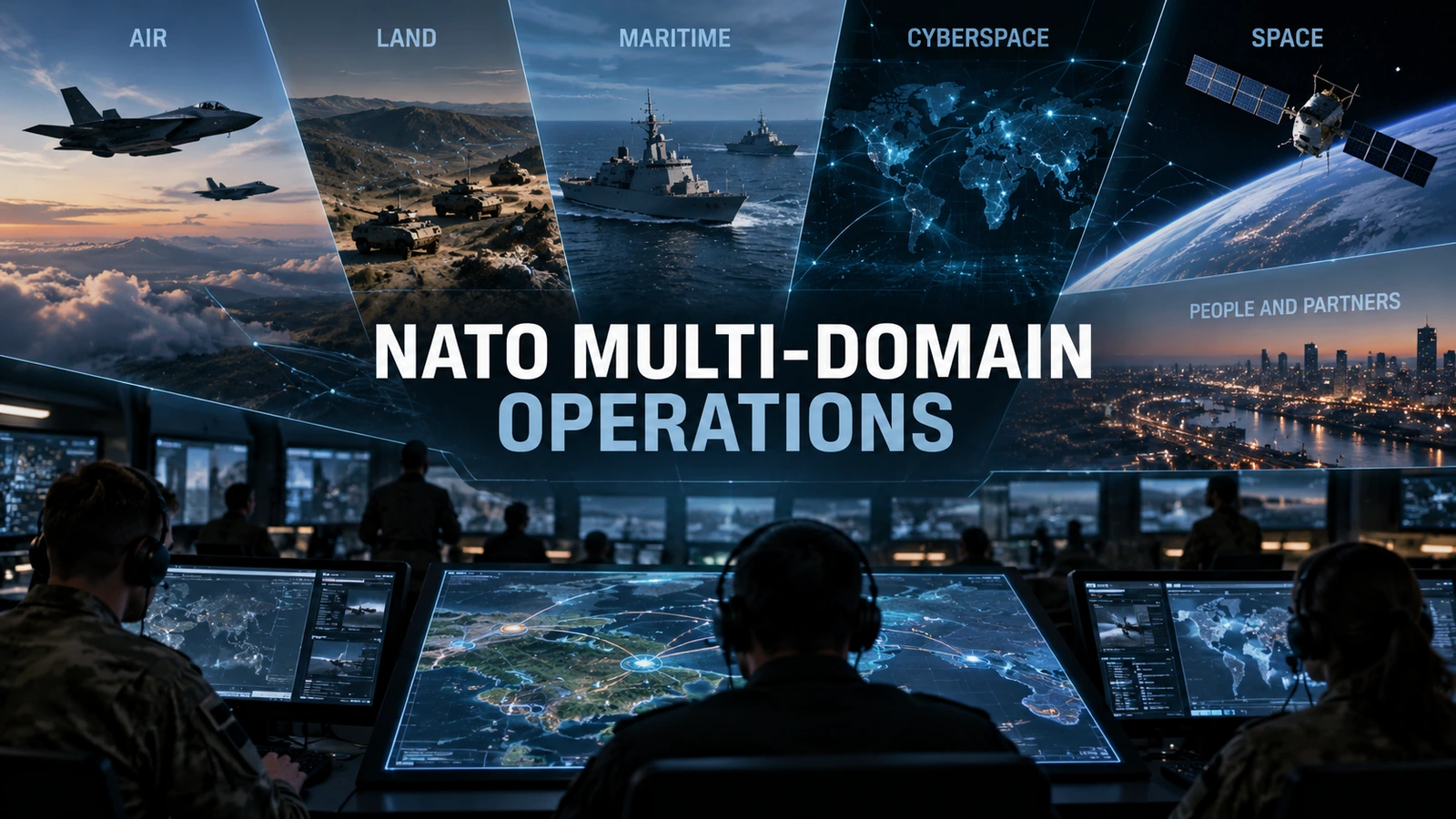
Multi-Domain Operations, usually shortened to MDO, is NATO's approach to orchestrating military activity across multiple operational domains while synchronising it with relevant non-military activity. NATO Allied Command Transformation describes MDO as the orchestration of military activities across all operational domains and environments, synchronised with non-military activities, so the Alliance can create converging effects at the speed of relevance.
The practical idea is straightforward. Modern military effects do not stay neatly inside one service or one physical environment. Air operations depend on data and communications. Maritime forces depend on space-based services. Land forces depend on cyber-resilient networks. Political, economic and information activity can also shape the same operational problem. MDO is about planning and coordinating those elements as a coherent whole rather than treating each one as a separate lane.
NATO identifies five operational domains: air, land, maritime, cyberspace and space. The objective is not merely to place activity in all five at once. It is to understand how actions in one domain affect options in another and how military activity can be synchronised with relevant non-military instruments and external stakeholders.
MDO at a glance
| Question | Answer |
|---|---|
| Meaning | Multi-Domain Operations |
| NATO domains | Air, land, maritime, cyberspace and space |
| Objective | Create converging effects across domains and relevant non-military activity |
| Key enablers | Command and control, data, interoperability, communications and shared situational understanding |
| Participants | Military forces, national authorities and relevant external stakeholders |
| Not the same as | Joint operations or CJADC2 |
Multi-Domain Operations is therefore not simply the simultaneous use of capabilities from several domains. NATO's framing is about orchestrating activity across those domains, understanding their dependencies and synchronising military activity with relevant non-military activity so that effects converge coherently.
NATO's five operational domains
NATO's MDO framework works across five operational domains:
| Domain | Typical focus in an MDO context |
|---|---|
| Air | Air power, airborne sensing, air mobility, air defence and airspace coordination |
| Land | Ground manoeuvre, fires, logistics, protection and land-based sensing |
| Maritime | Sea control, maritime security, naval manoeuvre and maritime sensing |
| Cyberspace | Digital systems, networks, cyber defence and cyber-related effects |
| Space | Satellite communications, positioning, timing, sensing and other space-enabled services |
These domains are connected by information, command relationships, communications and shared decision-making. A change in one can alter the operational value of another. Loss of space-based communications can affect air and maritime operations. Cyber disruption can reduce the usefulness of otherwise capable sensors. A land formation may depend on data originating from airborne, maritime or space-based sources.
That is why MDO is fundamentally a command-and-control problem as well as an operational concept.
Multi-Domain Operations vs joint operations
Joint operations and Multi-Domain Operations are related, but NATO does not treat them as identical concepts. Joint operations traditionally focus on cooperation among military services and components. MDO extends the problem by including orchestration across all operational domains and synchronisation with non-military activity where relevant. This can involve national ministries and agencies, international organisations, industry, academia and other external stakeholders.
NATO vs. U.S. Army
NATO and the U.S. Army both use the term Multi-Domain Operations, but the institutional context and doctrinal emphasis are different. NATO describes MDO at Alliance level as the orchestration of military activities across operational domains and environments, synchronised with relevant non-military activities to create converging effects. The U.S. Army uses multidomain operations as its operational concept for employing Army and joint capabilities across domains as part of the joint force.
| Aspect | NATO MDO | U.S. Army multidomain operations |
|---|---|---|
| Scope | Alliance-wide operational concept | Army operational doctrine within the joint force |
| Central idea | Orchestration across domains plus synchronisation with non-military activity | Combined-arms employment of Army and joint capabilities |
| Desired result | Converging effects at the speed of relevance | Create and exploit relative advantages in support of operational objectives |
| Organisational context | NATO, Allies, partners and external stakeholders | U.S. Army contribution to the joint force |
| Key distinction | Broader Alliance orchestration | Army operational employment |
The distinction matters when reading defence literature. A reference to ‘MDO’ in a NATO document should not automatically be interpreted as a reference to U.S. Army doctrine, and vice versa. They share important ideas about operating across domains, but their organisational scope, doctrinal context and terminology reflect different institutions.
What does converging effects mean?
The phrase “converging effects” is central to NATO's MDO language. It does not simply mean using many capabilities at the same time. It means coordinating different activities so their combined effect is greater, better timed or more decision-relevant than isolated actions.
For commanders and staffs, that increases the importance of timing, information quality, authorities, dependencies and cross-domain awareness. The right action in one domain may matter only if another domain provides access, protection, sensing, communications or decision support at the same time.
Why MDO depends on information and digital interoperability
MDO cannot function effectively if information remains trapped inside separate systems, classifications, services or national architectures. NATO's 2026 Alliance Digital Strategy links digital transformation to information and decision superiority in a multi-domain environment. It emphasises secure, resilient and interoperable digital capabilities, data-driven collaboration and federated approaches to sharing data and services.
That makes interoperability a core MDO enabler. Technical connectivity is only the first layer. Participants also need compatible data models, trusted identity, security controls, common procedures and enough semantic understanding for information to remain useful when it crosses organisational or national boundaries.
For the technical side of this problem, see Defence Data Interoperability. For the architectural view, see SynapseCommand Architecture.
MDO and command and control
The command-and-control challenge in MDO is not simply faster communication. It is coherent decision-making across a wider set of actors, domains and information sources. A headquarters may need to understand which domain is producing the most reliable information, whether a dependency in another domain is degraded, which authorities apply to a proposed action, how an effect in one domain changes options in another, which information can be shared with coalition partners and whether an apparent advantage remains valid when assumptions change.
Those questions make provenance, confidence, timing and explainability important. More data does not automatically produce better decisions.
Is MDO the same as CJADC2?
No. Multi-Domain Operations and Combined Joint All-Domain Command and Control are related but distinct. MDO is a broader operational concept. CJADC2 is a U.S. Department of Defense command-and-control effort focused on improving how data, systems and decision-makers connect across services, domains and authorised partners. It can support multi-domain operations, but it is not the definition of MDO and it is not a NATO programme.
For the U.S. concept, see What Is CJADC2?.
Where SynapseCommand fits
SynapseCommand is positioned as a sovereign decision-intelligence layer for command environments. Its relevance to MDO is at the level of decision support, interoperability and structured reasoning across authorised data sources. It does not claim to be a NATO MDO system, a NATO-certified capability or a replacement for national or Alliance command-and-control systems.
That is also the rationale behind the SynapseCommand Kill Web, which focuses on connecting information and decision workflows rather than replacing the underlying command systems.
Why MDO matters to NATO now
MDO reflects a basic reality of modern defence: operational advantage increasingly depends on how well military capabilities, information, digital infrastructure and partner activity are coordinated across organisational boundaries. For NATO, the challenge is not to erase the differences between domains. It is to orchestrate them while preserving the specialist expertise, authorities and capabilities that make each domain useful.
NATO's current digital strategy places MDO on a defined transformation timeline. The 2026 Alliance Digital Strategy states that NATO's digital-transformation efforts are to be aligned with the intent to fully enable Multi-Domain Operations by 2030 and to further amplify the Alliance's competitive advantage in the conduct of MDO by 2035. The 2030 milestone signals the intended transition from concept to fully enabled capability; the 2035 milestone signals a continuing effort to deepen and sustain that advantage. This makes MDO more than a conceptual discussion: it is tied directly to NATO's longer-term work on interoperable digital infrastructure, data-centric operations, resilient networks and decision superiority.
Frequently asked questions
What does MDO stand for?
MDO stands for Multi-Domain Operations.
What are NATO's five operational domains?
NATO identifies air, land, maritime, cyberspace and space as its five operational domains.
Is MDO the same as joint operations?
No. Joint operations focus on coordinated military activity across services. NATO's MDO concept goes further by orchestrating activity across all operational domains and synchronising relevant non-military activity.
Is MDO the same as CJADC2?
No. MDO is an operational concept. CJADC2 is a U.S. Department of Defense command-and-control effort that can support multi-domain activity.
Why is interoperability important to MDO?
Because effects and decisions often depend on information moving between services, domains, nations and partner organisations.
Does SynapseCommand claim NATO MDO certification?
No. SynapseCommand does not claim NATO MDO certification or NATO endorsement.
Primary sources
- NATO Allied Command Transformation
Multi-Domain Operations in NATO, Explained
Official explanation of NATO's Multi-Domain Operations concept, the orchestration of activities across all operational domains and synchronisation with non-military activity.
Read the NATO ACT explanation of MDO - NATO Allied Command Transformation
Multi-Domain Operations and Digital Transformation: Enabling Converged Effects in the Modern Battlespace
Official article linking digital transformation to the converging effects that Multi-Domain Operations requires.
Read the NATO ACT article on MDO and digital transformation - NATO Allied Command Transformation
Multi-Domain Operations
NATO ACT activity page describing the Alliance's work on Multi-Domain Operations.
Read the NATO ACT Multi-Domain Operations activity page - NATO13 January 2026
Alliance Digital Strategy
Official NATO text linking digital transformation to information and decision superiority in a multi-domain environment.
Read the NATO Alliance Digital Strategy - NATO13 December 2024
NATO Digital Backbone
Official NATO policy describing the technical foundation for secure connectivity and data transport across all five operational domains.
Read the NATO Digital Backbone policy - NATO Allied Command Transformation27 May 2025
2025 Multi-Domain Operations Conference: Driving Success Across All Domains
Official account of the 2025 NATO MDO Conference, attended by more than 200 decision-makers from more than 30 Allied nations and NATO commands.
Read the 2025 NATO MDO Conference report - UK Ministry of Defence
Driving Integration
Official UK Defence guidance recording the shift from multi-domain integration terminology to NATO's Multi-Domain Operations terminology and doctrine.
Read the UK Defence update on MDO terminology - U.S. Army28 March 2025
Convergence in MDO: A Guide for Junior Officers
Official U.S. Army explanation of Multi-Domain Operations, quoting FM 3-0 and describing convergence across maritime, land, air, space and cyberspace.
Read the U.S. Army explanation of MDO - U.S. Army Training and Doctrine Command10 October 2022
U.S. Army Training and Doctrine Command announces release of new Army capstone operations manual
Official U.S. Army article accompanying the 2022 update to Field Manual 3-0, which established multidomain operations as the Army's operational concept.
Read the U.S. Army account of FM 3-0 - U.S. Army Publishing DirectorateMarch 2025
FM 3-0, Operations
Current official Army field manual describing multidomain operations as the Army's operational concept and the combined-arms employment of Army and joint capabilities across domains.
Read the current U.S. Army FM 3-0
SynapseCommand® is developed by Decent Cybersecurity. This article explains publicly documented NATO concepts and does not imply NATO endorsement, certification or affiliation.