

Kill Web Orchestration: Transparent by Design
Every link in the multi-domain kill chain, observable, evidenced, and replayable. No black-box targeting.
Request a BriefingThe Kill Chain Is Now a Kill Web
Modern engagements span space, cyber, air, land, maritime and the electromagnetic spectrum simultaneously. The linear kill chain has become a multi-domain kill web, reflecting the complexity of modern Multi-Domain Operations, and the seams between domains, authorities, and C2 handoffs are precisely where operations fail.
Latency at a cross-domain handoff. An authority assumed rather than granted. A targeting decision no one can observe or reconstruct. Each of these is an operational risk carried silently into the engagement.
Most systems hide these seams behind a single confident output. SynapseCommand® makes every one of them explicit. Every recommendation carries its confidence and provenance. Supporting evidence is included where authorised for release; otherwise, the recipient receives a verifiable provenance reference to evidence retained at the originating node.
Multi-domain
Space, cyber, air, land, maritime and EMS fused into one operating picture.
Seams are risks
Handoffs between domains and authorities are where latency, ambiguity and failure hide.
No black boxes
Confidence and provenance accompany every recommendation. Supporting evidence is released only where authorised.
Anatomy of the Kill Web
Six functions, each owned by a named agent, cross-linked, not merely sequential.
Find
Detects and correlates signatures across multi-INT sensor feeds.
Fix
Resolves position and identity with calibrated confidence.
Track
Maintains custody of the track and sensor coverage across domains. Friendly readiness and coverage gaps come from the Blue-Force Posture Agent (SC-BLUE-01).
Target
Pairs effects to objectives. Deterministic ROE policy checks using authenticated, version-controlled rule sets, with explicit human-in-the-loop authorisation recorded at every irreversible decision gate and ML-DSA-signed in assured deployments.
Engage
Prepares the engagement sequence and the authority gate across handoffs. Course-of-action options are generated and compared by the COA Analysis Engine (SC-COA-01).
Assess
Measures effect against prediction and feeds the web forward.
Find → Fix → Track → Target → Engage → Assess runs left to right.
Dashed arrows show feedback loops: earlier stages update as new evidence arrives.
The moving dot represents a decision packet travelling the web in real time.
The glowing card and readout show which agent currently owns the chain.

Engagement Console: Decision by Decision
A running F2T2EA cycle with agent handoffs, latency telemetry, evidence quality, and an explicit human-in-the-loop authority gate. Deny a domain and watch the chain absorb the penalty.
What the console shows
The stream above replays a complete F2T2EA cycle (Find, Fix, Track, Target, Engage, Assess) as a multi-agent kill web. Each line is a decision event: an agent reports evidence, a handoff occurs between domains, or a human-in-the-loop authority gate is reached. The clock, confidence score, and latency meter update in real time as the chain unfolds.
How to read the timeline
- Agent tags show which AI agent owns the current step: ISR Fusion, Targeting, COA Analysis, and so on.
- Gold authority gates pause the simulated chain until a qualified operator approves. SynapseCommand does not autonomously release lethal or irreversible effects.
- Domain denial buttons let you degrade space, comms, or cyber and watch the kill web re-route with a latency penalty.
Each row is a timestamped decision with an owning agent and confidence score.
Track confidence, latency penalty and evidence quality update live as the chain runs.
Toggle Space, Comms or Cyber to simulate contested conditions and re-routing.
Gold overlays mark human-in-the-loop approval gates; the chain waits for command judgment.
Tip: hover over any button in the console for a description of what it does. Use the timeline scrubber to pause, rewind or jump to any event.
Autonomy matrix
What the system may do on its own, and what always requires a qualified operator. SynapseCommand does not autonomously release lethal or irreversible effects.
| Function | Permitted authority model |
|---|---|
| Data correlation and analytical triage | Human-on-the-loop; bounded and reversible |
| Course-of-action generation | Advisory only; human review required before operational use |
| Reversible workflow actions | Human-on-the-loop; bounded, reversible and policy-bounded |
| Target nomination | Human-in-the-loop; explicit approval required |
| Lethal or irreversible effect | Human-in-the-loop; no autonomous release |
Autonomy taxonomy
- Human-in-command
- The commander retains legal and operational responsibility.
- Human-in-the-loop
- Explicit human approval is required before a defined action.
- Human-on-the-loop
- A human supervises a bounded, reversible automated process and can monitor, interrupt or override it.
- Advisory only
- The system generates analysis or recommendations without acting.
SynapseCommand may automate bounded analysis, correlation and reversible workflow steps under human supervision. Target nomination, engagement approval and all lethal or irreversible effects require explicit human-in-the-loop authorisation. A human commander remains accountable and in command.
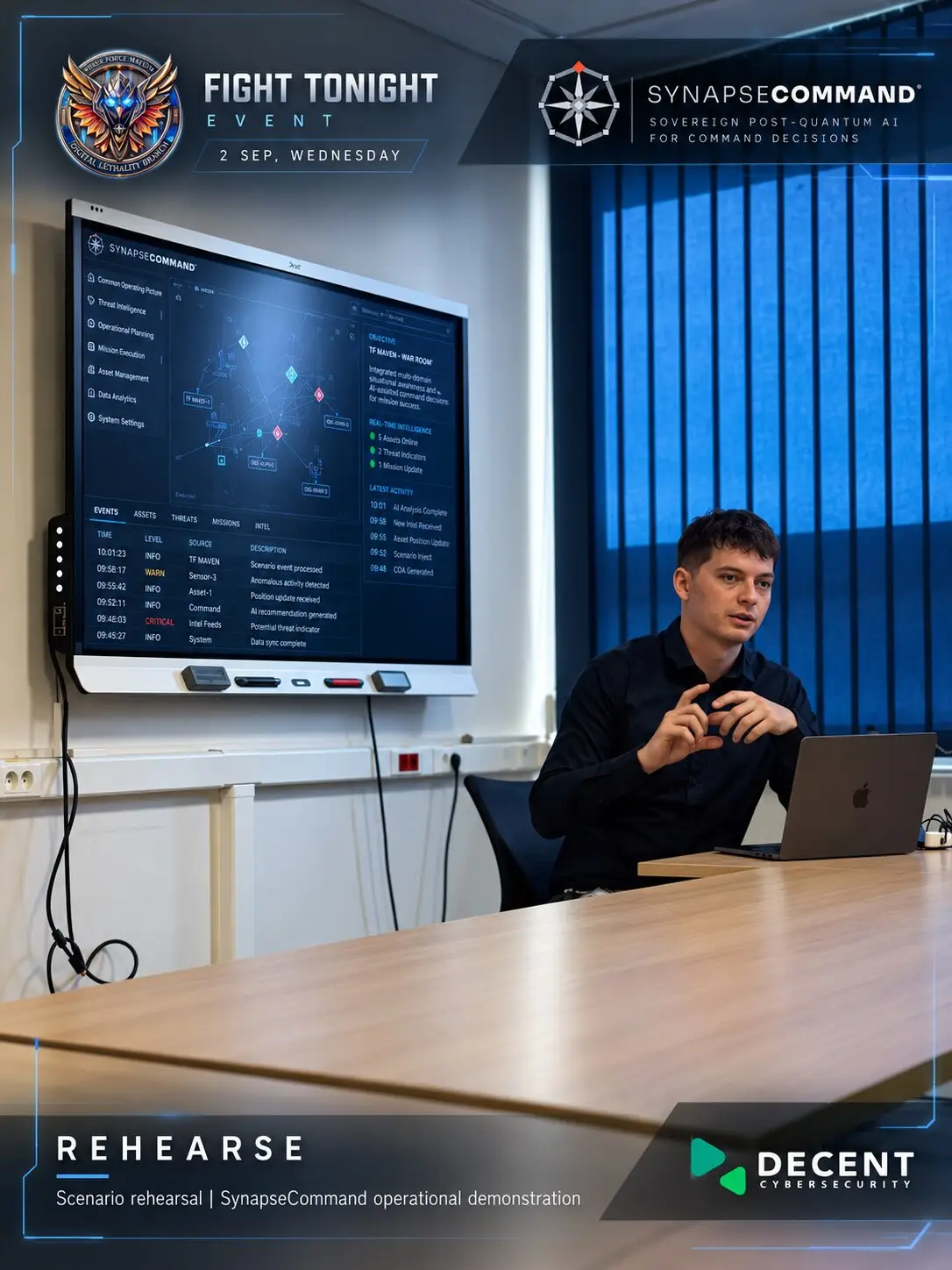
Rehearse. Execute. Replay.
Run contested MDO scenarios before commitment
Degrade domains (space, cyber, comms) and observe the kill web re-route in real time. Course-of-action analysis with evidence, not assumption.
- Model adversary denial of space, cyber and comms layers
- Measure latency and evidence quality across alternative paths
- Validate ROE and collateral constraints before commitment
Human-in-the-loop by design
CommanderNL™ surfaces every decision point where command judgment enters the chain. Authorities and handoffs are explicit, never implicit.
- Authority gates pause the simulated chain until a qualified operator approves
- Every handoff between agents and domains is logged
- Signed policy artefacts and execution gates enforce authorised policy versions and required operator approvals

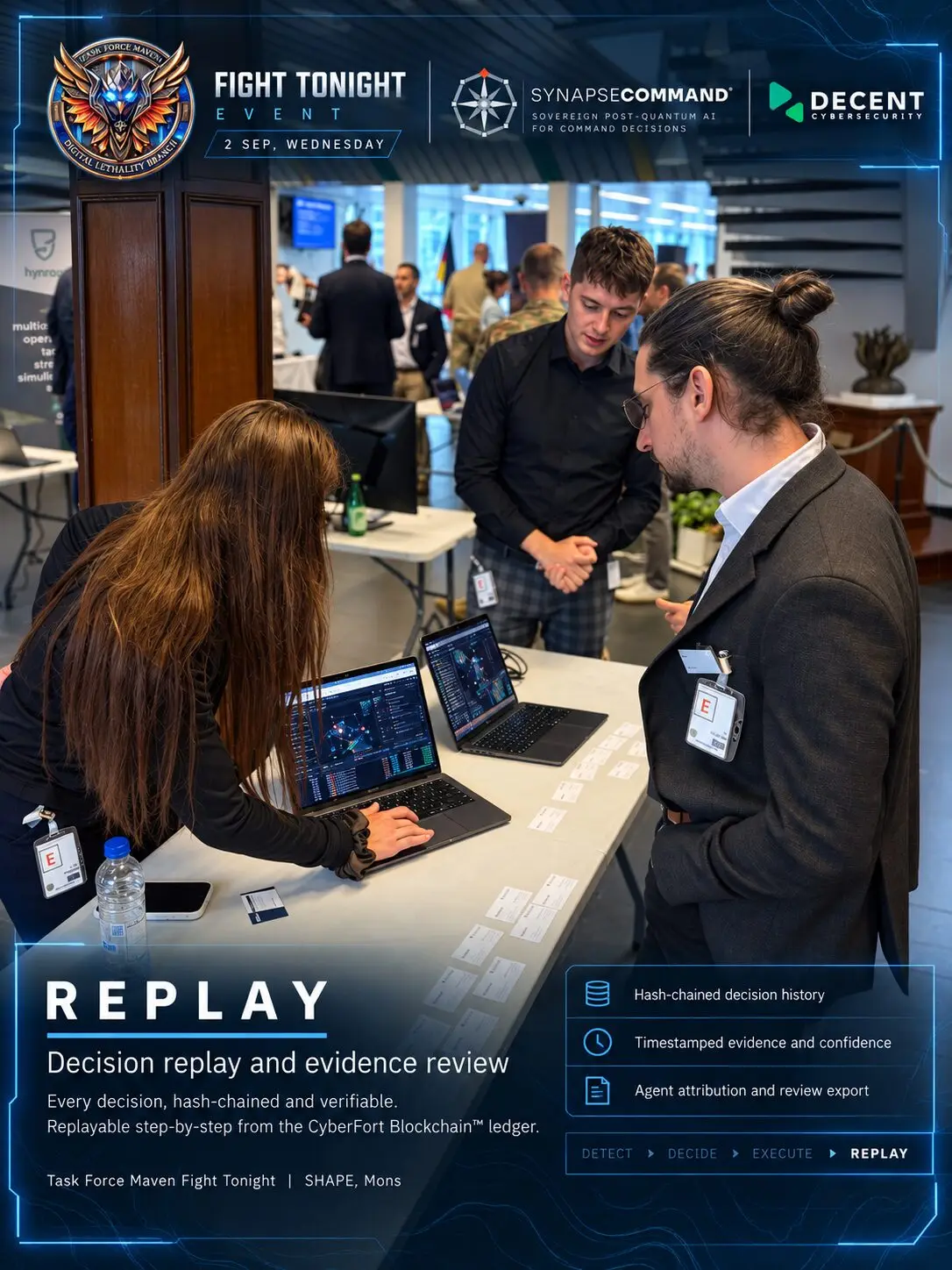
Every decision, hash-chained and verifiable
Replayable step-by-step from the CyberFort Blockchain™ ledger. Full accountability: what was known, what was decided, by whom, and why.
- Hash-chained record of every decision event, ML-DSA-signed in assured deployments
- Timestamped evidence, confidence and agent attribution
- Exportable CSV and PDF briefs for review or inquiry
Contested and Degraded by Design
When a domain is denied (space layer lost, comms contested, cyber degraded), the kill web re-routes. SynapseCommand® shows the alternative paths, their latencies, and their evidence quality, so commanders choose among viable chains rather than discovering failure at engagement.
SATCOM link severed; fallback to airborne relay or terrestrial line-of-sight.
Spectrum interference adds latency; redundant paths are evaluated and ranked.
Compromised nodes isolated; traffic re-routed through resilient cross-links.
Each alternative path displays latency penalty and confidence cost.
Text description of this diagram
The diagram plots six nodes of a multi-domain kill web on a grid. The primary route runs from the sensor node, up to a satellite communications node, and down into the fusion node. Both legs of that route are drawn as faded dashed lines and the satellite node is struck through, labelled "space layer denied": the space link has been lost to jamming or attack.
A second, highlighted route runs from the same sensor node down through an airborne relay node, across to a cyber effects node, and up into the effector node. A moving marker travels along it to show it is the live path. It is labelled "alt path, plus 140 milliseconds, evidence: high", meaning the chain still completes with a modest latency penalty and no loss of evidential confidence. A faint dashed link between fusion and effector shows the residual connection that remains available.
The point of the diagram: when one domain is denied, the kill web re-forms across the remaining domains rather than breaking, and the operator is shown the cost of each alternative before the chain proceeds.
Deployable in operational, exercise, and staff-preparation environments: classified enclave, sovereign cloud, or tactical edge.
Request a Classified Briefing