

By Decent Cybersecurity, publisher of SynapseCommand®
What Is C4ISR? Command, Control, Communications, Computers, Intelligence, Surveillance and Reconnaissance Explained
C4ISR stands for Command, Control, Communications, Computers, Intelligence, Surveillance and Reconnaissance. This guide explains what C4ISR means, how it works, how it differs from C2 and C5ISR, and why interoperability and resilience matter.
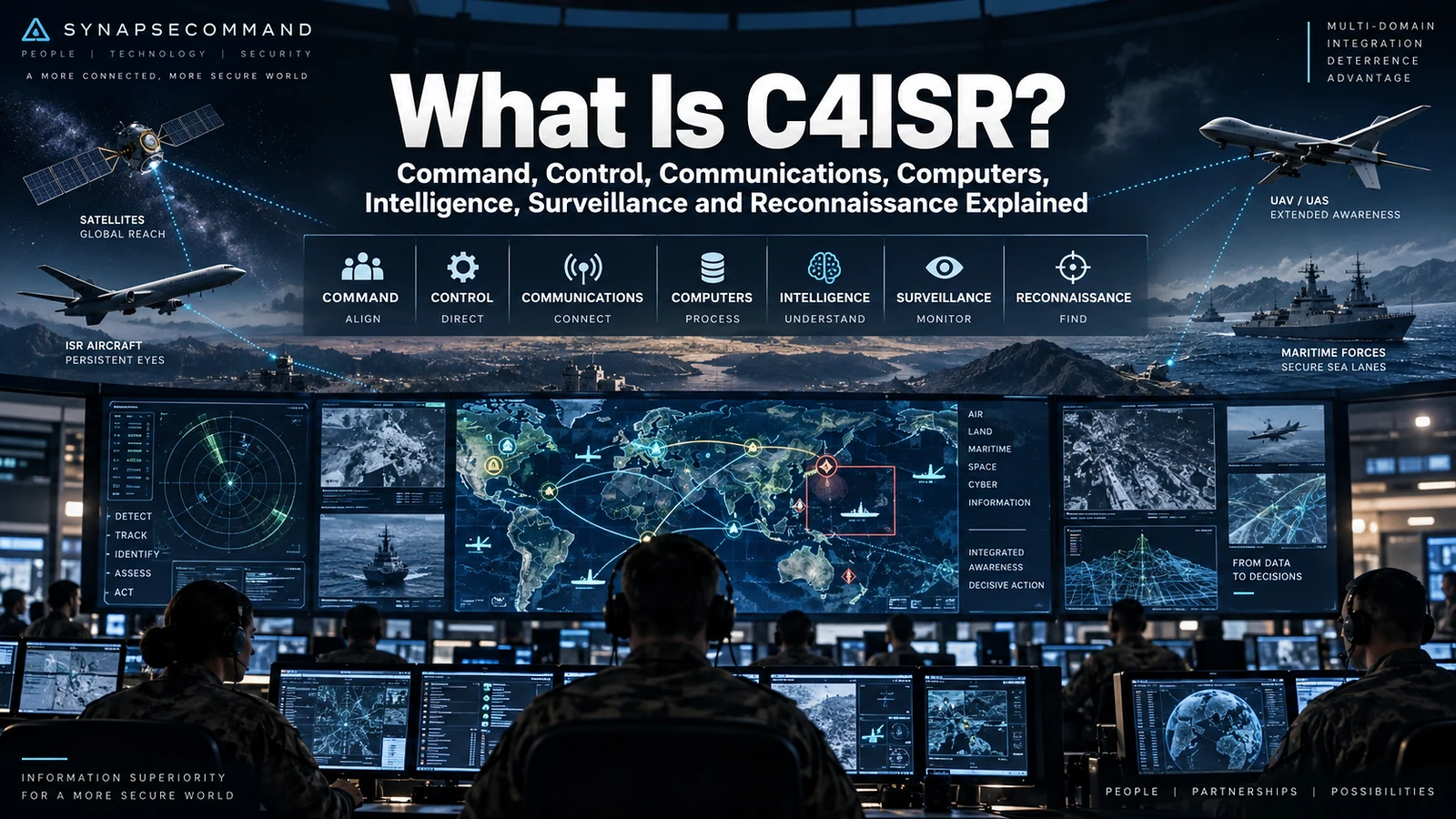
C4ISR stands for Command, Control, Communications, Computers, Intelligence, Surveillance and Reconnaissance. It is a broad military term for the capabilities that allow a force to collect information, move it, make sense of it and use it to command and coordinate operations.
That definition sounds technical. The underlying problem is not.
A radar detects an aircraft. Someone has to receive the track, understand what it represents, combine it with other information and decide whether it matters. If action is required, that decision has to reach the people or systems responsible for carrying it out. The same basic challenge appears on land, at sea, in the air and across increasingly distributed military networks.
The sensors, communications links, computers and intelligence systems matter. But none of them is the point on its own. C4ISR is about turning information into something useful for command.
The U.S. Army still uses C4ISR in this sense. Tobyhanna Army Depot's C4ISR capability page applies the acronym to Command, Control, Communications, Computers, Intelligence, Surveillance and Reconnaissance systems, while current Army organisations may use the expanded term C5ISR when cyber is explicit.
C4ISR in one sentence
“C4ISR stands for Command, Control, Communications, Computers, Intelligence, Surveillance and Reconnaissance. It describes the people, systems, networks and processes that help military forces collect information, develop situational understanding, communicate decisions and coordinate operations. C4ISR is not one specific system; it is a broader capability environment.”
Short definition
C4ISR at a glance
| Element | Meaning | Role |
|---|---|---|
| Command | Command | Authority, intent and decisions |
| Control | Control | Directing and coordinating activity |
| Communications | Communications | Moving information between people and systems |
| Computers | Computers | Processing, storing and presenting information |
| Intelligence | Intelligence | Turning information into assessed understanding |
| Surveillance | Surveillance | Systematic observation |
| Reconnaissance | Reconnaissance | Obtaining information to answer operational requirements |
C4ISR is not one system
One of the easiest ways to misunderstand C4ISR is to imagine a single piece of software, a command post full of screens or a particular family of military equipment.
There is no universal C4ISR machine.
Depending on who is using the term, C4ISR can describe a capability area, an architecture or an environment made up of many systems. A tactical radio may be part of it. So may a radar, an intelligence application, a satellite link, a command-and-control system or a server processing operational data.
That lack of a single neat definition is not an oversight. It reflects the terminology itself. In the Canadian Army Journal, Major Jan Kool observed that C4ISR is widely used but “remarkably ill defined”, and argued that discussion often concentrates on technology at the expense of command and control.
A useful definition therefore starts with people and decisions, not hardware.
What do the seven parts of C4ISR actually do?
Command
Command is where authority sits.
U.S. Army doctrine defines command and control as the exercise of authority and direction by a properly designated commander over assigned and attached forces in accomplishing a mission. It describes the Army's command-and-control system as people, processes, networks and command posts, rather than merely an information system.
A computer can calculate. A sensor can observe. A network can carry data. None possesses command authority. Technology supports commanders and staffs as they understand a situation, plan, communicate intent, monitor execution and adapt when events refuse to follow the plan.
Control
If command establishes authority and direction, control helps turn those decisions into coordinated activity. It includes the feedback, information and communication required to keep operations aligned with a commander's intent. ADP 6-0 identifies direction, feedback, information and communication among the elements of control.
In practice, that means knowing what subordinate units are doing, whether orders have been understood, how the situation has changed and whether the plan still makes sense. Command and control together form C2.
Communications
Information has little operational value if it cannot reach the people who need it. Military communications may involve radios, satellite links, terrestrial networks, tactical data links, secure IP networks and gateways between otherwise incompatible environments. The architecture varies enormously by mission and echelon.
A headquarters may have substantial connectivity; a dispersed formation may be working through intermittent links with limited bandwidth while moving. During the 4th Infantry Division's Ivy Mass exercise, the U.S. Army reported division-scale testing under denied, degraded, intermittent and limited conditions.
Communications in C4ISR therefore means more than having a network. It means having information pathways that remain useful under operational conditions.
Computers
The fourth C covers the machines and software that process the information moving through those networks. That can include rugged field devices, vehicle systems, command-post servers, edge computing, data services and specialised mission applications.
Their jobs vary: processing sensor data, correlating tracks, displaying maps, storing information, managing messages, running planning tools or helping analysts sift through large datasets. The problem is no longer simply getting information from one place to another. It is deciding what to do with the volume of data once it arrives.
The Army has acknowledged that difficulty directly. At a 2024 command-and-control data meeting, its Chief Data and Analytics Officer described a legacy of siloed battle-command systems and questioned whether existing data models were robust enough for the transition under way, according to the Army's report on data as a challenge for command and control.
Intelligence
Data and intelligence are not the same thing.
A sensor report is information. Intelligence requires assessment: placing information in context, evaluating what it means, comparing it with other sources and considering how reliable it is. Modern systems can generate far more data than a commander or staff can absorb, so the challenge is not simply to collect more. It is to identify what is relevant, understand its provenance and confidence, and present it in time to affect a decision.
Surveillance
Surveillance is systematic observation. Army doctrine uses the term for observation of places, persons, areas or things by visual, aural, electronic, photographic or other means. It can involve radar, electro-optical sensors, aircraft, uncrewed systems, ground sensors or other means of maintaining observation.
Surveillance is often persistent. It can reveal patterns or changes that would be difficult to see from a single observation. The doctrinal relationship between surveillance, information collection and reconnaissance is covered across Army intelligence doctrine and FM 3-98, Reconnaissance and Security Operations.
Reconnaissance
Reconnaissance is related to surveillance, but the terms are not interchangeable. FM 3-98 treats reconnaissance as a mission undertaken to obtain information about an adversary, terrain or other characteristics of an area of operations. It is directed towards answering information requirements that help commanders understand the operational environment.
“Surveillance watches. Reconnaissance goes looking for answers.”
A useful shorthand, not a complete doctrinal definition
From detection to decision: how C4ISR works in practice
Consider a simplified air-defence example. A radar reports an aircraft. That observation alone does not tell a commander what to do.
The track may have to be transmitted over a network, correlated with other sensors, checked against identification data and placed in operational context. Operators may need to determine whether the aircraft is friendly, unknown or potentially hostile. The information then has to reach whoever has authority to make the relevant decision. If action follows, that direction must travel back through the organisation.
“Sensor → communications → computing → assessment → command decision → coordination”
Simplified information-to-decision sequence
Real operations are considerably messier. Links fail. Reports conflict. Sensors have limitations. Information arrives late. Classification rules constrain who can see what. Different nations or services may describe the same object differently. That messiness is precisely why integration matters.
C2 and C4ISR are not the same thing
C4ISR contains C2, but the terms should not be used as synonyms.
| Aspect | C2 | C4ISR |
|---|---|---|
| Full term | Command and Control | Command, Control, Communications, Computers, Intelligence, Surveillance and Reconnaissance |
| Core concern | Exercising authority and directing forces | The wider command-and-information environment |
| Communications explicit | No | Yes |
| Computing explicit | No | Yes |
| ISR explicit | No | Yes |
| One specific product | No | No |
The difference is more than semantic. C2 is fundamentally about authority and direction. C4ISR includes the communications, computing and ISR capabilities that can support that process. Army doctrine is useful here because it explicitly treats the C2 system as people, processes, networks and command posts, rather than reducing command to technology.
Why interoperability is the hard part
A modern force rarely operates a single, homogeneous technology stack. A radar may come from one manufacturer, a command application from another and the communications network from somewhere else. Coalition operations add national systems, different data models, different security rules and, sometimes, different interpretations of apparently identical information.
Making those systems communicate is only the first step. A message can cross a network and still be useless. The receiving system has to know what the data means. A track identifier, coordinate, confidence value or timestamp has to retain its meaning as it moves. Users also need to be authorised to receive it.
That creates several layers of interoperability:
- Technical: can the systems connect?
- Syntactic: can they exchange data in compatible formats?
- Semantic: do they interpret that data in the same way?
- Operational: can the receiving organisation actually use it?
This is why standards, gateways and adapters matter so much in C4ISR.
C4ISR under pressure
A C4ISR architecture designed only for perfect connectivity is designed for the wrong environment. Communications can be jammed. Infrastructure can be damaged. Networks can disappear without warning. Command posts can become targets because of the electromagnetic signatures they produce.
The Army has examined these problems through doctrine, experimentation and exercises, including ways to reduce command-post signatures and maintain communications in contested environments. Ivy Mass is a current example of testing at division scale under degraded network conditions.
Resilience may therefore matter as much as raw performance. Depending on the mission, that can mean redundant communications, distributed processing, edge computing, local data storage, disconnected operation or the ability to degrade gracefully rather than fail completely.
The Canadian Army Journal's tactical C4ISR analysis makes the same point from a command perspective: technology suited to a static headquarters can become a liability if it creates dependence on communications that an adversary can disrupt.
A resilient C4ISR system is not one that assumes the network will always be there. It is one designed around the possibility that it will not.
Where does AI fit?
Artificial intelligence is becoming more visible in C4ISR, but it does not change the basic problem. AI can help process sensor feeds, find patterns, prioritise information, flag anomalies or assist analysts dealing with more data than a human team can review manually.
The Army's current work offers concrete examples. Its researchers have developed applications that combine live information including unit locations, sensor coverage, logistics status, weather and terrain to support command decisions, according to an official report on a decision-support tool for Next Generation Command and Control.
Faster analysis is not automatically better command. An AI-generated recommendation is useful only if the people relying on it understand enough about the data, assumptions and limitations behind the result. In military decision-making, provenance and confidence can matter as much as speed. AI belongs inside the wider C4ISR problem. It does not replace it.
C4ISR, C5ISR, CJADC2 and COP: four terms that should not be confused
C4ISR
Command, Control, Communications, Computers, Intelligence, Surveillance and Reconnaissance. It is a broad capability term.
C5ISR
In current U.S. Army usage, C5ISR adds Cyber: Command, Control, Communications, Computers, Cyber, Intelligence, Surveillance and Reconnaissance. The DEVCOM C5ISR Center uses that expansion in its official name and mission.
CJADC2
Combined Joint All-Domain Command and Control is a specific U.S. Department of Defense concept. GAO describes it as an effort to improve command and control by connecting selected assets across air, land, sea, space and cyberspace, and makes clear that it is not itself a single system. The dedicated CJADC2 explainer covers that concept and the terminology change from JADC2.
Common Operational Picture
A Common Operational Picture, or COP, is a shared representation of operationally relevant information. It may be supported by a C4ISR environment, but the terms do not describe the same thing. The distinction is covered in the separate guide to Common Operational Pictures.
What good C4ISR looks like
There is a temptation to judge C4ISR by the visible technology: screens, sensors, bandwidth and computing power. Those things are easy to count. Operational usefulness is harder.
A good C4ISR environment gets several less glamorous things right:
- The information is relevant. A commander is not forced to search through every available data point to find the one that matters.
- It arrives in time. Perfect information delivered after the decision has been made has limited value.
- Its provenance is understood. Users know where important information came from and, where relevant, how confident they should be in it.
- Systems can exchange it. Information does not stop at organisational or technical boundaries without good reason.
- The architecture survives disruption. Losing a link or node does not automatically collapse the whole system.
- People remain in command. Technology supports authority and judgement instead of quietly dictating them.
Those qualities are difficult to demonstrate in a product brochure, but they are closer to the real test of C4ISR than the number of applications connected to a network.
Where SynapseCommand fits
SynapseCommand does not claim to be an entire C4ISR architecture.
It is designed to work alongside existing command-and-control and mission systems, using authorised operational data made available through supported interfaces. Its focus is the decision layer: helping organise information, support staff work, develop or compare courses of action and preserve a traceable record of how a decision was reached.
That is deliberately narrower than C4ISR. SynapseCommand does not replace military communications infrastructure, ISR sensors, tactical radios, established battle-management systems or command authority. Specific compatibility and interoperability claims are documented separately rather than implied by this article.
That distinction matters. “C4ISR” is too broad a term to use as a marketing synonym for one software platform.
The simplest way to understand C4ISR
Strip away the acronym and C4ISR is trying to answer four questions:
- What is happening? Intelligence, surveillance and reconnaissance help build an understanding of the environment.
- Can the information get where it needs to go? Communications connect people and systems.
- Can it be processed and understood? Computers and applications help organise, correlate and present it.
- What does the force do next? Commanders and staffs exercise command and control.
That final step is why the human element matters so much.
The purpose of C4ISR is not to create the largest possible digital picture of a battlefield. It is to help a military organisation understand enough of that battlefield, soon enough, to make and execute better decisions.
Key points
- C4ISR means Command, Control, Communications, Computers, Intelligence, Surveillance and Reconnaissance.
- It is a broad capability concept, not one universal military system.
- Command and control sit at its centre; technology exists to support them.
- C4ISR depends on more than connectivity. Information must remain understandable and useful as it moves between systems.
- Surveillance and reconnaissance are related, but they are not the same activity.
- Modern C4ISR has to function when communications are degraded or contested.
- C5ISR, CJADC2 and a Common Operational Picture are related terms, but none is simply another name for C4ISR.
Frequently asked questions
What does C4ISR stand for?
C4ISR stands for Command, Control, Communications, Computers, Intelligence, Surveillance and Reconnaissance.
What is C4ISR in simple terms?
C4ISR is the wider environment of people, processes, sensors, networks and computer systems that helps a military force collect information, understand it, communicate decisions and coordinate operations.
Is C4ISR a single military system?
No. C4ISR is a broad capability area or architecture made up of many people, processes and systems. It is not one universal product, network or command-post application.
What is the difference between C2 and C4ISR?
C2 means Command and Control and centres on authority and direction. C4ISR includes C2 plus the communications, computing, intelligence, surveillance and reconnaissance capabilities that support it.
What is the difference between C4ISR and C5ISR?
C5ISR adds Cyber to Command, Control, Communications, Computers, Intelligence, Surveillance and Reconnaissance. Usage varies by organisation, but the U.S. Army DEVCOM C5ISR Center uses that expansion.
Are surveillance and reconnaissance the same?
No. They overlap, but surveillance is generally systematic and often persistent observation, while reconnaissance is directed towards obtaining information needed to answer operational requirements.
Is C4ISR the same as CJADC2?
No. C4ISR is a broad capability term. CJADC2 is a specific U.S. Department of Defense command-and-control concept for connecting selected assets across services, domains and authorised partners.
Does C4ISR include AI?
AI can support C4ISR by processing sensor data, finding patterns, prioritising information and assisting analysts. It remains one enabling technology within a wider environment that depends on reliable data, human judgement and command authority.
Primary sources
- Tobyhanna Army Depot
C4ISR
Official U.S. Army capability page covering support for command, control, communications, computers, intelligence, surveillance and reconnaissance systems.
Read the Tobyhanna C4ISR capability page - Canadian Army Journal2024
Tactical C4ISR: Lessons from the Front
Major Jan Kool's analysis of tactical C4ISR, its contested definition and the risk of placing technology ahead of command and control.
Read Tactical C4ISR: Lessons from the Front - U.S. Army Publishing Directorate31 July 2019
ADP 6-0, Mission Command: Command and Control of Army Forces
Army doctrine defining command and control and explaining the people, processes, networks and command posts that form the command-and-control system.
Read ADP 6-0 - U.S. Army Publishing DirectorateMarch 2021
TC 6-0, Training the Command and Control Warfighting Function
Army training circular addressing the command-and-control warfighting function and its supporting system.
Read TC 6-0 - U.S. Army Publishing DirectorateJanuary 2023
FM 3-98, Reconnaissance and Security Operations
Current Army field manual on reconnaissance and security operations, including reconnaissance in support of information requirements.
Read FM 3-98 - U.S. Army DEVCOM C5ISR Center
About the C5ISR Center
Official explanation of the Center's Command, Control, Communications, Computers, Cyber, Intelligence, Surveillance and Reconnaissance mission.
Read about the DEVCOM C5ISR Center - U.S. Army3 June 2026
Ivy Mass exercises NGC2 at division scale
Official Army reporting on division-scale experimentation and communications in denied, degraded, intermittent and limited conditions.
Read the Army's Ivy Mass report - U.S. Army20 August 2024
Data: a Challenge for Command and Control
Army reporting on siloed battle-command systems, data models and the challenge of making operational data usable across command-and-control environments.
Read the Army article on the C2 data challenge - U.S. Army
Army researchers turn battlefield data into decision dominance tool for NGC2
Official coverage of Army applications combining live operational data to support command decisions.
Read the Army decision-support article - U.S. Government Accountability Office8 April 2025
Defense Command and Control: Further Progress Hinges on Establishing a Comprehensive Framework
GAO-25-106454 explains CJADC2 as a Department of Defense effort to connect selected assets across services and domains, rather than a single system.
Read GAO-25-106454
SynapseCommand® is a product of Decent Cybersecurity. This article explains a general military capability concept using official government and military sources. It does not imply endorsement by the U.S. Department of Defense, U.S. Army, Canadian Armed Forces, NATO, the European Union or any government organisation.