
By Decent Cybersecurity, publisher of SynapseCommand®
Maven Smart System: How AI Is Transforming Military Command and Control
What the Maven Smart System is, how it grew out of Project Maven, and what its expansion across U.S. and NATO operations means for AI-enabled command and control.
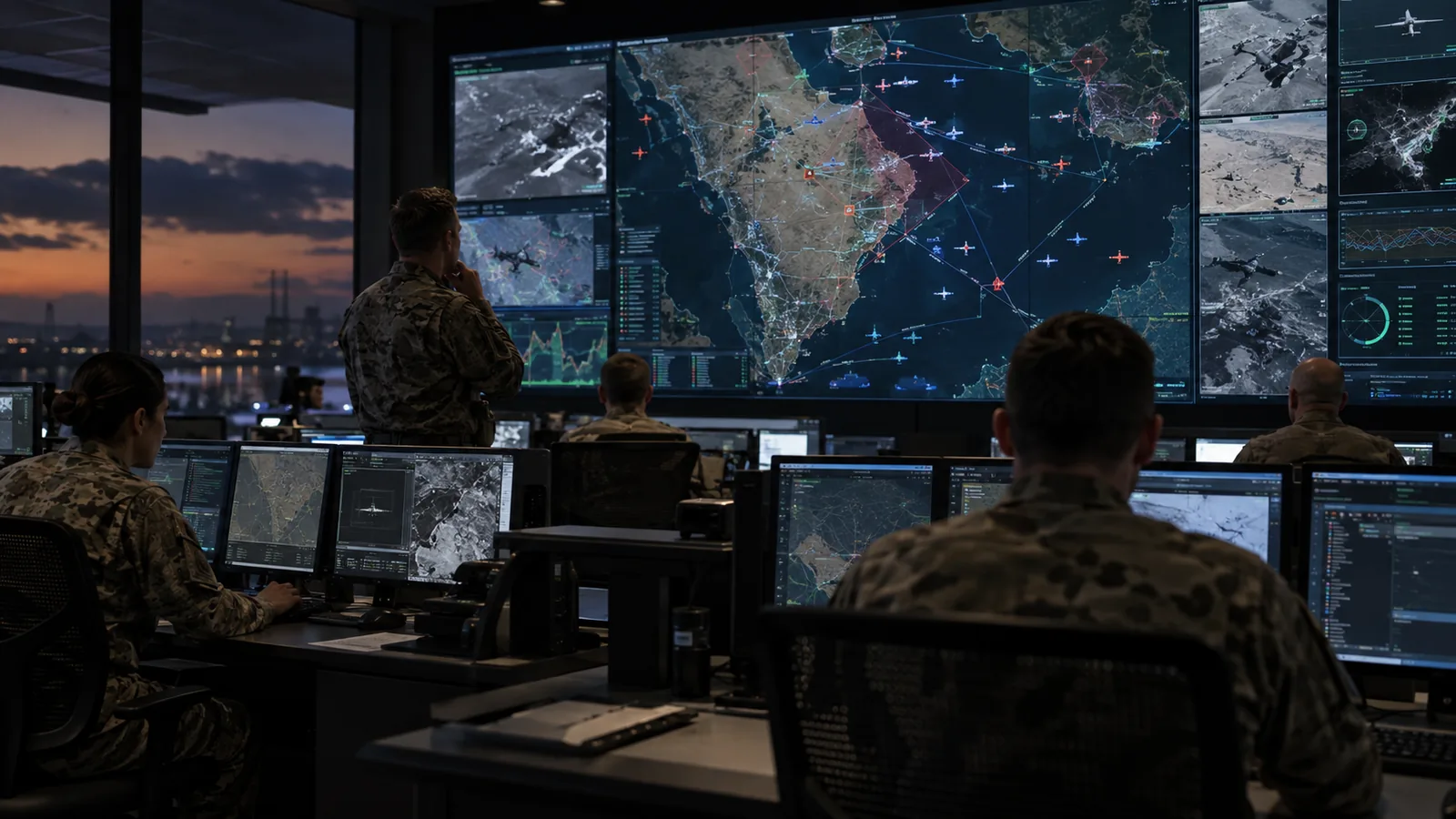
Maven Smart System is expanding from an intelligence and operations capability into a broader AI-enabled military decision environment. New reporting shows the U.S. Department of Defense extending Maven into readiness, logistics, force disposition, supply chains, budgeting, modeling and simulation. For military command and control, the significance is larger than any individual application: data, artificial intelligence and operational workflows are increasingly converging around the decision cycle.
That development has direct relevance for NATO, which operates the separate NATO Maven Smart System capability across Allied Command Operations, and for the wider question of how AI should integrate with existing command-and-control systems.
It also helps define the problem SynapseCommand is designed to address: what happens between an increasingly data-rich operational picture and an authorised command decision?
| Attribute | Maven Smart System |
|---|---|
| Common name | MSS |
| Origin | Project Maven, the U.S. Department of Defense artificial-intelligence effort |
| Domain | Military AI, data integration and command and control |
| Core purpose | Bringing operational data, analytics and AI together to support military workflows and decision-making |
| Principal supplier | Palantir Technologies |
| Related concept | Combined Joint All-Domain Command and Control (CJADC2) |
| NATO context | NATO Maven Smart System (MSS NATO), a separate capability for Allied Command Operations |
| Typical use cases | Situational awareness, intelligence fusion, targeting support, planning and operational workflows |
What is Maven Smart System?
Maven Smart System, commonly abbreviated MSS, is an AI-enabled military platform used to combine operational data, analytics and artificial intelligence in support of military operations and decision-making.
Defense One reported on 9 September 2026 that MSS is used across all U.S. combatant commands for intelligence and operations data analysis. According to that reporting, the Pentagon is now extending the system into additional functions including force readiness, force disposition, logistics, supply chains, budgeting, modeling and simulation.
The direction is important.
Maven is moving beyond the idea of AI as a specialist intelligence tool. It is increasingly becoming part of the digital environment through which different military functions understand the same operational problem.
That changes the role of AI in command and control.
From Project Maven to Maven Smart System
Project Maven began as a U.S. Department of Defense effort to apply machine learning to the processing of large volumes of intelligence data, in particular imagery and full-motion video that human analysts could not review at the pace it was being collected.
Maven Smart System is the software environment that grew out of that work. Rather than a single analytic model, it is a data and application layer in which operational information from many sources is brought together and made available to analytical and workflow tools.
The shorthand distinction is useful: Project Maven is the programme and its lineage, while Maven Smart System is the fielded software environment associated with it today.
Who developed Maven Smart System?
The system is delivered by Palantir Technologies for the U.S. Department of Defense, and Palantir is also the industry partner behind the separate NATO capability acquired by the NATO Communications and Information Agency in March 2025.
The software is not a standalone product used in isolation. It sits within government-operated environments, alongside existing command-and-control, intelligence and mission systems, and its usefulness depends on the operational data that those systems make available to it.
Maven Smart System and CJADC2
Combined Joint All-Domain Command and Control, usually abbreviated CJADC2, is the U.S. Department of Defense concept for connecting sensors, decision-makers and effects across all operational domains and with allies and partners.
Maven is frequently discussed in that context because it addresses one of the concept's hardest practical requirements: making operational data from many separate systems usable together, quickly enough to matter to a commander. CJADC2 is the objective; software environments such as Maven are among the means through which parts of it are pursued.
Maven is expanding beyond intelligence
The current Maven Smart System is much broader than that original focus.
According to Defense One, U.S. Chief Digital and Artificial Intelligence Officer Cameron Stanley described a Department of Defense objective of connecting information from sensors through aggregation and visualisation to decision-making and action.
MSS has already replaced multiple systems previously used to analyse information, according to Stanley.
The Pentagon is now seeking what amounts to horizontal integration across functions that have traditionally been separated by organisations, systems and datasets.
That includes intelligence, operations, force readiness, force disposition, logistics, supply chains, budget information, modeling and simulation.
This matters because military decisions rarely belong to only one functional area.
A commander considering a course of action may need to understand the adversary, friendly force disposition, ammunition availability, logistics capacity, platform readiness, intelligence confidence, timing, air support, communications constraints and possible second-order effects at the same time.
A system that connects those variables can support a fundamentally different decision process from one that merely displays isolated information.
From a common operational picture to a common decision environment
For decades, an important objective of military digitisation has been the creation of a common operational picture.
The next challenge is turning that picture into a common decision environment.
Those are not the same thing.
A common operational picture helps answer one question: what is happening?
An AI-enabled decision environment must help commanders and staff address several more: why is it happening, what is likely to happen next, what constraints affect us, what options are available, what are the consequences of each option, what information supports the recommendation, and who has authority to decide?
That requires more than putting a large language model on top of military data.
A credible military decision-support architecture needs structured operational information, provenance, confidence, classification handling, doctrinal context, explicit constraints, human authority and a record of how consequential recommendations were produced.
The expansion of Maven suggests that these functions are beginning to converge.
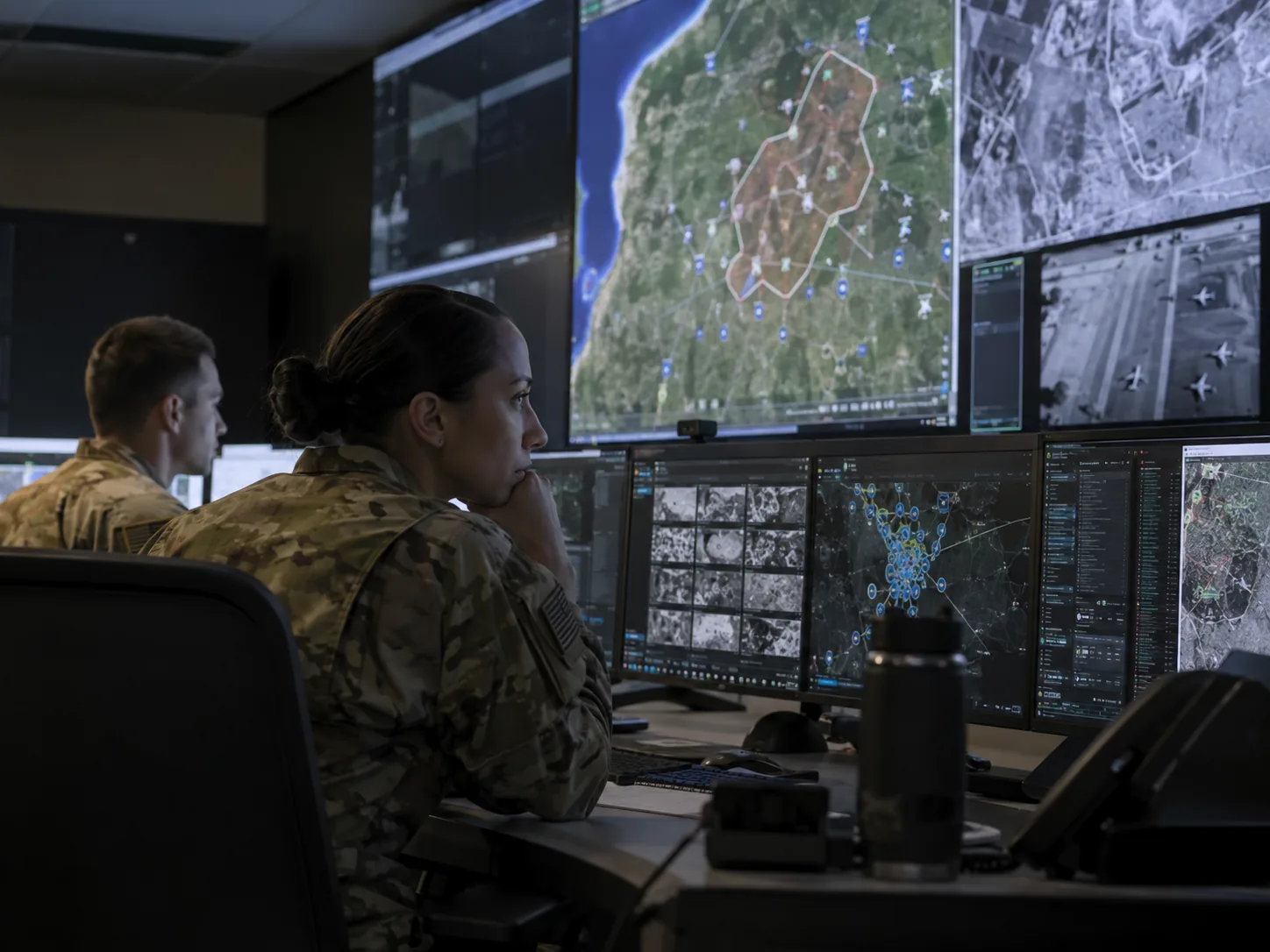
The military AI problem is becoming an integration problem
The effectiveness of an AI system depends heavily on the information available to it.
In military environments, that information can originate from many systems and many formats.
Air-surveillance information may use ASTERIX. Ground moving-target information may use STANAG 4607. Track information may be exchanged through STANAG 4676. Full-motion video and associated metadata may involve STANAG 4609. Uncrewed systems may use STANAG 4586.
Tactical applications may exchange Cursor-on-Target information through TAK environments. Maritime and aviation sources can introduce AIS and ADS-B data.
The AI layer therefore cannot be separated from interoperability.
Before an AI system can reason usefully across operational information, data from different sources needs to be translated into a coherent representation while retaining information about its origin, time, confidence and security context.
This is why military AI and military interoperability are increasingly part of the same architectural problem.
What is Maven Smart System NATO?
Maven Smart System NATO, or MSS NATO, is NATO's AI-enabled warfighting capability for Allied Command Operations.
The NATO Communications and Information Agency and Palantir Technologies finalised the acquisition of MSS NATO on 25 March 2025.
NATO said the capability was intended to provide a common data-enabled warfighting environment supporting applications including intelligence fusion, targeting, battlespace awareness, planning and accelerated decision-making.
MSS NATO is related to the broader Maven technology family, but it should not be treated as identical to the U.S. Department of Defense implementation.
That distinction matters.
The developments reported in the United States show the direction in which Maven-based military AI environments can evolve. NATO has its own operational requirements, governance, systems, security boundaries and Alliance context.
NATO Maven Smart System has moved rapidly into operational use
NATO's adoption of MSS NATO has progressed quickly.
The original procurement took approximately six months from requirement to acquisition.
NATO subsequently introduced MSS NATO into exercises, training and operational command structures.
During Steadfast Duel 2025, the NATO Communications and Information Agency described Maven Smart System as the primary platform for warfighting integration during the exercise.
The NATO Joint Warfare Centre has also trained personnel and developers to use the platform in NATO exercises.
In August 2026, the Joint Warfare Centre reported that NATO Maven Smart System had achieved full technical operational capability on 22 June 2026 after meeting Allied Command Operations requirements.
This progression is significant because it demonstrates that AI-enabled C2 is moving beyond experimentation.
The question is increasingly not whether artificial intelligence will enter command workflows, but how it will be integrated, governed and used.
Why Maven's expansion matters for military command and control
The most important lesson from Maven's expansion is not that one platform can absorb more applications.
It is that military organisations increasingly want to connect the entire chain from information to action.
A simplified digital decision cycle runs from sensors and operational systems, through data integration, the operational picture, analysis and courses of action, to a human decision, execution and review.
Each transition presents a different problem.
Sensors produce observations.
Integration systems make those observations usable together.
C2 systems establish operational context.
Analytics help identify relationships, patterns and risks.
Decision-support systems help develop and compare courses of action.
Commanders exercise authority.
Execution systems carry approved decisions into action.
Afterwards, the organisation needs to understand what happened and why.
The closer AI moves toward the decision point, the more important provenance, explainability, constraints and human authority become.
Faster is not automatically better
Much of the value proposition around military AI concerns speed.
That is understandable.
Reducing the time between observation, understanding and action can create operational advantage.
But decision superiority is not simply decision speed.
A fast recommendation based on incomplete, stale or misunderstood information can be worse than a slower one.
The useful objective is therefore not merely to make decisions faster. It is to make well-supported decisions faster, while preserving command authority and the ability to inspect how the recommendation was formed.
That distinction becomes increasingly important as AI participates in higher-consequence military workflows.
Where SynapseCommand fits
SynapseCommand is designed for the part of the military decision cycle between the operational picture and the authorised decision.
It is not intended to replace an existing command-and-control environment.
The existing C2 remains in place.
SynapseCommand adds a sovereign multi-agent decision-intelligence layer alongside it.
Operational information enters through an integration layer and is translated into a canonical data model. Source, timing, classification and confidence can remain attached to the information as it moves into the decision environment.
Specialist agents can then examine the same operational state from different functional perspectives.
These include capabilities for ISR fusion, course-of-action analysis, planning, logistics, air-tasking support and other decision functions.
The objective is not to allow an autonomous system to assume command authority.
The objective is to help authorised personnel understand the situation, surface constraints, develop options and compare possible courses of action.
Material decisions remain subject to a human decision gate.
SynapseCommand and NATO Maven Smart System
SynapseCommand is architected to operate alongside environments such as Maven Smart System NATO through authorised integration paths.
Its current NATO Maven Smart System integration status is Integration-ready.
That term has a specific meaning.
SynapseCommand is architecturally capable of integrating with the system, but a validated end-to-end integration with MSS NATO has not been completed.
Integration would require authorised access to the relevant interfaces and deployment environment.
The status therefore does not imply NATO certification, NATO endorsement, procurement or an operational deployment.
This qualification is important because military interoperability claims should describe exactly what has been demonstrated and no more.
SynapseCommand at NATO FIGHT TONIGHT!
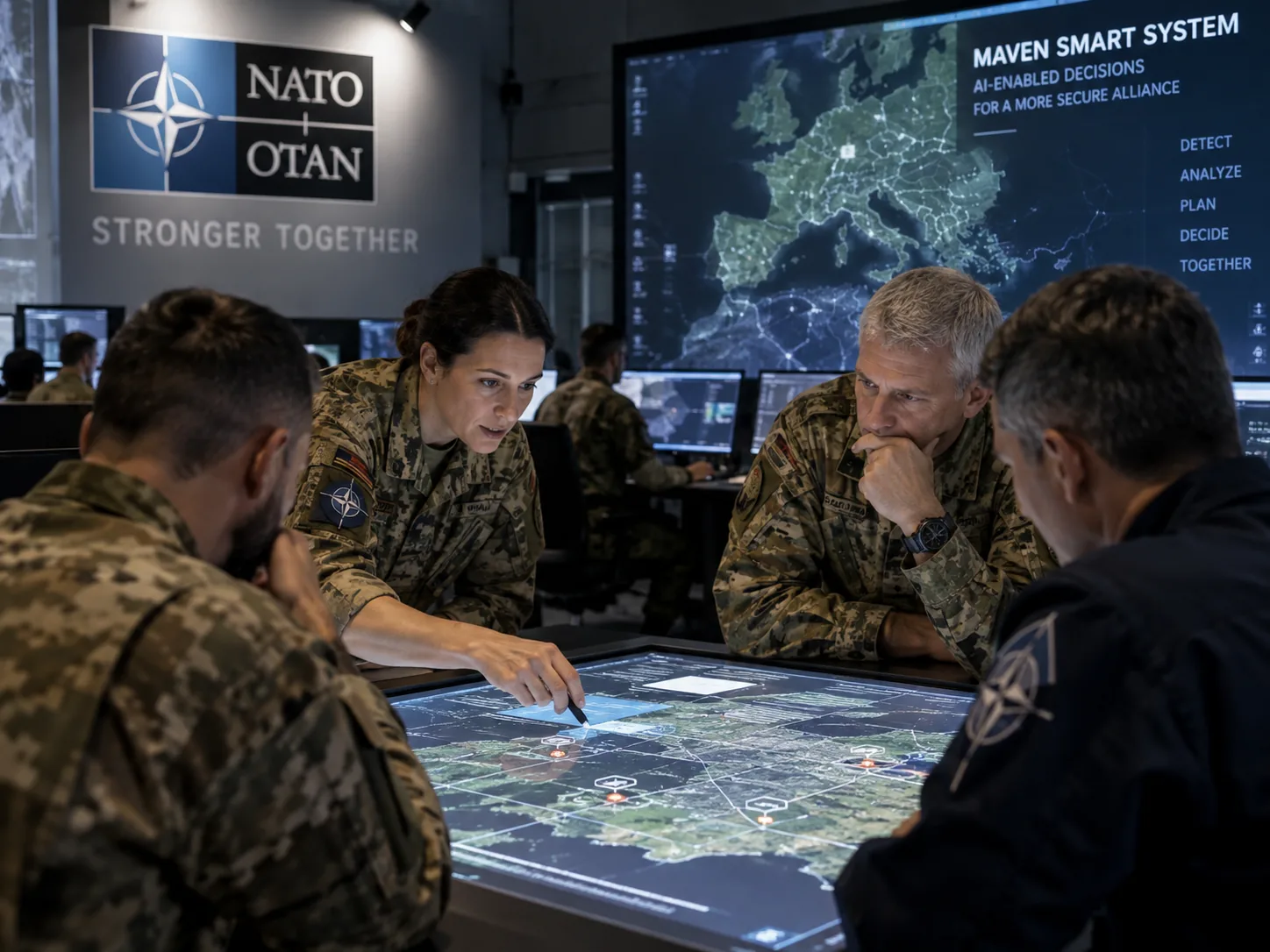
SynapseCommand was demonstrated at NATO's "FIGHT TONIGHT!" event at SHAPE on 6 September 2026, during an Allied Command Operations event focused on the NATO Maven Smart System digital battlespace.
This participation does not constitute NATO certification, endorsement or evidence of a completed technical integration with MSS NATO. It is reported here by SynapseCommand rather than independently verified by NATO.
The demonstration provides relevant context for the environment in which SynapseCommand's decision-intelligence approach is being developed and evaluated, following selection in the NATO DIANA Decision Superiority for NATO Warfighters Challenge.
Interoperability becomes strategic infrastructure for military AI
As Maven-style environments expand, interoperability becomes more valuable rather than less.
An AI capability that can reason only over information contained inside a single application sees only part of the operational environment.
A decision layer able to consume normalised information from multiple sensors, C2 platforms and mission systems can work from a much richer picture.
SynapseCommand therefore separates interoperability from the decision runtime.
Its integration architecture maps external operational information into a common canonical model before that information reaches the agent layer.
Current interoperability work includes EUROCONTROL ASTERIX, STANAG 4607 GMTI, STANAG 4676 NITS, STANAG 4609, STANAG 4586, Cursor-on-Target and TAK, ADS-B and AIS.
For each supported standard, SynapseCommand publishes implementation information describing what is supported, the direction of exchange and the evidence behind the claim.
The principle is simple: inspect the contract before you integrate.
Maven Smart System versus traditional C2 software
Traditional command-and-control software primarily helps personnel collect, exchange, organise and display operational information.
An AI-enabled environment such as Maven can add machine analysis across that information and increasingly connect multiple military functions around a common data foundation.
A decision-intelligence layer adds another function.
It uses the operational picture to support structured reasoning about possible actions.
The three roles can therefore be complementary. C2 systems establish and distribute the operational picture. Data and AI environments such as Maven help integrate, analyse and exploit that picture. Decision-intelligence systems such as SynapseCommand can help develop, constrain, compare and review courses of action before an authorised human decision.
The boundaries will vary between systems and deployments, but separating these functions helps explain the emerging architecture of AI-enabled command and control.
Sovereign AI becomes more important as AI moves deeper into C2
The closer artificial intelligence moves to command workflows, the more important deployment architecture becomes.
Military organisations cannot assume permanent access to public cloud infrastructure.
Sensitive operational information may need to remain inside national or Alliance security boundaries.
Connectivity may be degraded or unavailable.
Models and data may need to remain under the control of the organisation operating the capability.
SynapseCommand is therefore designed for self-hosted and disconnected operation.
AI models can run inside the deployment environment without requiring external AI calls at runtime.
This is not simply a hosting preference.
In military C2, sovereignty, resilience and operational continuity are architectural requirements.
From more data to better decisions
The latest developments around Maven Smart System illustrate a wider change in defence technology.
The first phase of military digitisation was about moving information from paper into software.
The next phase connected systems and created shared operational pictures.
The emerging phase is about turning that information into decision advantage.
That requires more than collecting additional data.
It requires systems capable of combining operational information, preserving its provenance, applying appropriate machine analysis, understanding constraints, generating useful options and keeping humans responsible for consequential decisions.
The expansion of Maven across U.S. military functions provides a strong signal of this direction.
NATO's rapid deployment of Maven Smart System NATO demonstrates the same broader shift inside the Alliance.
The next competitive question in military AI is therefore unlikely to be simply: who has the best model?
A more important question may be: who can connect the operational picture to a faster, better-supported and accountable command decision?
That is the problem SynapseCommand is being built to solve.
Further reading: SynapseCommand compatibility with NATO Maven Smart System sets out the current Integration-ready status, the supported interfaces and the limits of what has been demonstrated.
Frequently asked questions
What is Maven Smart System?
Maven Smart System, or MSS, is an AI-enabled military platform used to integrate operational data, analytics and artificial intelligence in support of intelligence, operations and military decision-making. The U.S. Department of Defense is expanding its use into areas including readiness, logistics, supply chains, budgeting, force disposition, modeling and simulation.
Is Maven Smart System the same as Project Maven?
They are related but not identical. Project Maven is the U.S. Department of Defense programme that applied machine learning to intelligence data, in particular imagery and full-motion video. Maven Smart System is the software environment that grew out of that programme and is used today to bring operational data, analytics and AI together.
Who developed Maven Smart System?
Maven Smart System is delivered by Palantir Technologies for the U.S. Department of Defense. Palantir is also the industry partner for the separate NATO capability acquired by the NATO Communications and Information Agency in March 2025.
What is the relationship between Maven Smart System and CJADC2?
Combined Joint All-Domain Command and Control, or CJADC2, is the U.S. concept for connecting sensors, decision-makers and effects across domains and with allies. Maven is discussed in that context because it addresses one of the concept's practical requirements: making operational data from many separate systems usable together.
What is Maven Smart System NATO?
Maven Smart System NATO, also called MSS NATO or NATO Maven Smart System, is an AI-enabled warfighting capability acquired for NATO Allied Command Operations. NATO uses it to support functions including intelligence fusion, targeting, battlespace awareness, planning and accelerated decision-making.
Is Maven Smart System NATO the same as the U.S. Maven Smart System?
No. They are related Maven-based environments, but MSS NATO is NATO's capability operated within the Alliance context. Statements about the U.S. Department of Defense implementation should not automatically be assumed to describe NATO's deployment.
How does Maven Smart System use AI?
Maven combines operational data with AI and analytical capabilities to help users process information, identify relevant patterns, build situational awareness and support military workflows. The U.S. implementation is increasingly extending those capabilities across multiple organisational functions.
Why is Maven important for military command and control?
Maven illustrates the shift from isolated military applications toward integrated data environments that connect sensors, operational information, machine analysis and decision-making. This can reduce the time needed to turn information into usable operational understanding.
What is the difference between Maven Smart System and SynapseCommand?
Maven provides a broad data and AI environment for operational workflows. SynapseCommand is designed as a sovereign decision-intelligence layer that can operate alongside existing C2 environments, consume operational information, support course-of-action development and comparison, preserve human decision authority and maintain an inspectable decision record.
Does NATO endorse SynapseCommand?
No. Participation in NATO programmes, exercises or demonstrations does not constitute NATO endorsement, certification, procurement or operational deployment. Decent Cybersecurity is a selected NATO DIANA innovator in the Decision Superiority for NATO Warfighters Challenge, and SynapseCommand has been demonstrated at an Allied Command Operations event at SHAPE.
Sources
- Defense One9 September 2026
Maven is becoming the Pentagon's everything app
Principal source for the September 2026 reporting concerning expansion of the U.S. Maven Smart System into readiness, force disposition, logistics, supply-chain information, budgeting, modeling and simulation. Reporting by John Croxton.
Read the original Defense One report - NATO Communications and Information Agency14 April 2025
NATO acquires AI-enabled warfighting system
Primary NATO source confirming that NCIA and Palantir Technologies finalised the acquisition of Maven Smart System NATO on 25 March 2025 for Allied Command Operations, and describing intelligence fusion, targeting, battlespace awareness, planning and accelerated decision-making functions.
Read the NCIA announcement - NATO Joint Warfare Centre25 August 2025
The Joint Warfare Centre Trains to Integrate Maven Smart System
Primary NATO source concerning MSS NATO deployment, training and use in NATO exercises.
Read the Joint Warfare Centre article - NATO Communications and Information Agency
NCIA enables Steadfast Duel 25, NATO's largest computer-assisted command post exercise
Primary NATO source describing NATO Maven Smart System as the primary platform for warfighting integration during Steadfast Duel 25.
Read the Steadfast Duel 25 report - NATO Joint Warfare Centre12 August 2026
NATO Maven Smart System Achieves Full Technical Operational Capability
Primary NATO source confirming that NATO Maven Smart System achieved full technical operational capability on 22 June 2026 after meeting Allied Command Operations requirements.
Read the full technical operational capability report - SynapseCommand6 September 2026
SynapseCommand Demonstrated at NATO "FIGHT TONIGHT!" Event at SHAPE
SynapseCommand source documenting its demonstration at SHAPE. It is evidence of the demonstration only, and not of NATO certification, endorsement or a completed MSS NATO integration.
Read the SynapseCommand report - SynapseCommand
NATO Maven Smart System Compatibility
SynapseCommand compatibility documentation defining the current status as Integration-ready and explicitly qualifying that a validated end-to-end MSS NATO integration has not been completed.
Read the compatibility record
Decent Cybersecurity is a European defence deeptech specialising in sovereign AI, post-quantum cryptography and quantum-resistant blockchain, holding NATO SECRET facility clearance, ISO 9001 and ISO 27001 certifications, and participating in EU EDF: AIDA (Artificial Intelligence Deployable Agent) as a consortium participant and NATO DIANA as a selected innovator. The company operates entities in Slovakia, Czechia, Poland, Austria, Ireland, the United Kingdom, Canada and the United States. Download the capability brief.