

By Decent Cybersecurity, publisher of SynapseCommand®
Decent Cybersecurity at AUSA 2026 with SynapseCommand
Decent Cybersecurity attended AUSA 2026 with SynapseCommand, connecting sovereign military AI, U.S. Army modernisation priorities and its American presence through Decent Cybersecurity USA Inc.
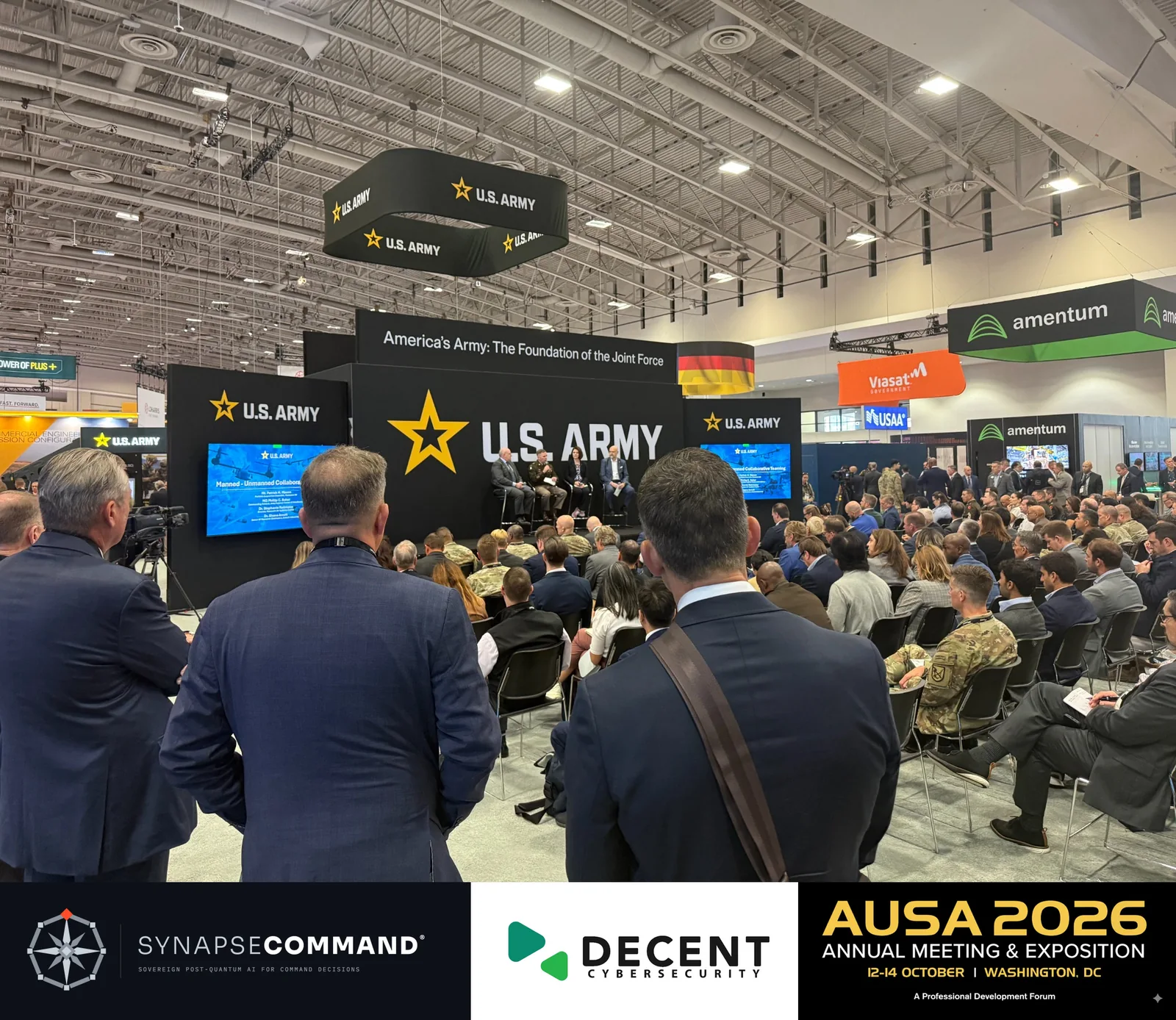
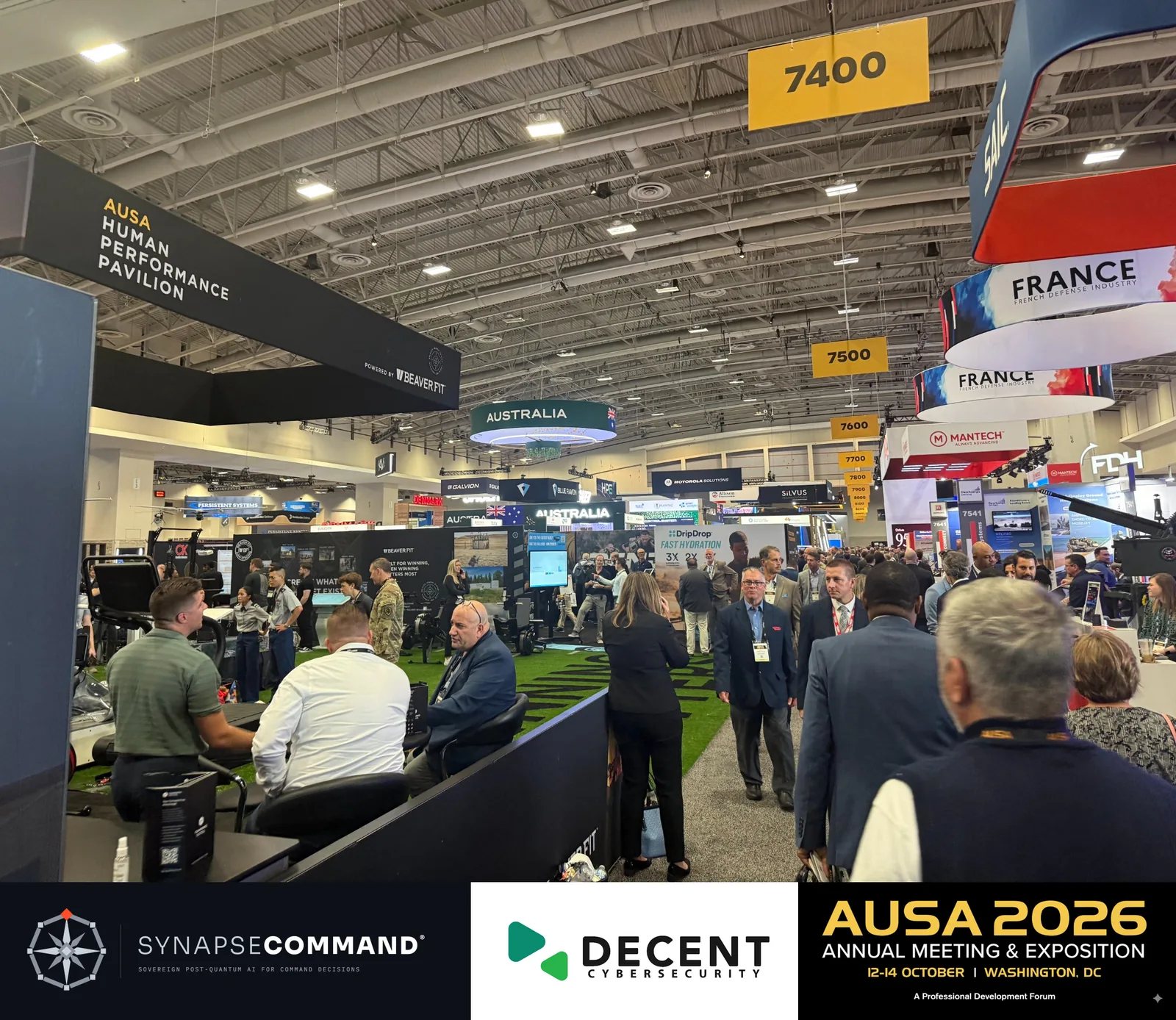
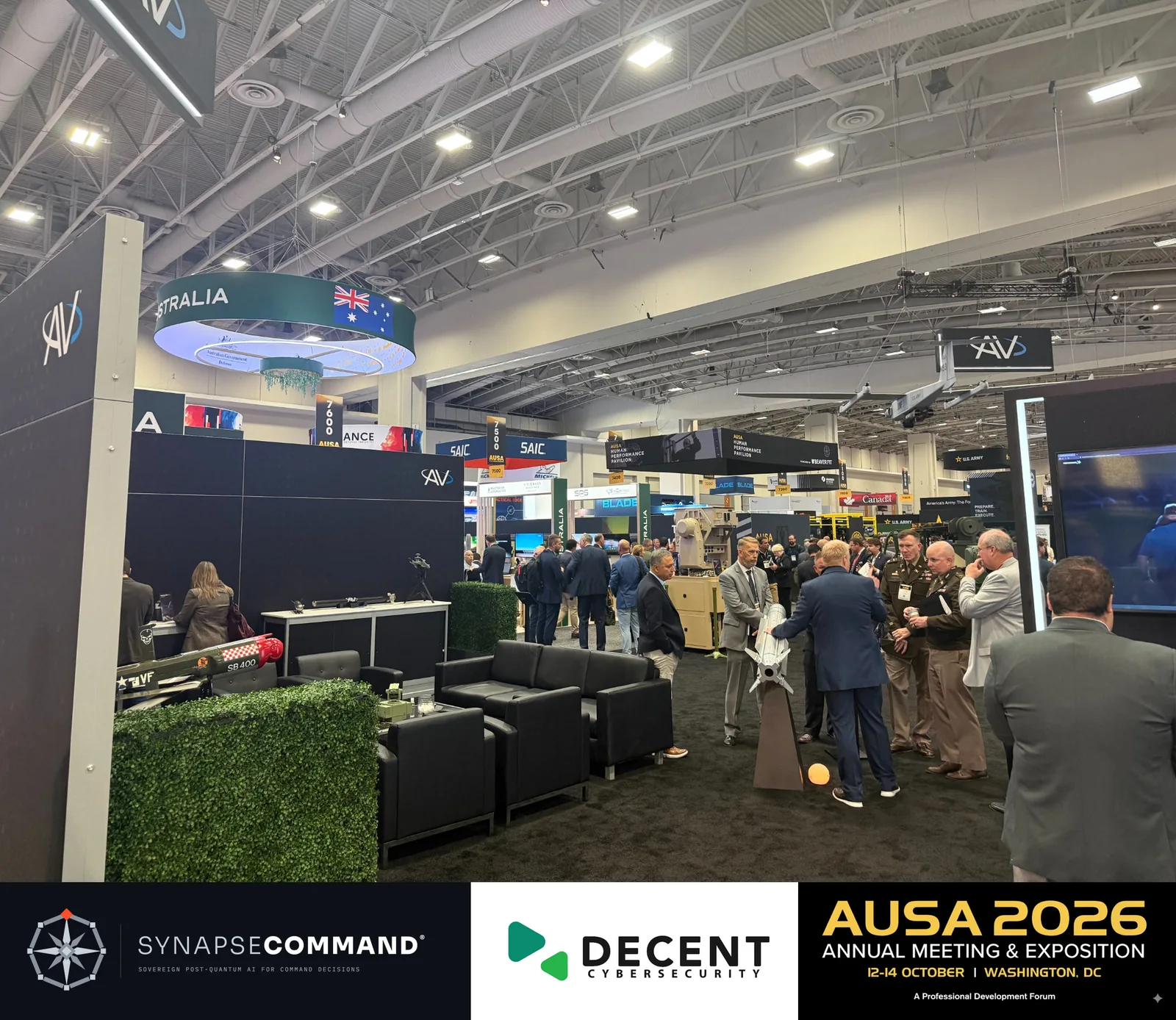
Decent Cybersecurity attended the Association of the United States Army’s Annual Meeting and Exposition in Washington, D.C., with SynapseCommand®, its sovereign multi-agent artificial intelligence platform for military command. Held from 12 to 14 October 2026 at the Walter E. Washington Convention Center, AUSA 2026 brought the company’s work on military decision support into the U.S. Army’s annual gathering of soldiers, industry and international partners.
For Decent Cybersecurity, the subject is concrete: how can a headquarters make better use of information without losing control of its decisions? SynapseCommand supports that work alongside existing command systems. The company also has a U.S. corporate presence through Decent Cybersecurity USA Inc., connecting its European development work with the American defence market.
At a glance
| Item | Detail |
|---|---|
| Event | AUSA Annual Meeting and Exposition 2026 |
| Dates | 12 to 14 October 2026 |
| Location | Walter E. Washington Convention Center, Washington, D.C. |
| Company | Decent Cybersecurity |
| U.S. presence | Decent Cybersecurity USA Inc. |
| Platform | SynapseCommand sovereign multi-agent AI for military command |
| Relevance | Decision support alongside existing C2, human authority, interoperability and auditable outputs |
AUSA 2026 and the move towards integrated autonomy
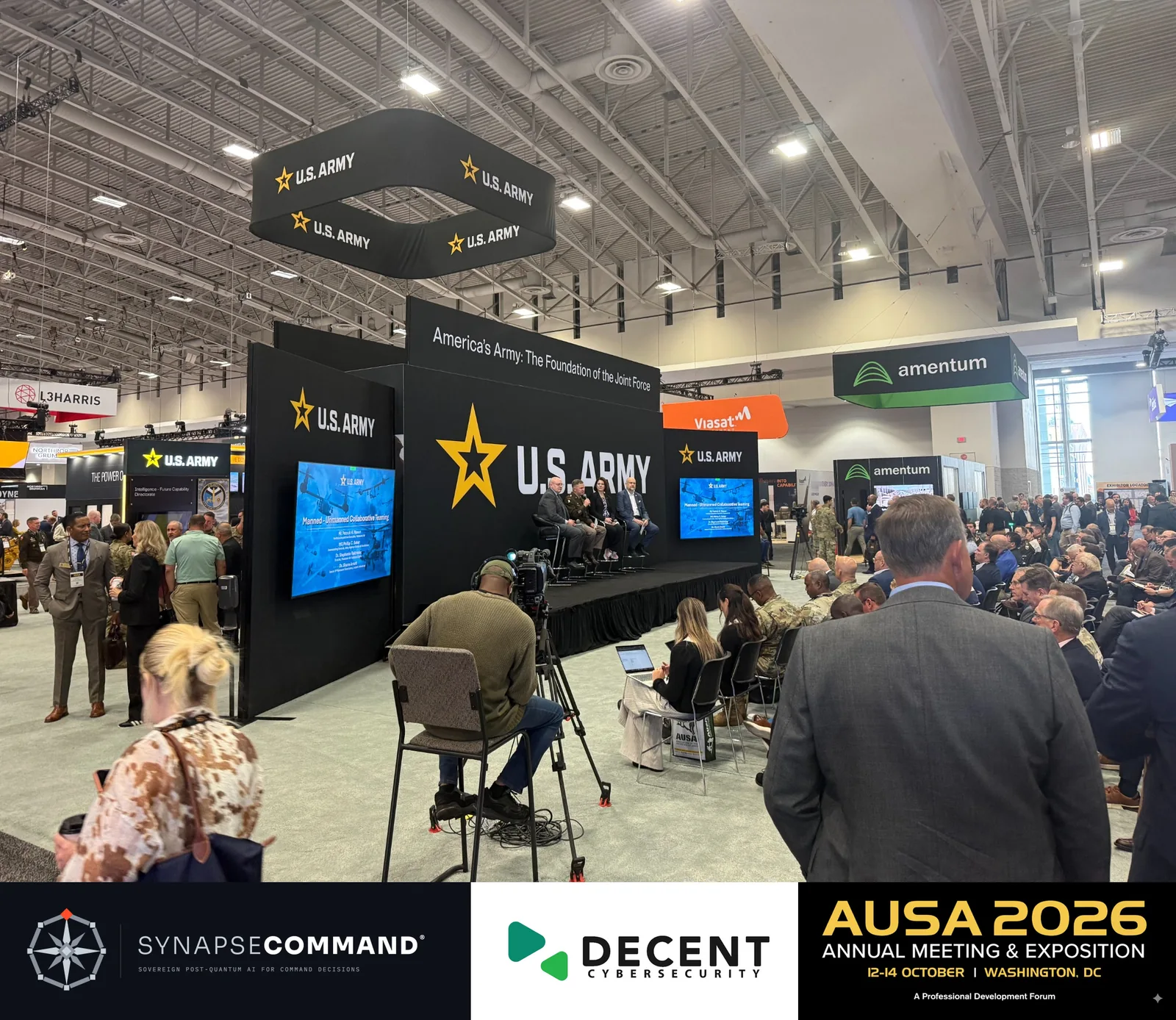
Under the theme “America’s Army: The Foundation of the Joint Force,” the meeting brought military requirements, industrial development and international participation into the same forum. The U.S. Army’s published AUSA programme included sessions addressing integrated autonomy, data-centric operations, scaling command and control for joint operations, and AI-enabled cyber defence. The programme put command software and information exchange alongside the equipment on the exhibition floor.
The event also followed a concrete organisational development. On 2 October, the U.S. Army announced a directive to establish Futures and Autonomous Systems Command. The announcement described work to integrate autonomous capabilities across aviation, armour, fires, sustainment, engineer and training formations, together with changes to acquisition and specialist personnel.
A headquarters receiving reports from more autonomous systems still has to establish what is current, what is uncertain and who can approve the next step. Adding another capable system can increase staff workload when its outputs do not fit the command process.
SynapseCommand addresses this staff work: interpreting information and comparing options within the command environment already in use.
U.S. Army budget priorities for FY2026 and FY2027
The Army’s budget requests show the scale of the modernisation effort behind these discussions. The Army’s original FY2026 budget request totalled $197.4 billion, including $5.4 billion in anticipated reconciliation funding. Its FY2027 budget request totalled $252.8 billion, rounded to $253 billion in the Army’s public announcement. These are the published presidential budget requests for the Army, rather than final expenditure figures or the budget of the entire U.S. military.
The Army’s FY2027 announcement proposed a 28.7% increase in discretionary procurement funding and a 12.9% increase in discretionary research and development funding. It connected these investments with force transformation, faster acquisition, industrial capacity and the introduction of next-generation capabilities. The FY2026 overview had already identified Next Generation Command and Control among its research and development priorities.
For SynapseCommand, the relevant connection is the need to make expanding capabilities usable within command workflows. More sensors, autonomous systems and modernised equipment generate additional information and coordination demands. Decision-support software must help staff interpret that information, compare options and maintain a traceable record of human approval. These are Army-wide investment priorities. Any SynapseCommand evaluation or acquisition would require its own defined requirement and funding decision.
U.S. presence through Decent Cybersecurity USA Inc.
Decent Cybersecurity has a U.S. corporate presence through Decent Cybersecurity USA Inc. AUSA formed part of the company’s engagement with the American defence community, alongside its European engineering work and NATO programme participation.
For prospective U.S. partners, the American entity provides a corporate point of engagement. The technical work begins with a specific staff problem, the systems that hold the relevant data, and the evidence a customer needs before adopting software. The company’s recent European activity included its SynapseCommand presentation at Rheinmetall Industry Supplier Day in Vienna. AUSA extended that international engagement to Washington.
The command problem behind the technology
A headquarters may receive a current position report, an older readiness return and a forecast derived from a different model. Displaying them together does not make them equally reliable or equally recent. Staff still need to establish their relevance, identify contradictions and understand how a changed assumption affects a recommendation.
SynapseCommand is designed to support this work alongside existing command-and-control systems, commonly abbreviated as C2. Its platform architecture combines specialised agents with an integration layer, a commander interface and a record of the reasoning process and outputs. Existing mission systems continue to supply the operational information and functions for which they are responsible.
An integration programme can start with one staff task, its inputs, the required output and the person authorised to approve it. That makes the evaluation testable. A fluent answer is of little use if it rests on an obsolete report or leaves the reviewer unable to trace a calculation.
For example, a headquarters evaluating a training plan could require an assistant to identify unsupported assumptions, compare resource demands and explain why an alternative changes the assessment.
Specialised agents for staff work
SynapseCommand’s agent suite assigns different analytical responsibilities to purpose-built modules. The published catalogue covers functions including intelligence, surveillance and reconnaissance fusion, force-posture assessment, scenario synthesis, course-of-action analysis, operational planning and lessons learned. Logistics, doctrine and other staff functions extend the scope of the suite, with maturity and verification status stated separately for individual modules.
Two capabilities illustrate the intended relationship between analysis and staff production.
The COA Analysis Engine supports the comparison of courses of action, or COAs. Its documentation describes the use of reinforcement learning, Bayesian causal models and Monte Carlo simulation to explore alternatives and their uncertainty. Ranking criteria are adjustable by the commander, and sensitivity analysis helps identify where a conclusion depends on particular assumptions. The engine presents alternatives for a human decision.
The Operational Planning Agent supports the preparation of staff products using mission orders, commander guidance and staff estimates. Its documented outputs include draft annexes, synchronisation matrices and decision-support templates, with links back to the material that informed them. Staff review, amend and approve those products.
The recommendation, its supporting analysis and the draft staff product need to remain connected. If an assumption changes, staff should be able to identify which conclusions and documents need revision.
Integration starts with the meaning of the data
A major integration challenge is preserving meaning as information moves between systems. A message can be syntactically valid while its timestamp, identifier, coordinate reference or confidence field is interpreted incorrectly by the receiving application.
SynapseCommand’s published canonical data model provides four principal object types: entities, events, tracks and plan objects. These represent things that exist, occurrences, position histories and output objects. The documentation also records source-system and adapter information, external identifiers and explicit distinctions between synthetic and operational data.
The interoperability register gives engineers a way to inspect implemented standards and exchange directions. Those distinctions matter in exercises and subsequent evaluation. A simulated observation must remain recognisable as simulated as it moves through an analytical workflow. Likewise, an original identifier needs to survive translation if an operator is to trace an assessment back to the source record.
The compatibility catalogue distinguishes a published format adapter from a working connection to a named system. It also distinguishes architectural readiness from validated end-to-end integration. For example, the catalogue lists NATO Maven Smart System as integration-ready and describes TAK Server coverage in terms of an available Cursor-on-Target format adapter, without claiming that the adapter itself is a TAK Server connector.
For an acquisition team, this creates a useful set of questions: which interface exists, which direction of exchange is implemented, which configuration was tested, and which work remains specific to the customer environment? Answering those questions is part of delivering interoperability.
CommanderNL and human decision authority
CommanderNL™ is the natural-language interface through which operators task the SynapseCommand stack and receive ranked, explainable options. The published architecture places it above the agent and orchestration layers, connecting user intent with the relevant analytical functions.
A natural-language interface can make a complex system easier to access, but the authority boundary must remain explicit. A request to prepare an assessment is different from permission to approve a plan or execute an irreversible action. Identity, role permissions and approval gates therefore need to operate throughout the workflow.
SynapseCommand’s documented approach combines role-based controls, approved-model checks and human authorisation requirements. Its planning module produces drafts for review, while its COA module ranks options without selecting the commander’s decision.
More autonomous systems make these approval boundaries increasingly important. Automation can perform bounded tasks and present evidence, while command authority remains attributable to the responsible person. A reviewer should be able to determine what the system recommended, what the human approved and whether the authorised action matched the approved scope.
Sovereignty under operational constraints
For defence users, sovereignty includes control over the environment in which analysis takes place. It affects where source data resides, who controls models and configuration, how updates enter the system and whether essential functions depend on an external service.
SynapseCommand’s deployment documentation describes customer-controlled sovereign cloud, on-premises and air-gapped options, without a mandatory external inference service. It distinguishes the designated cloud environment used for the NATO DIANA demonstration from potential production deployment models.
Its federation approach is also relevant to coalition operations. The reference architecture retains source records at their originating nodes while permitting authorised queries, derived outputs and required provenance information to cross boundaries under an agreed release policy.
Information exchange therefore has to follow permission and need. Shared analysis does not remove national responsibilities for protecting source material. Integrators still need to define release rules, identity handling, classification markings and how a receiving system treats incomplete or withheld information.
Disconnected operation introduces another constraint: local processing cannot make an unavailable feed current. An evaluation should examine whether operators can recognise stale information, understand the limitations of an offline result and reconcile changes when connectivity returns. Deployment approval and accreditation remain specific to the environment and configuration.
Cryptographic evidence for decisions that must be reviewed
SynapseCommand’s decision-quality evidence describes a separation between language-model generation and deterministic services responsible for calculations, policy evaluation and source-record retrieval. It also describes a hash-chained decision ledger recording software and configuration information so that outputs can be examined after the event.
Where an appropriate signing key is configured, the documentation specifies ML-DSA signatures for decision records. ML-DSA is the post-quantum digital-signature algorithm standardised by the U.S. National Institute of Standards and Technology in FIPS 204. Digital signatures support verification of record integrity and the signing identity.
These mechanisms address the integrity of the evidence. They do not establish that a source report was accurate, that an analytical model was suitable or that a recommendation was correct. Those questions require separate testing and professional judgement. Use of a standardised algorithm also does not, by itself, establish certification of the complete product.
The decision record links inputs, software configuration, analysis and approval. That record can support after-action review, investigation of a disputed output and comparison between software versions. It makes it possible to examine how a result was reached rather than relying on an isolated screenshot or a retrospective explanation.
A NATO programme connection with a defined scope
Decent Cybersecurity’s attendance at AUSA took place during its participation in NATO DIANA’s Decision Superiority for NATO Warfighters Challenge.
NATO’s announcement of 13 July 2026 names Decent Cybersecurity among ten selected companies. The programme, delivered with Allied Command Operations, provides €100,000 in contractual funding to each company for integration and demonstration work, with a demonstration phase planned by December 2026.
The announcement identifies modelling and simulation, operational wargaming and analytical support as areas of focus. It also describes the intention to augment existing digital warfighting environments, including Maven Smart System NATO.
The DIANA challenge description sets out a process of use-case discovery, technical feasibility work and iteration with NATO stakeholders. Successful demonstrations may create opportunities for follow-on activity. Selection is an established programme milestone; it is not evidence that every proposed integration has already been fielded.
This NATO DIANA participation gives SynapseCommand a development setting for questions also relevant to the AUSA audience: how to integrate analytical software with existing command environments, how to evaluate it with users and how to produce evidence that supports adoption decisions.
What a meaningful evaluation should measure
For prospective users and integration partners, the next useful step is a bounded evaluation with agreed inputs, expected outputs and acceptance criteria. A useful evaluation would address the following priorities.
Evaluation priorities
| Priority | Question for the evaluation |
|---|---|
| Staff workload | Does the workflow reduce the effort needed to prepare a usable assessment, including human review? |
| Source traceability | Can a reviewer trace significant statements and calculations to their inputs? |
| Uncertainty | Are missing, stale and contradictory inputs visible to the operator? |
| Human authority | Are restricted actions blocked until the correct approval is recorded? |
| Integration | Does the complete exchange work with the actual customer system and configuration? |
| Resilience | What remains usable when feeds or connectivity are unavailable? |
| Change control | Can evaluators identify how a model, software or configuration update changes behaviour? |
SynapseCommand publishes a first-party verification baseline dated 27 August 2026, covering deterministic tool checks, model-bearing evaluations and structural tests. That evidence provides a starting point for technical review. Customer acceptance still needs to address the intended task, data, users and deployment conditions.
An evaluation should also assess the total workflow. A faster initial answer offers limited benefit if staff must spend longer correcting its assumptions or tracing its sources. Measures of speed become more informative when paired with accuracy, review effort, reproducibility and the handling of unavailable information.
A transatlantic role for sovereign decision support
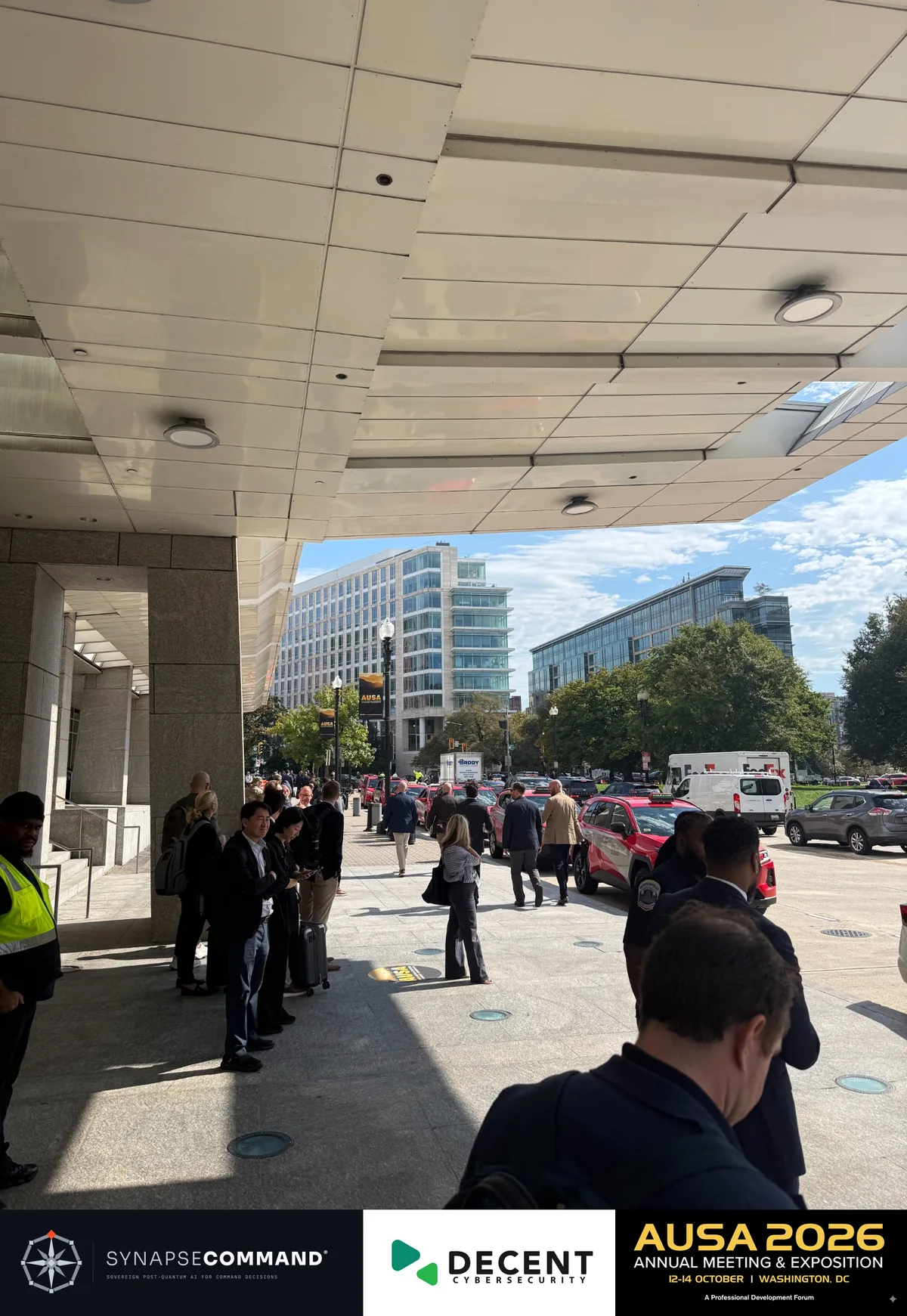
AUSA 2026 brought the American defence market into the same frame as Decent Cybersecurity’s European development work and NATO DIANA participation. Decent Cybersecurity USA Inc. gives that transatlantic activity a U.S. corporate presence.
For commanders, the central issue is whether assistance produces clearer, better-supported options while preserving authority. For integrators, it is whether interfaces, data semantics and security boundaries can be made to work in the intended environment. For acquisition teams, it is whether the evidence supports a defined operational requirement and a credible route through evaluation.
For SynapseCommand, progress will be measured in the staff tasks it can support, the integrations it can demonstrate and the decisions a customer can reconstruct. Those are the questions that should shape the next technical discussion after AUSA.
Organisations evaluating the platform can request a technical briefing focused on their command workflow, data interfaces, deployment constraints and evidence requirements.
SynapseCommand® is a product of Decent Cybersecurity. Photographs supplied by Decent Cybersecurity.