
By Decent Cybersecurity, publisher of SynapseCommand®
SynapseCommand at Future Forces 2026: Sovereign AI for Czech and Allied Defence
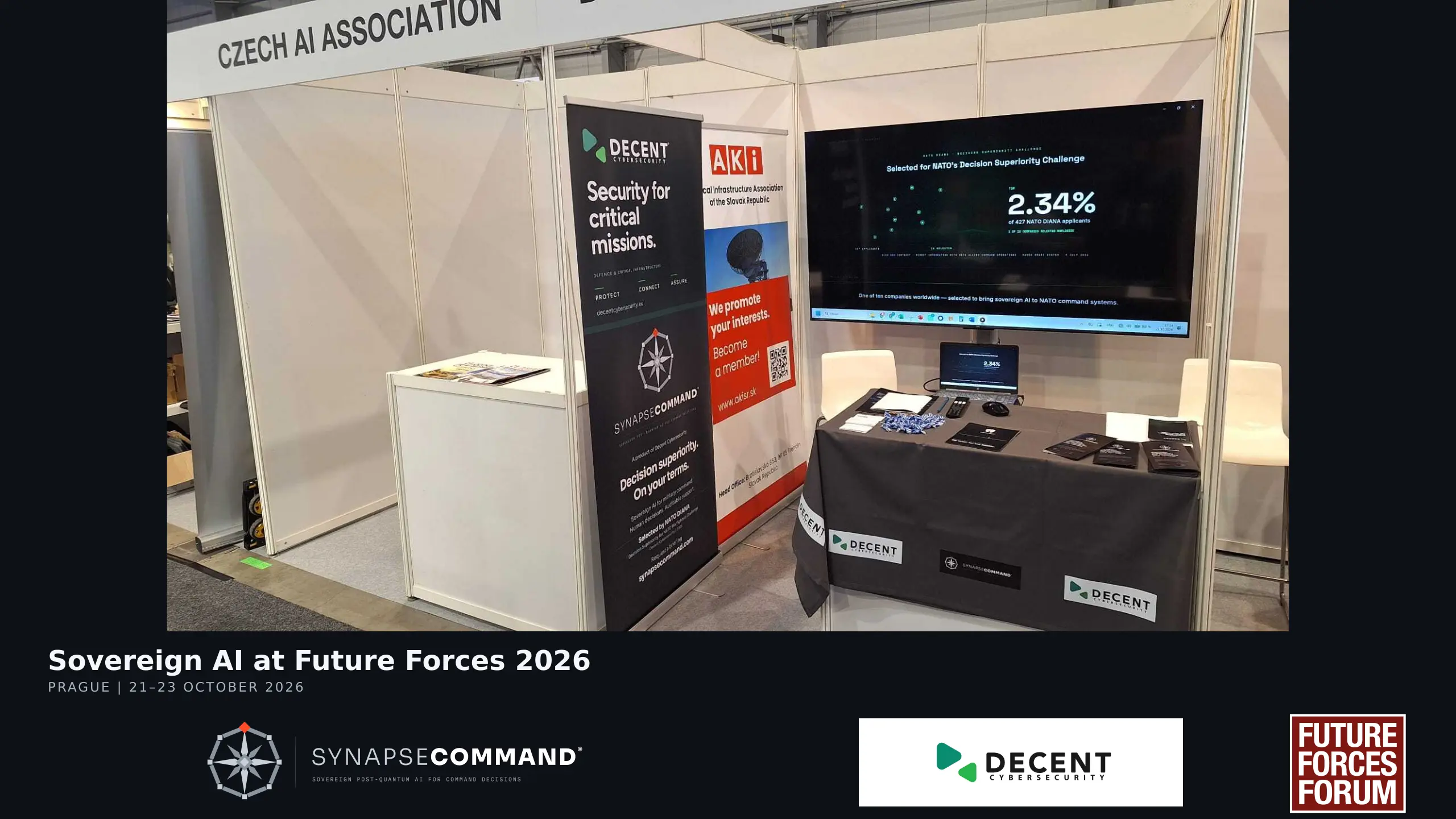
Decent Cybersecurity presented SynapseCommand® at Future Forces Exhibition & Forum in Prague on 21–23 October 2026, bringing its sovereign military AI platform to discussions with Czech and international defence stakeholders. At stand H2/270, the team introduced an approach that combines national control over AI with integration into Allied command environments, including NATO Maven Smart System. The event followed the company's selection for NATO DIANA's Decision Superiority for NATO Warfighters Challenge: one of ten selected companies from a field the company reports comprised 427 submissions.
Engaging the Czech and Allied defence community
Held at PVA EXPO Prague in Letňany, Future Forces provided a setting for direct engagement with military users, public institutions, industry and researchers. Decent Cybersecurity's team included Karel Marčík, Magdaléna Zlevorová and Michaela Abel.
Visitors to the stand included specialists from the armed forces, government and private sector, alongside students interested in cybersecurity and defence technology. Representatives of the Canadian and French embassies also visited. Beyond the exhibition stand, the team held discussions with Czech defence stakeholders and took part in networking organised by Defence Hub CzechInvest.
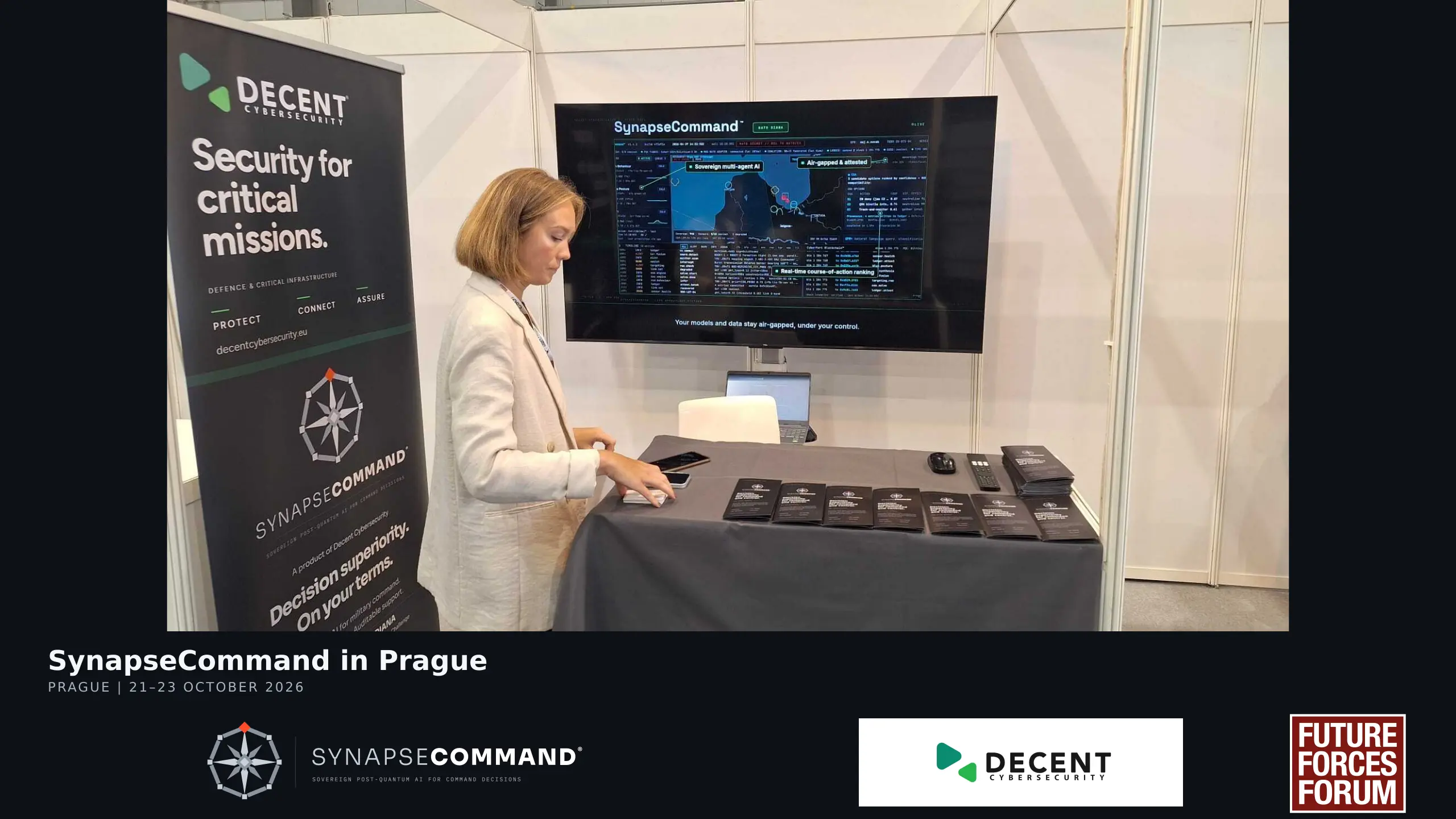
The presentation centred on SynapseCommand's sovereign AI platform: specialist agents that support staff analysis and command decisions on infrastructure controlled by the customer. For prospective users, the practical discussion is how such a capability can work with their existing information systems, security boundaries and decision procedures.
Why AI sovereignty matters for the Czech Republic
For the Czech Republic, defence AI sovereignty means retaining the ability to operate, govern and adapt systems that support national security. Hosting location is one part of that requirement. Control also extends to the data used by the system, the models it runs, the authority to approve changes, and the conditions under which information may be shared.
That has an industrial dimension. The Czech National Artificial Intelligence Strategy 2030, approved in July 2024, sets out an ambition for the country to develop advanced AI technologies as well as use them. Its priorities include research, skills, security and cooperation between industry and academia. In defence, the implication is practical: national institutions need both useful technology and the expertise to evaluate, integrate and sustain it.
Four questions make sovereignty concrete for a defence organisation:
- Data control: who can access operational information, and which authority decides what leaves the national security boundary?
- Model control: who selects and evaluates the models, approves updates and determines whether their behaviour is acceptable for the intended task?
- Operational continuity: can essential analysis continue when external connectivity or a remote service is unavailable?
- Decision authority: can an authorised person inspect the basis of a recommendation, approve consequential action and reconstruct the decision afterwards?
SynapseCommand's deployment architecture is designed around customer-controlled infrastructure, including on-premises and air-gapped environments, without a mandatory external inference service. Its trust and assurance framework combines human decision authority with traceable decision records. Each deployment still requires its own security assessment, configuration and acceptance by the responsible authority.
These considerations extend to other nations. An Ally may need to protect sensitive national sources while contributing useful information to a coalition. Sovereignty therefore depends on being able to define and enforce sharing rules, maintain domestic competence and sustain critical functions through disruption. Allied cooperation is stronger when those responsibilities are explicit.
Sovereign AI connected to NATO Maven Smart System
SynapseCommand is integrated with NATO Maven Smart System, according to the published NATO-Maven Smart System integration record, whose status was confirmed by the product owner on 25 October 2026. This is a confirmation date, rather than the date the integration was achieved. The public record does not specify its version, environment or operational deployment scope.
The wider context is NATO's adoption of AI-enabled command capabilities. The NATO Communications and Information Agency announced that it finalised acquisition of Palantir's Maven Smart System NATO for Allied Command Operations on 25 March 2025. The platform brings together information and analytical capabilities to support military planning and decision-making.
SynapseCommand's role is to add a sovereign decision-support layer alongside existing command systems. Specialist agents help analyse information, develop and compare options, and preserve an inspectable record, while consequential decisions remain with authorised people. Its published interoperability layer provides a separate, inspectable account of supported defence data formats and adapters.
For Czech and other Allied organisations, this illustrates an important design principle: national control and coalition connectivity can be pursued together. The engineering task is to agree which information crosses a boundary, preserve its provenance and meaning, and ensure that access and decision rights remain enforceable. Integration status alone does not establish an accredited operational deployment or third-party endorsement.
NATO DIANA selection: one of ten from 427 submissions
NATO formally named Decent Cybersecurity among ten selected innovators in July 2026. The Decision Superiority for NATO Warfighters Challenge brings companies together with Allied Command Operations to develop and demonstrate capabilities that augment existing digital warfighting platforms, including MSS NATO.
Against the 427 submissions reported in SynapseCommand's programme information, ten selections represent approximately 2.34% of the submission pool. Decent Cybersecurity's “top 2.34%” distinction refers to its place in that selected cohort, rather than a published comparative ranking of company performance.
The programme connects innovation with military user requirements through integration, iteration and demonstration. NATO's announcement identifies a demonstration phase by December 2026. SynapseCommand's work with Task Force Maven provides the programme context for that engagement; selection itself is distinct from a procurement award or operational deployment.
From Prague discussions to practical cooperation
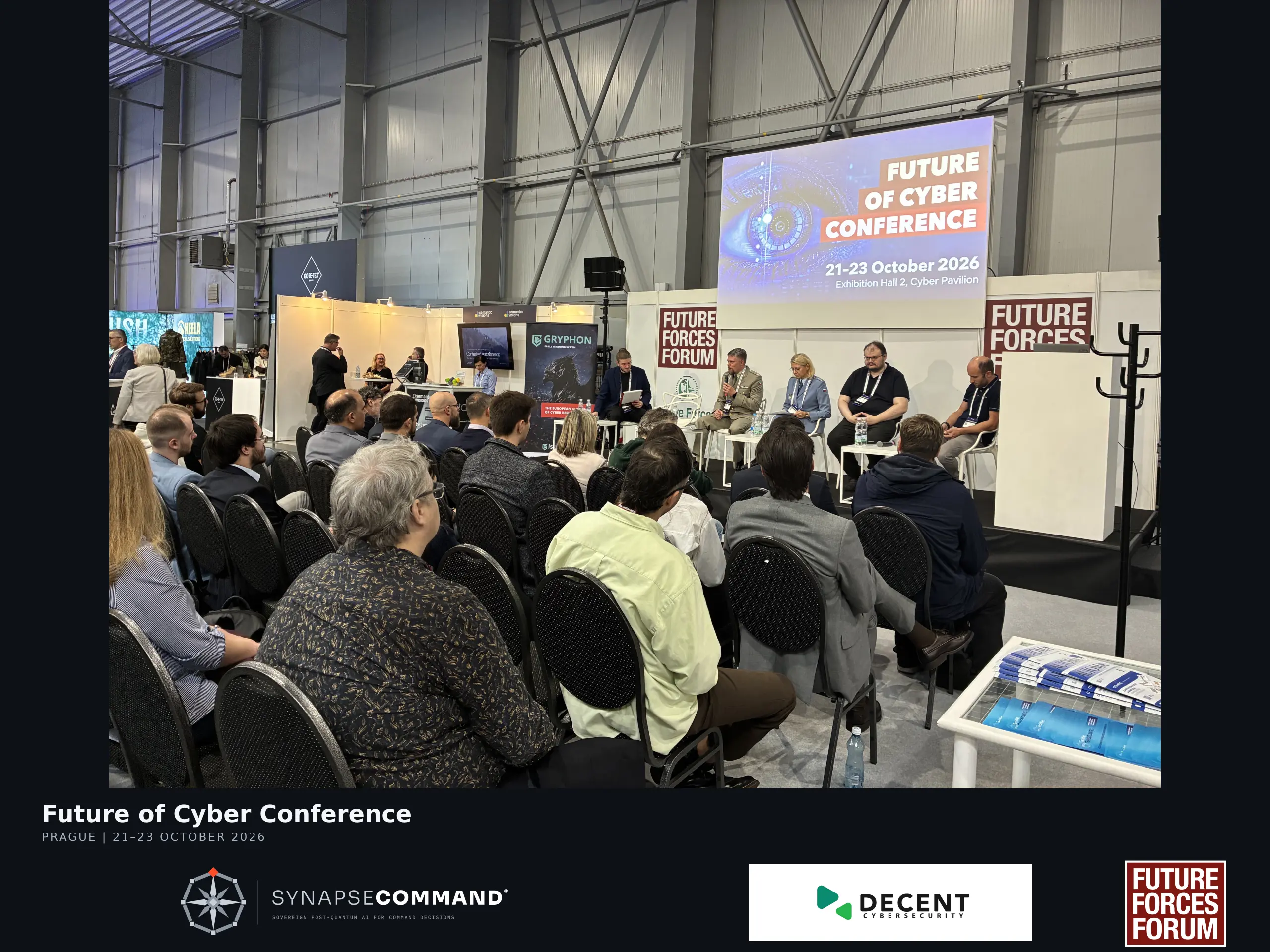
Future Forces extended SynapseCommand's engagement with Czech defence institutions and the wider Allied technology community. The team is following up on the contacts and opportunities identified in Prague, with the focus on matching operational needs to suitable evaluation and integration work.
For organisations exploring sovereign military AI, the next useful step is a focused technical discussion: the staff task to support, the information available, the deployment boundary and the evidence required to assess performance. These decisions turn a broad ambition for AI sovereignty into an implementable capability.
To discuss SynapseCommand for Czech or Allied defence requirements, contact the SynapseCommand team.