

By Decent Cybersecurity, publisher of SynapseCommand®
Introducing the SynapseCommand Warfighting Agent Suite
The current release of SynapseCommand presents the Warfighting Agent Suite in full, including the training-only White Force module that is compiled out of operational builds.
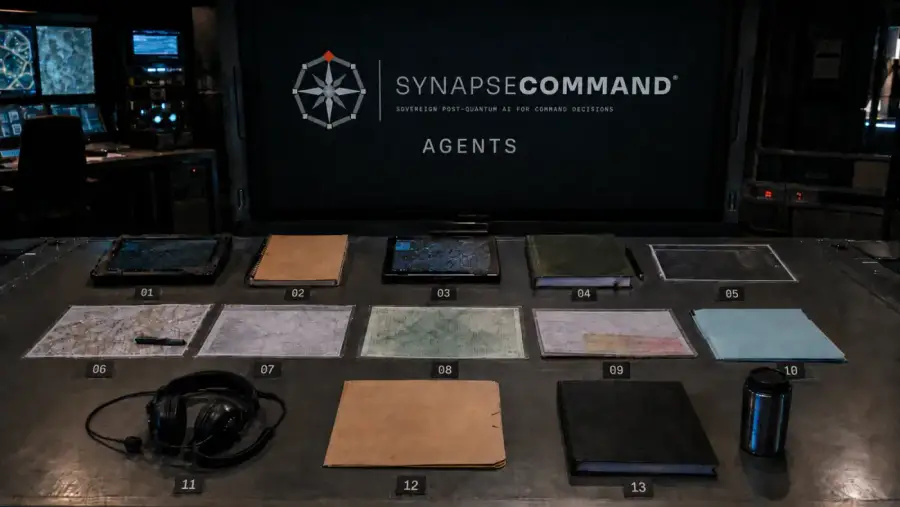
The current release of SynapseCommand® presents the Warfighting Agent Suite in full: doctrinally grounded agent modules, including a training-only White Force module that is compiled out of operational builds. Every agent follows the same pattern. Each is purpose-built around a doctrinal task, individually versioned, independently removable, and accountable through the platform's append-only decision records. The suite covers ISR fusion, red and blue force reasoning, scenario synthesis, course-of-action analysis, targeting and engagement, operational planning, lessons learned, logistics and sustainment, structured planning, strategy and doctrine, exercise control, and air tasking.
Five of those modules are described in detail below.
SC-LOG-01 · Logistics Agent
Decision support for sustainment and convoy planning. SC-LOG-01 separates recorded-state calculations from forecasts. Current stock, readiness, consumption and resupply figures are calculated from customer-held source data by deterministic services, so every current-state figure can be traced back to its source record. Forecasts may use approved analytical models calibrated on historical usage and are clearly labelled as forecasts with traceable inputs. A language model may support task interpretation, structured reasoning and explanation, but it does not generate the underlying source figures. SC-LOG-01 was originally developed as an internal reference implementation used to establish and exercise the platform's agent pattern, and it remains the most extensively exercised agent in the product.
SC-LNP-01 · Logic and Planning Agent
Structured reasoning and plan decomposition. The agent breaks a commander intent into ordered, checkable planning steps, making intermediate reasoning visible and inspectable. Staff can challenge a plan at the specific step where they disagree rather than accepting or rejecting it whole. It also serves the rest of the suite as a rigour layer, supplying structured task decomposition that other agents build on.
SC-STR-01 · Strategy and Doctrine Agent
Strategic-level and doctrinal analysis. The agent grounds operational recommendations in doctrinal sources and standing guidance, making alignment with doctrine an explicit, recorded step in the decision process rather than an assumption left to individual staff memory. Its assessments are written to the decision record alongside the recommendation they qualify.
SC-WHT-01 · White Force Agent
Exercise control for the training variant of SynapseCommand. The agent supports exercise directors with scenario adjudication, dynamic event injection and exercise management, enabling units to train against the same agent suite they would operate with. It ships only in the training variant, a deliberate separation that keeps exercise tooling out of operational deployments and out of operational accreditation scope.
SC-ATO-01 · Air Tasking Agent
Air tasking order workflows, delivered in the dedicated Air Tasking package. The air tasking cycle is among the most process-intensive activities in joint operations, with rigid timelines and heavy coordination demands. The agent supports development and management of the cycle within the same governed framework as the rest of the suite: outputs pass the evaluator, records are written to the decision ledger, and a human remains in command throughout.
Governance applies to every agent, without exception
Every agent inherits the full control set of the platform. Every answer follows one mandatory path: orchestrate, evaluate, append, deliver. A rejected answer returns its rejection reason to the commander, never the suppressed output. Every answer is written to the hash-chained decision ledger before a human sees it. With a signing key configured, each record carries an ML-DSA-87 (FIPS 204) signature; without one, the console reports the record as UNVERIFIED rather than presenting a false assurance. The models permitted to serve an answer are a register decision: a model tag that has not been approved is refused, never assumed acceptable, and the model that served each answer is recorded on the answer itself. SynapseCommand agent modules may combine deterministic software components, approved analytical models and, where appropriate, customer-approved self-hosted open-weight language models. Numerical calculations, policy evaluations and source-record retrieval remain separate from language-model generation. All model inference runs inside the customer's boundary, with zero external AI calls in runtime code, a property enforced by an automated test that parses every file in the codebase.
Verification
The suite is backed by the platform's standing verification programme: 1,287 test functions across 81 test files, 29 agent-side and 52 platform-side; 484 engine and conformance tests, including 8 conformance tests covering package isolation between agents, unique identifiers, endpoint presence and register completeness; and 418 offline tool assertions covering 361 tool invocations. The verification record holds 1,908 recorded model-bearing runs across 318 verification cases, one file per agent per model set, each capturing the commit, component versions, models used and per-case pass rates.
What this means for customers
Logistics, planning structure, doctrinal alignment, exercise control and air tasking sit alongside ISR, force reasoning, course-of-action analysis, targeting and planning in a single governed platform, reducing the number of disconnected tools a staff must operate. Deployment is modular. Each agent is independently deployable and can be removed without breaking the core platform runtime. Removing an agent also removes its functions and may disable or degrade declared dependent workflows, since agents exchange structured outputs and some supply a rigour layer to others. Dependencies are explicit and can be reviewed before deployment, so the platform keeps running and unaffected agents remain available, while the removed capability is genuinely absent rather than silently substituted. Each doctrinal task arrives already governed, already auditable and already under the customer's control.
Briefings on the suite are available under NDA. Classified briefings can be arranged through cleared channels. The SynapseCommand capability brief is available to download from this site.
Decent Cybersecurity is a European defence deeptech specialising in sovereign AI, post-quantum cryptography and quantum-resistant blockchain, holding NATO SECRET facility clearance, ISO 9001 and ISO 27001 certifications, and participating in EU EDF: AIDA (Artificial Intelligence Deployable Agent) as a consortium participant and NATO DIANA as a selected innovator. The company operates entities in Slovakia, Czechia, Poland, Austria, Ireland, the United Kingdom, Canada and the United States. Download the capability brief.