

By SynapseCommand
SynapseCommand at NATO Headquarters: Integrated Decision Support for Commanders and Watchstanders
Decent Cybersecurity demonstrated SynapseCommand, integrated into NATO Maven Smart System, at NATO Headquarters in Brussels as NATO DIANA’s first Dynamic Challenge concluded.
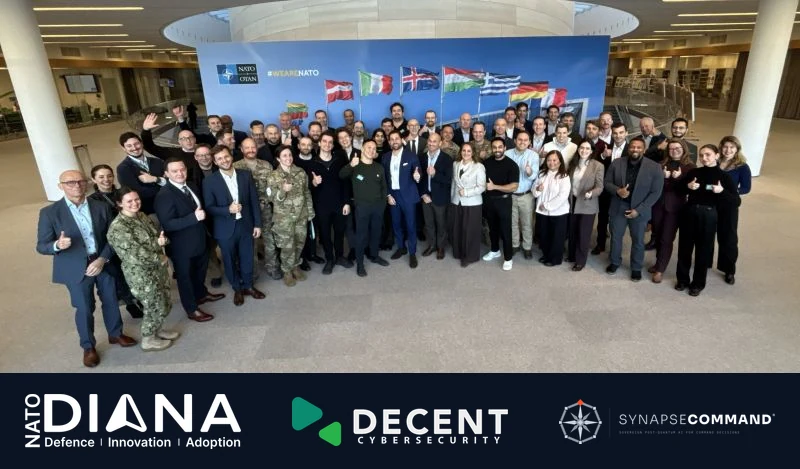
SynapseCommand is fully integrated into NATO’s Maven Smart System (MSS), developed by Palantir. On 24 November 2026, Decent Cybersecurity demonstrated the capability at NATO Headquarters in Brussels as NATO DIANA’s first Dynamic Challenge reached its conclusion.
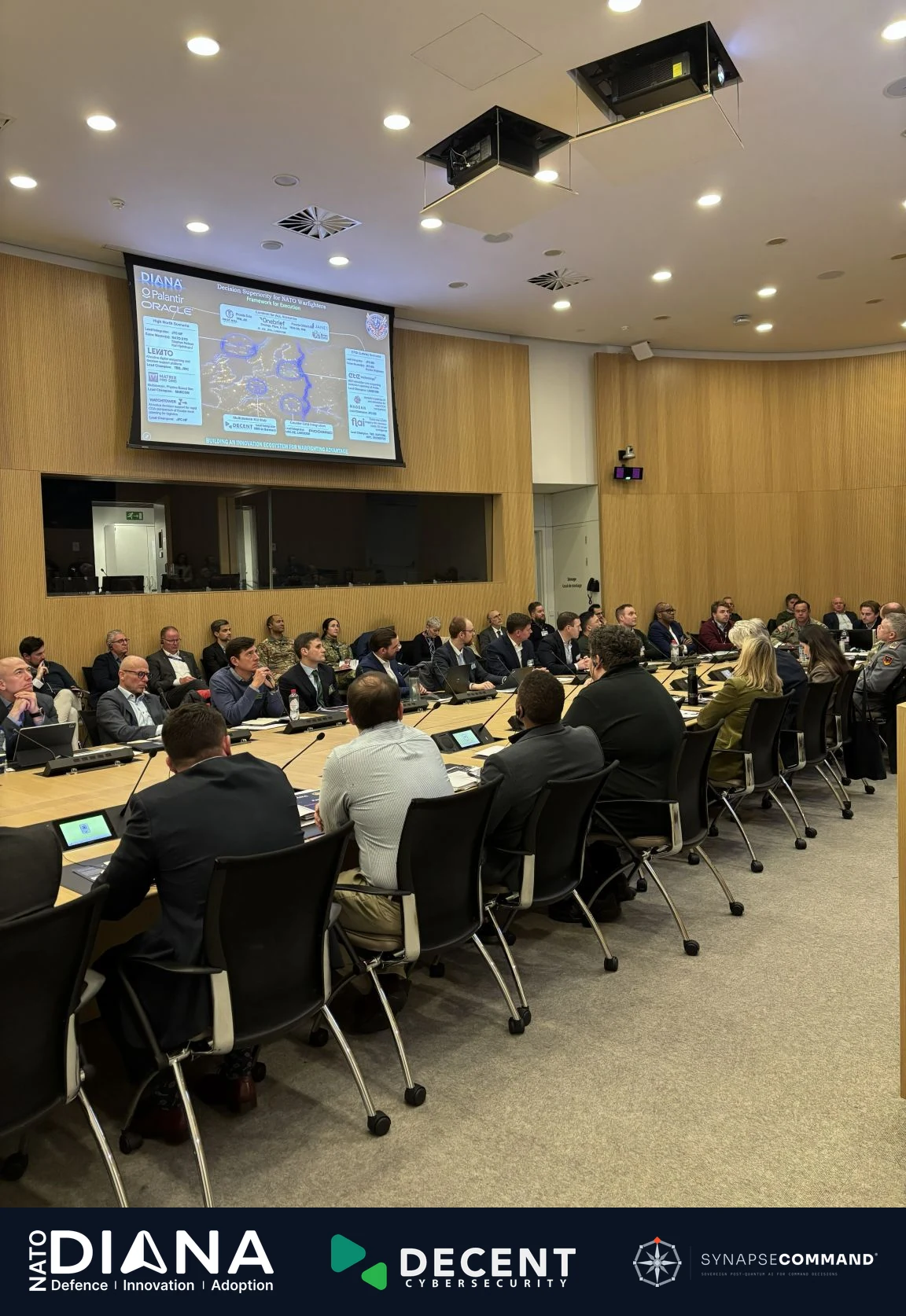
The demonstration brought together ten innovators following six months of development and integration under the Decision Superiority for NATO Warfighters Challenge. Working within a shared environment supported by Oracle cloud infrastructure, the participating companies demonstrated their technologies through fictional scenarios focused on the Eastern Flank and High North.
For SynapseCommand, the event connected engineering work with the people it is intended to serve: commanders, watchstanders and operational staff who must make sense of incomplete information and prepare decisions under pressure. NATO DIANA’s account of the challenge describes an approach built around integrated capabilities and direct engagement with military end users.
Decision support within NATO Maven Smart System
The SynapseCommand platform combines specialised AI agents, blockchain technology and post-quantum cryptography (PQC). Its purpose is to help staff turn incoming information into assessments they can examine, options they can compare and decisions they can subsequently reconstruct.
Through its integration with NATO Maven Smart System, SynapseCommand adds this decision support to the environment in which operational information is already being brought together. Agents support analysis and planning while the commander or authorised operator retains decision authority.
The Sensor Integration scenario
Decent Cybersecurity’s assigned challenge scenario was Sensor Integration. That work addressed a familiar headquarters problem: reporting arrives from different sources, at different times and with different levels of confidence. Staff need to understand where reports agree, where they conflict and what remains unknown. NATO DIANA’s profile of Decent Cybersecurity describes how SynapseCommand supports that process, including the work leading into the High North wargame at Oxford Brookes and the subsequent Brussels demonstration.
Support for commanders
For a commander, access to specialised AI agents creates an opportunity to examine more of the information behind a recommendation before committing to a decision. Agents can work on distinct analytical tasks in parallel, helping staff reconcile reporting, prepare planning material and compare options against stated constraints.
The practical questions remain straightforward. What has changed since the last brief? Which evidence supports this assessment? Which assumptions are carrying the most weight? What information is still missing?
SynapseCommand is designed to make those questions easier to investigate. A commander can review the supporting evidence, challenge an assumption and ask staff to reconsider an option. The intended benefit is more time for judgement, with less staff effort spent assembling the material needed to exercise it.
Support for watchstanders
For a watchstander, the same approach supports the continuous work of maintaining an accurate picture. Incoming reports need to be checked against earlier information, discrepancies need attention and unresolved questions need to remain visible as the situation develops.
An agent-supported watch could, for example, prepare a draft update showing what has changed, identify conflicting reports and retain links to the underlying sources for review. At handover, the incoming watchstander could examine the current assessment alongside outstanding questions and the record of earlier decisions. These are intended workflow benefits whose value must be evaluated against the unit’s data, procedures and operational requirements.
Reconstructing decisions
That continuity also matters after an exercise. Staff need to reconstruct what was known at the time, what the system proposed and what a person approved, amended or rejected. SynapseCommand’s approach to decision quality and verification makes that distinction central to evaluating its outputs.
Blockchain and PQC support the integrity of this record. SynapseCommand uses a hash-chained, append-only decision ledger through CyberFort Blockchain, with post-quantum signatures in assured signing deployments. Records without an active signing key are marked unverified. This gives reviewers a basis for checking the integrity and authenticity of recorded decisions; the quality of the underlying assessment still requires scrutiny.
Connecting these capabilities to existing systems is equally important. SynapseCommand’s interoperability framework provides inspectable data models and adapters so that integration can be examined against the requirements of a particular environment.
The team in Brussels
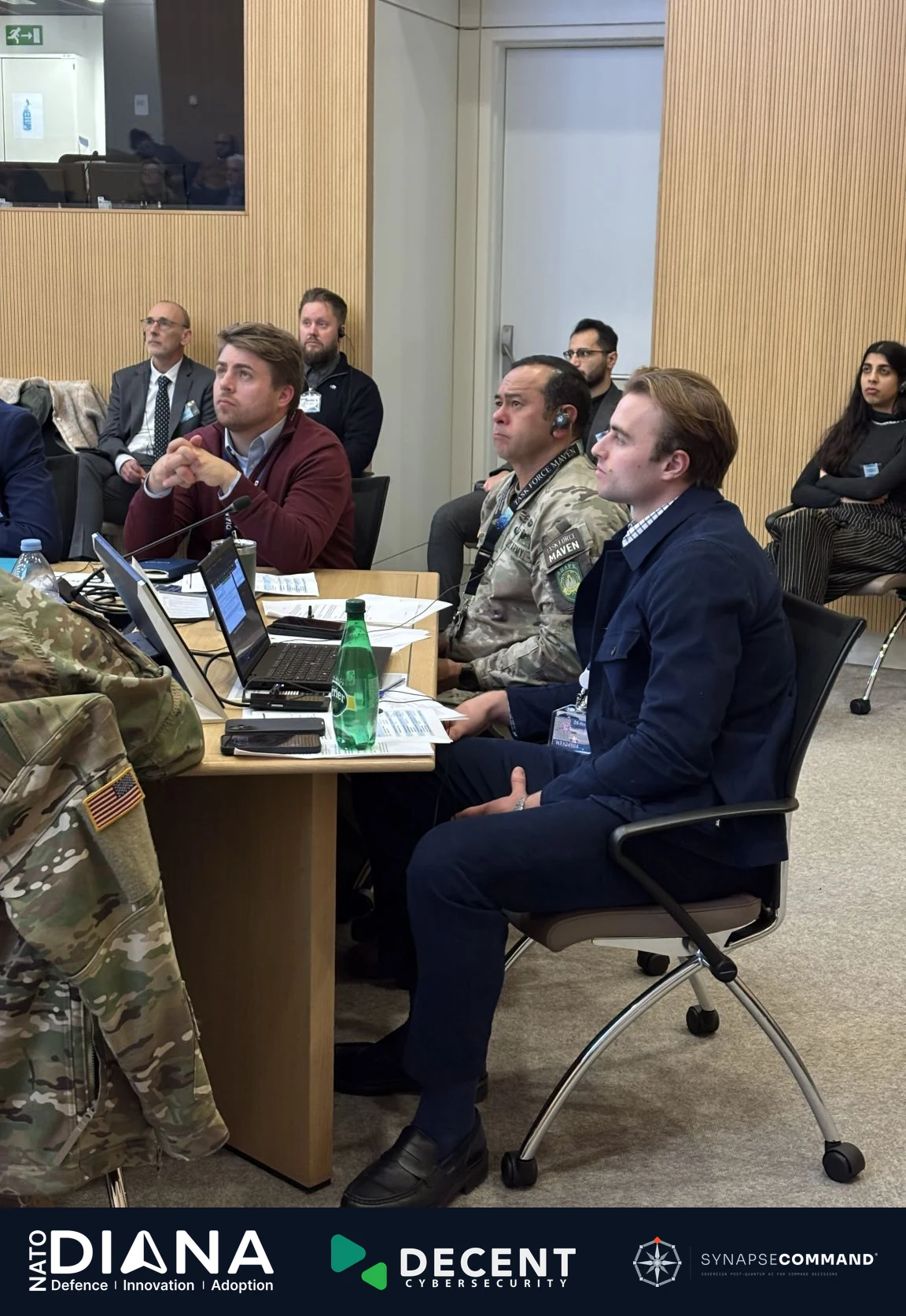
Decent Cybersecurity was represented in Brussels by Matej Michalko, Founder, CEO and Chairman, and Cpt. Theron Lessey, with Jakub Hampl supporting remotely.
The team thanks Col. Arnel David and Task Force Maven NATO for their support and operational engagement, alongside James Orr, Adoption Officer at NATO DIANA; Rhys Roberts, NATO DIANA Industry Lead; and Elena Abellan, Project Coordinator at NATO DIANA.
NATO DIANA, Task Force Maven NATO, Palantir and Oracle helped provide the coordination, integration environment and infrastructure needed to bring the participating technologies together. Working with the other innovators gave each team a concrete setting in which to demonstrate its contribution to a shared operational problem.
Follow-on work through the Rapid Adoption Service
The conclusion of the challenge also opens a route to further work. Decent Cybersecurity is eligible for follow-on contracts for SynapseCommand through NATO DIANA’s Rapid Adoption Service (RAS).
RAS helps connect technologies developed through DIANA with NATO bodies and Allied nations that have a defined capability requirement. It provides a contracting route for further development, prototyping and evaluation, with the potential to progress towards acquisition and deployment.
Under the service’s opt-in framework, DIANA can award research and development or prototype contracts on behalf of participating Allies. Its legal, commercial and adoption teams help translate the customer’s requirement into a contract specification. Other Allies and NATO bodies can join future research, trials or prototyping, supporting work around shared needs.
A successfully demonstrated prototype can subsequently progress to production without further competition under the applicable framework. NATO DIANA has already used RAS to award an R&D contract to HonuWorx on behalf of Defence Research and Development Canada, providing a concrete example of the service in use. The framework also supports NATO’s wider ambition to shorten technology adoption timelines to a maximum of 24 months. Read NATO DIANA’s explanation of the RAS contracting model.
For this Dynamic Challenge specifically, DIANA’s published guidance states that selected innovators are eligible for follow-on contracts awarded on behalf of Allied Command Operations, NATO and Allies for prototyping and potentially full deployment without further competition, at the discretion of the relevant entities. See the challenge’s follow-on contracting guidance.
For SynapseCommand, this creates a practical route for an interested customer to define a requirement, agree the scope of further work and evaluate the capability in its intended setting. Eligibility does not constitute a contract award; any next step depends on the customer’s decision and applicable requirements.
Next steps
The Brussels demonstration marked the completion of six months of collaborative work. The next stage is to build on that evidence with operational users: testing how SynapseCommand’s agents, secure decision records and integration with NATO MSS can support the daily work of commanders and watchstanders.
Contact the SynapseCommand team to discuss a capability briefing, operational evaluation or potential follow-on work through NATO DIANA’s Rapid Adoption Service.