
By Decent Cybersecurity, publisher of SynapseCommand®
ABMS vs Project Convergence vs Project Overmatch: How They Fit Into CJADC2
ABMS, Project Convergence and Project Overmatch are three major U.S. military efforts commonly associated with Combined Joint All-Domain Command and Control, or CJADC2, but they are not three equivalent programmes. In 2026, the Department of the Air Force identifies the DAF Battle Network as its contribution to CJADC2, with ABMS funding a subset of its capabilities. Project Convergence is the Army's major experimentation campaign, while Project Overmatch develops and delivers the Navy's Naval Operational Architecture for distributed maritime operations.
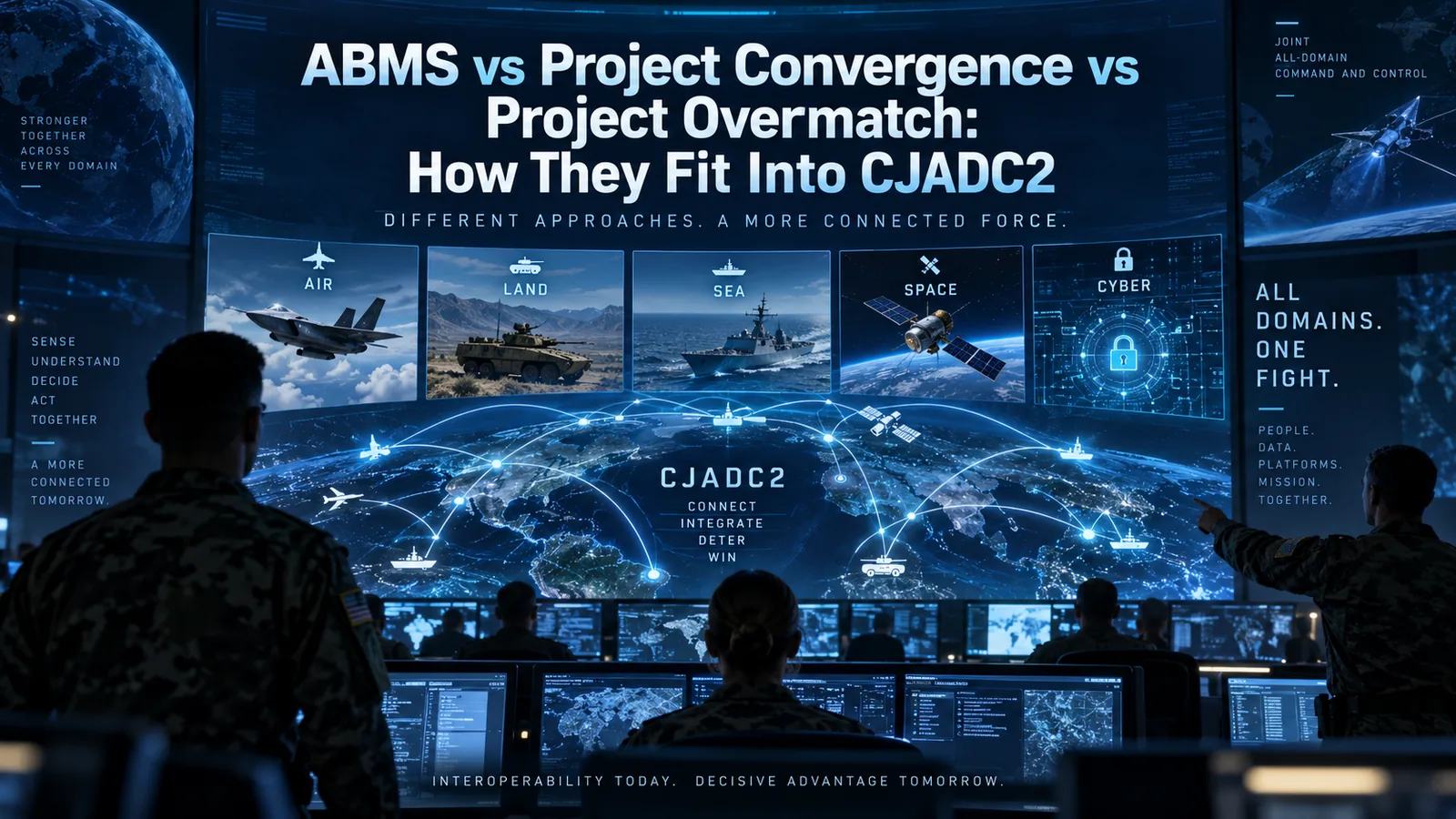
ABMS vs Project Convergence vs Project Overmatch at a glance
ABMS, Project Convergence and Project Overmatch are closely associated with CJADC2, but they are different types of effort. If you need the underlying concept first, see our explainer on What Is CJADC2?, which also sets out how the terminology moved from JADC2 to CJADC2.
| Aspect | ABMS / DAF Battle Network | Project Convergence | Project Overmatch |
|---|---|---|---|
| Lead | Department of the Air Force | U.S. Army | U.S. Navy |
| What it is | ABMS funds part of the broader DAF Battle Network | Persistent Army experimentation campaign | Naval C2 architecture and digital integration effort |
| CJADC2 relationship | DAF Battle Network is officially the DAF contribution to CJADC2 | Tests and informs Army, joint and multinational C2 capabilities | Develops Naval Operational Architecture supporting joint operations |
| Main emphasis | Distributed battle management, connectivity, data and applications | Experimentation, integration and operational learning | Resilient maritime communications, data and decision advantage |
| Current related effort | DAF Battle Network | NGC2 | Naval Operational Architecture |
| Multinational dimension | Supports Joint and Coalition forces | PC-C6 included multinational allies and partners | Formal Five Eyes Project Arrangement |
| One standalone CJADC2 system? | No | No | No |
The shortest accurate answer: ABMS, Project Convergence and Project Overmatch contribute to related CJADC2 objectives, but they are different kinds of initiatives. CJADC2 is the broader Department of Defense concept, not a fourth system sitting above them. The U.S. Government Accountability Office found in April 2025 that these military-department efforts could contribute to CJADC2 objectives, while the extent to which they collectively did so was not yet clear.
What is ABMS?
ABMS stands for Advanced Battle Management System. For years it was commonly described as the Air Force contribution to JADC2 and later CJADC2. That description now needs an important qualification.
The Department of the Air Force currently identifies the DAF Battle Network as its contribution to CJADC2. The Air Force describes the Battle Network as an integrated system-of-systems connecting sensor, effector and logistics systems, and integrating roughly 50 programmes of record across the Air Force and Space Force.
ABMS remains a major part of that effort, but it does not represent the entirety of the DAF Battle Network. The FY2026 Defense Budget Overview states that ABMS funds a subset of DAF Battle Network capabilities, including capabilities associated with connectivity, secure processing and data management.
How ABMS fits into the DAF Battle Network
The relationship is hierarchical rather than parallel. CJADC2 is the Department of Defense concept. The DAF Battle Network is the Department of the Air Force contribution to it. ABMS funds part of the Battle Network.
- CJADC2: the wider Department of Defense command-and-control concept.
- DAF Battle Network: the official Department of the Air Force contribution to CJADC2.
- ABMS-funded capabilities, alongside other Air Force and Space Force programmes of record, inside that Battle Network.
The more accurate 2026 answer to “What is the Air Force contribution to CJADC2?” is therefore the DAF Battle Network, not ABMS alone.
The FY2026 ABMS budget request
The FY2026 President's Budget request includes $966.820 million in Air Force RDT&E for PE 0604003F, Advanced Battle Management System.
This is an ABMS RDT&E request. It is not the budget for the entire DAF Battle Network and it is not the CJADC2 budget.
What is Project Convergence?
Project Convergence is the U.S. Army's major experimentation campaign for testing future technologies, formations, architectures and operational concepts with Army, joint and multinational participants.
It puts combinations of capabilities under realistic conditions rather than testing them in isolation:
- command-and-control systems
- communications and transport
- sensors
- data architectures
- artificial intelligence
- autonomous systems
- fires
- formations and operational concepts
The purpose is not simply demonstration. It is to discover what works, what fails, what scales and what should move closer to fielding.
Project Convergence-Capstone 6 took place from 20 to 29 July 2026 at Fort Irwin, California, with Joint Force and multinational participation. Army reporting described more than 9,700 participants. Official estimates of the total vary, and approximate figures such as around 10,000 also appear in Army material.
How NGC2 changes the Army picture
Next Generation Command and Control, NGC2, is one of the most important current Army developments associated with Project Convergence. It addresses the fragmentation created by decades of function-specific C2 systems, each with its own data model, interface and sustainment path.
The intent is a more unified data environment in which intelligence, fires, manoeuvre, sustainment and protection information can be worked with coherently, rather than reconciled by hand between separate applications.
Following PC-C6, Army leaders announced that NGC2 was “ready to scale”. That statement describes readiness to expand, not completed Army-wide fielding.
Project Convergence should therefore be understood primarily as an experimentation engine, while NGC2 is increasingly important to the Army's operational C2 architecture.
What is Project Overmatch?
Project Overmatch is the U.S. Navy effort associated with developing and delivering the Naval Operational Architecture needed for resilient communications and decision advantage across distributed maritime forces. GAO describes it in those terms, tied to Distributed Maritime Operations and related concepts.
The maritime problem differs from the land and air problems. Forces are separated by long distances, communications are contested, and the force itself is heterogeneous: ships, aircraft, submarines, unmanned systems, Marine formations and shore nodes.
Work associated with the effort therefore spans networks, computing, software, data management, security, communications, analytics and operational integration. Detailed architecture is not public, and this analysis does not speculate about it.
Project Overmatch is increasingly multinational
On 26 February 2025, NAVWAR announced the first formal Project Overmatch Project Arrangement involving five nations:
- Australia
- Canada
- New Zealand
- United Kingdom
- United States
This matters to the “Combined” dimension of CJADC2. Working with partner navies means reconciling classification and releasability rules, identity and permissions, national policies, different C2 systems and different data standards. Trusted interoperability, not raw connectivity, is the limiting factor.
So what is actually different?
DAF Battle Network and ABMS: build and integrate
The Department of the Air Force approach is a system-of-systems: connect existing and new sensor, effector and logistics programmes so they behave as one operational network. The question it answers is how the Air Force and Space Force can perform resilient, distributed battle management across sensors, effectors, data and operational nodes.
Project Convergence: experiment and learn
The Army campaign exists to generate evidence. The question it answers is what actually works when new technologies, operational concepts and multinational forces are combined under realistic conditions.
Project Overmatch: connect the distributed maritime force
The Navy effort is architectural. The question it answers is how a geographically dispersed maritime force can move trusted operational information resiliently enough to create decision advantage.
They overlap, but they are not equivalent.
Who is building what for CJADC2 in 2026?
Department of the Air Force
DAF Battle Network is the official Department of the Air Force contribution to CJADC2, integrating roughly 50 programmes of record. ABMS funds a subset of DAF Battle Network capabilities.
U.S. Army
Project Convergence is the Army's major experimentation campaign. NGC2 is the Army's emerging operational C2 architecture.
U.S. Navy
Project Overmatch develops and delivers the Naval Operational Architecture for distributed maritime operations.
U.S. Marine Corps
Project Dynamis was formally established on 10 September 2025 to accelerate Marine Corps contributions to CJADC2 in partnership with Project Overmatch. It is a more recent and narrower initiative than the three major military-department efforts identified by GAO, and should not be read as organisationally identical to them.
Why do these efforts have to work together?
Real operations cross service boundaries. An Air Force sensor may support a Navy action. An Army formation may depend on space-derived data. Marine units may contribute targeting information. Allied sensors may inform coalition decisions.
Connectivity alone is insufficient. Useful interoperability requires that meaning survives the transfer:
- identity, time and location
- data semantics and track correlation
- provenance and confidence
- permissions, classification and releasability
- security and interface meaning
- command authorities
CJADC2 is fundamentally a command-and-control and data-integration problem, not merely a networking programme.
The biggest CJADC2 problem may be coordination
The military departments are modernising extensively. The harder question is whether those investments collectively create the intended joint and combined result.
In its April 2025 assessment, GAO found that the Department of Defense had not yet established a comprehensive framework for guiding CJADC2 investments and tracking progress across the enterprise. GAO also identified inadequate enterprise-wide coordination and the risk that organisations could continue pursuing command-and-control efforts largely in isolation.
Service modernisation does not automatically produce joint interoperability. New silos can still emerge from:
- incompatible interfaces
- incompatible data semantics
- security boundaries
- non-federated identities
- partner-access restrictions
- manual joint workflows
- lost provenance
Are ABMS, Project Convergence and Project Overmatch being merged?
No. The goal is interoperability, not one universal application. Different services have legitimate mission-specific requirements, and a single programme replacing all of them is neither planned nor realistic.
The practical model is: different mission systems, plus interoperable data and interfaces, plus resilient communications, plus federated security, plus shared decision workflows.
What role does artificial intelligence play?
Artificial intelligence can help with information correlation, pattern recognition, prioritisation, battle management, analysis, course-of-action support and the reduction of manual processing.
CJADC2 is not an AI programme, and AI cannot compensate for poor, ambiguous or untrusted data. The useful sequence is connect, understand, trust, decide, not add AI and expect decision advantage.
Why the “Combined” part matters
Coalition interoperability changes the problem. The DAF Battle Network is described as supporting Joint and Coalition forces. PC-C6 included multinational participation. Project Overmatch now has a formal Five Eyes Project Arrangement.
The challenge is no longer only “Can the Army talk to the Navy?” It increasingly becomes: can heterogeneous U.S. and allied systems exchange the right authorised information, preserve its meaning and provenance, and use it at operational speed?
Where SynapseCommand fits
SynapseCommand is not CJADC2, ABMS, Project Convergence, Project Overmatch, NGC2 or Project Dynamis. It is not presented as CJADC2-certified and does not claim U.S. Department of Defense endorsement.
Its relevance is narrower and technical. SynapseCommand is designed as a decision-intelligence layer that can operate alongside existing command-and-control environments rather than requiring their replacement, as set out in its architecture.
Its published interoperability coverage includes operational formats and sources such as ASTERIX, STANAG 4607, STANAG 4676, STANAG 4609, STANAG 4586, TAK, ADS-B and AIS.
The architectural principle is simple: keep the existing C2, and translate heterogeneous operational information into a consistent decision layer. That addresses one part of the wider interoperability problem, not the whole of it.
The bottom line
ABMS, Project Convergence and Project Overmatch contribute to overlapping CJADC2 goals, but they are not equivalent programmes.
The Department of the Air Force now identifies the DAF Battle Network as its contribution to CJADC2, with ABMS funding a subset of its capabilities. The Army's Project Convergence is principally a persistent experimentation campaign, while NGC2 is becoming increasingly important to the Army's operational command-and-control architecture. The Navy's Project Overmatch develops and delivers the Naval Operational Architecture required for resilient distributed maritime operations.
A current 2026 map should also include the Marine Corps' Project Dynamis, established in partnership with Project Overmatch to accelerate Marine Corps CJADC2 contributions.
CJADC2 is not a fourth system connecting these programmes. It is the broader objective they ultimately need to support: getting the right authorised information to the right decision-makers and capabilities across services, domains and partner nations quickly enough to matter.
The real measure of success is not whether each service builds an impressive architecture of its own. It is whether those architectures can work together when the mission demands it.
Frequently asked questions
What is the difference between ABMS and Project Convergence?
ABMS is an Air Force programme element funding a subset of capabilities within the broader DAF Battle Network. Project Convergence is an Army experimentation campaign used to test technologies, architectures and operational concepts with Army, joint and multinational participants.
Is ABMS still the Air Force contribution to CJADC2?
Not by itself. The Department of the Air Force currently identifies the DAF Battle Network as its contribution to CJADC2. ABMS funds a subset of DAF Battle Network capabilities.
What is the difference between Project Convergence and Project Overmatch?
Project Convergence is primarily an Army experimentation campaign. Project Overmatch develops and delivers the Navy's Naval Operational Architecture for distributed maritime operations.
Is Project Overmatch part of CJADC2?
Project Overmatch is a major Navy C2 effort associated with CJADC2 objectives and is one of the large service efforts identified by GAO as potentially contributing to the broader CJADC2 mission.
Is Project Convergence part of CJADC2?
Project Convergence contributes experimentation and learning relevant to CJADC2, but it should not be described as the entirety of the Army's CJADC2 architecture.
What is the DAF Battle Network?
The DAF Battle Network is an integrated system-of-systems connecting sensor, effector and logistics systems. The Department of the Air Force identifies it as its contribution to CJADC2.
What happened to ABMS?
ABMS remains active. Current FY2026 DoD documentation describes it as funding a subset of DAF Battle Network capabilities.
How much is the FY2026 ABMS budget request?
The FY2026 President's Budget includes $966.820 million in Air Force RDT&E for PE 0604003F, Advanced Battle Management System. This is not the budget for the entire DAF Battle Network or CJADC2.
What is NGC2?
Next Generation Command and Control is the Army's emerging C2 architecture intended to reduce fragmentation across legacy systems and create a more unified data environment. Army leaders said after PC-C6 that NGC2 was ready to scale.
What is Project Dynamis?
Project Dynamis is a Marine Corps initiative formally established on 10 September 2025 to accelerate Marine Corps contributions to CJADC2 in partnership with Project Overmatch.
Are ABMS, Project Convergence and Project Overmatch being merged?
No. The goal is interoperability between specialised service capabilities rather than replacement by one universal programme.
Is CJADC2 one military network?
No. CJADC2 is a Department of Defense concept, not a single network, platform or weapon-system acquisition programme.
Which programme is most advanced?
There is no meaningful single ranking because they perform different functions. DAF Battle Network integrates operational and developmental capabilities, Project Convergence is an experimentation campaign and Project Overmatch concentrates on naval architecture and distributed operations.
Primary sources
- U.S. Government Accountability Office8 April 2025
Defense Command and Control: Further Progress Hinges on Establishing a Comprehensive Framework
GAO-25-106454 examines the major military-department C2 efforts, their possible contribution to CJADC2 and the enterprise coordination gap.
Read GAO-25-106454 - Department of the Air Force
DAF Battle Network
Official Department of the Air Force page describing the DAF Battle Network as its contribution to CJADC2 and as a system-of-systems integrating roughly 50 programmes of record.
Read the DAF Battle Network page - Department of Defense Comptroller
FY2026 Defense Budget Overview
Official budget overview stating that ABMS funds a subset of DAF Battle Network capabilities.
Read the FY2026 budget overview - Department of the Air Force
FY2026 RDT&E Budget Justification, PE 0604003F Advanced Battle Management System
Official Air Force budget justification material containing the FY2026 RDT&E request for programme element 0604003F.
Read the FY2026 Air Force budget material - U.S. Army15 July 2026
Army announces Project Convergence-Capstone 6: A milestone in modernization
Official Army announcement of PC-C6 at Fort Irwin, California, from 20 to 29 July 2026, with joint and multinational participation.
Read the PC-C6 announcement - U.S. Army31 July 2026
Army leaders: Next Generation Command and Control ready to scale
Official Army reporting on NGC2 following PC-C6, including the statement that it was ready to scale.
Read the NGC2 statement - U.S. Army
Project Convergence-Capstone 6: FCC's role in Army experimentation
Official Army coverage of the experimentation role of PC-C6 and participation figures.
Read the PC-C6 experimentation coverage - NAVWAR26 February 2025
Project Overmatch Achieves Historic Milestone with Five Eyes Agreement
Official NAVWAR announcement of the first formal Project Overmatch Project Arrangement with Australia, Canada, New Zealand and the United Kingdom.
Read the NAVWAR announcement - U.S. Marine CorpsSeptember 2025
Marine Corps Announces Project Dynamis to Accelerate AI-Powered Decision Advantage
Official Marine Corps announcement establishing Project Dynamis in partnership with Project Overmatch.
Read the Project Dynamis announcement - U.S. Marine Corps
Project Dynamis
Official Marine Corps page for Project Dynamis and its role in accelerating Marine Corps CJADC2 contributions.
Read the Project Dynamis page
Add decision intelligence to your existing C2
SynapseCommand is designed to work alongside existing command-and-control environments through an inspectable interoperability layer.
SynapseCommand® is a product of Decent Cybersecurity. This analysis summarises publicly available U.S. government information. SynapseCommand is not CJADC2-certified and claims no U.S. Department of Defense, Army, Navy, Air Force or Marine Corps endorsement or affiliation.