

By Decent Cybersecurity, publisher of SynapseCommand®
What Is a NATO STANAG? Standardization Agreements Explained
A NATO Standardization Agreement, commonly called a STANAG, records an agreement among member nations to implement a standard in order to meet an interoperability requirement. This guide explains what a STANAG is, how ratification and implementation work, and how STANAGs relate to Allied Publications.
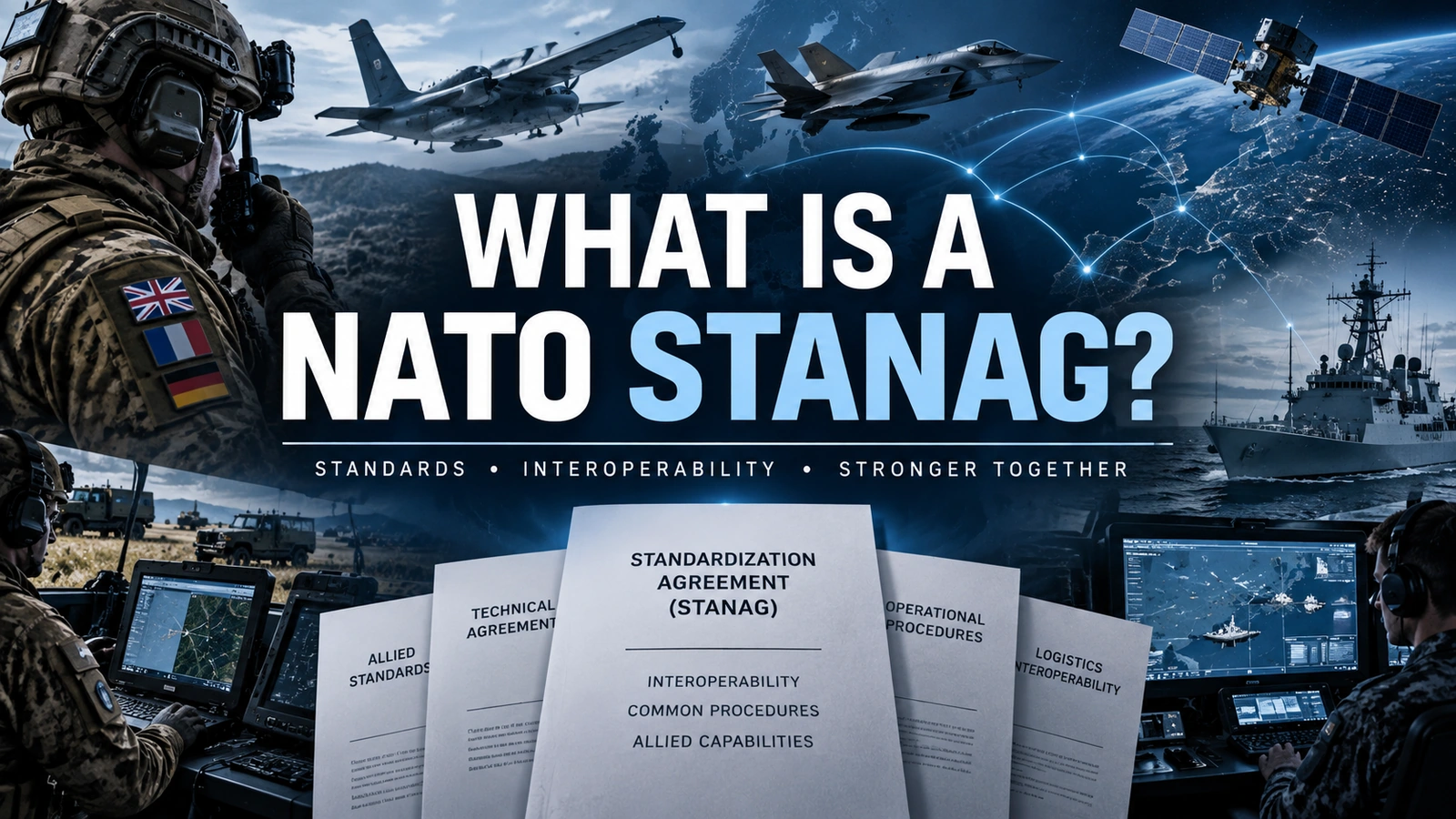
A NATO Standardization Agreement, commonly called a STANAG, is a NATO standardization document that records an agreement among member nations to implement a standard, in whole or in part, with or without reservation, in order to meet an interoperability requirement. NATO's own standardization guidance makes the purpose clear: standards help Allied forces use compatible equipment, procedures, terminology and support arrangements so they can work together effectively.
A STANAG is therefore not simply a technical specification and it is not the same thing as a procurement certificate. It is part of NATO's wider standardization system, which spans operational doctrine, communications, logistics, terminology, procedures and equipment.
What does STANAG stand for?
STANAG stands for Standardization Agreement.
NATO defines a STANAG as a document specifying the agreement of member nations to implement a standard. The agreement can apply in full or in part and may include national reservations. The purpose is to meet an interoperability requirement, not to make every Allied military identical.
Why NATO uses STANAGs
Interoperability depends on more than putting different systems on the same network. Forces need compatible procedures, data conventions, terminology, logistics arrangements and technical interfaces.
A STANAG can help create that common baseline. Depending on the subject, it may support shared operational procedures, compatible communications, common terminology, logistics arrangements, technical interfaces, training frameworks and equipment compatibility.
NATO describes interoperability as the ability of Allies to act together coherently, effectively and efficiently. Standardization is one of the principal tools used to make that possible.
Is a STANAG itself the technical standard?
Not always. NATO distinguishes between the Standardization Agreement and the standard or standards-related publication it covers. A STANAG is the agreement by nations to implement a standard. The detailed standard may be contained in an Allied Publication or another referenced document.
That is why users sometimes see a STANAG number associated with an Allied Engineering Publication, Allied Data Publication, Allied Tactical Publication or another NATO publication family.
How does a STANAG become relevant to a nation?
NATO standardization is based on national agreement and implementation. Member states consider the proposed standard, decide whether to ratify it and then implement it according to the terms they have accepted.
A country may ratify with reservations or implement only part of a standard where the agreement allows that. As a result, the existence of a STANAG does not prove that every nation, system or organisation implements every detail in exactly the same way.
This is one reason system-level interoperability still requires testing, configuration control and evidence. A standards claim should never be treated as a substitute for actual integration or validation.
Who manages NATO standardization?
The NATO Standardization Office supports the development and coordination of standardization activity across the Alliance. NATO also has subject-specific standardization bodies and working groups that develop and maintain standards in their areas of responsibility.
NATO says that the ultimate goal of standardization is interoperability. The process therefore connects doctrine, capability development, defence planning and technical implementation.
Examples of STANAG families relevant to command and control
SynapseCommand's interoperability library already has separate technical owner pages for several standards that should not be duplicated here.
STANAG 4607 is associated with ground moving target indicator data exchange.
STANAG 4609 is associated with digital motion imagery.
STANAG 4676 covers NATO intelligence, surveillance and reconnaissance tracking information.
STANAG 4586 is associated with interfaces for unmanned control systems.
Those pages own implementation-oriented questions. This article owns only the generic question: what a NATO STANAG is and why the mechanism exists.
STANAG vs Allied Publication
The two terms are related but not interchangeable. A STANAG records the agreement to implement a standard. An Allied Publication is a NATO publication that may contain the underlying standard, doctrine, procedure or supporting material.
In practice, a technical team may need to consult both the STANAG and the publication or publications it references.
Why STANAG compliance claims require care
A product should not claim generic “NATO compliant” or “STANAG compliant” status without specifying what has actually been implemented and verified.
For software and data adapters, the useful questions are narrower: which edition is supported, which messages or profiles are implemented, what evidence exists from tests, what limitations remain, and whether interoperability has been validated with the intended external system.
That is why SynapseCommand separates educational standards content from its interoperability evidence pages.
Why STANAGs matter for coalition command and control
Coalition command environments combine national systems designed under different constraints. Standardization reduces bespoke translation and procedural mismatches. STANAGs cannot remove every interoperability problem, but the common standards framework gives Allies a shared basis for designing, testing and improving interoperability.
Frequently asked questions
What does STANAG mean?
STANAG means NATO Standardization Agreement.
Is a STANAG mandatory for every NATO nation?
A STANAG records national agreement to implement a standard, but nations may ratify and implement according to applicable conditions and reservations.
Is a STANAG the same as an Allied Publication?
No. A STANAG is the agreement to implement a standard. The technical or doctrinal material may be contained in an Allied Publication or another referenced standard.
Does using a STANAG make two systems automatically interoperable?
No. Standards are a foundation, but actual interoperability also depends on implementation, configuration, security, testing and operational context.
Does SynapseCommand claim blanket STANAG compliance?
No. SynapseCommand documents individual interoperability interfaces and evidence separately.
Primary sources
- NATO
Standardization
Official NATO topic page explaining standardization, its role in interoperability and how standards are developed and agreed.
Read the NATO standardization topic page - NATO
Standardization Agreements
Official NATO page on Standardization Agreements and their role in recording national agreement to implement a standard.
Read the NATO Standardization Agreements page - NATO
NATO Standardization Office
Official description of the NATO Standardization Office and its role in coordinating standardization activity across the Alliance.
Read about the NATO Standardization Office - NATO
Publications
Official NATO publications index, including standardization agreements and related Allied publications.
Browse NATO publications
SynapseCommand® is developed by Decent Cybersecurity. This article explains publicly documented NATO standardization concepts and does not imply NATO endorsement or certification.