

By Decent Cybersecurity, publisher of SynapseCommand®
NATO DIANA Spotlights SynapseCommand’s Sovereign AI and Post-Quantum Security
NATO DIANA spotlights SynapseCommand’s sovereign AI, sensor integration and post-quantum security, with human oversight at the centre of military decision support.
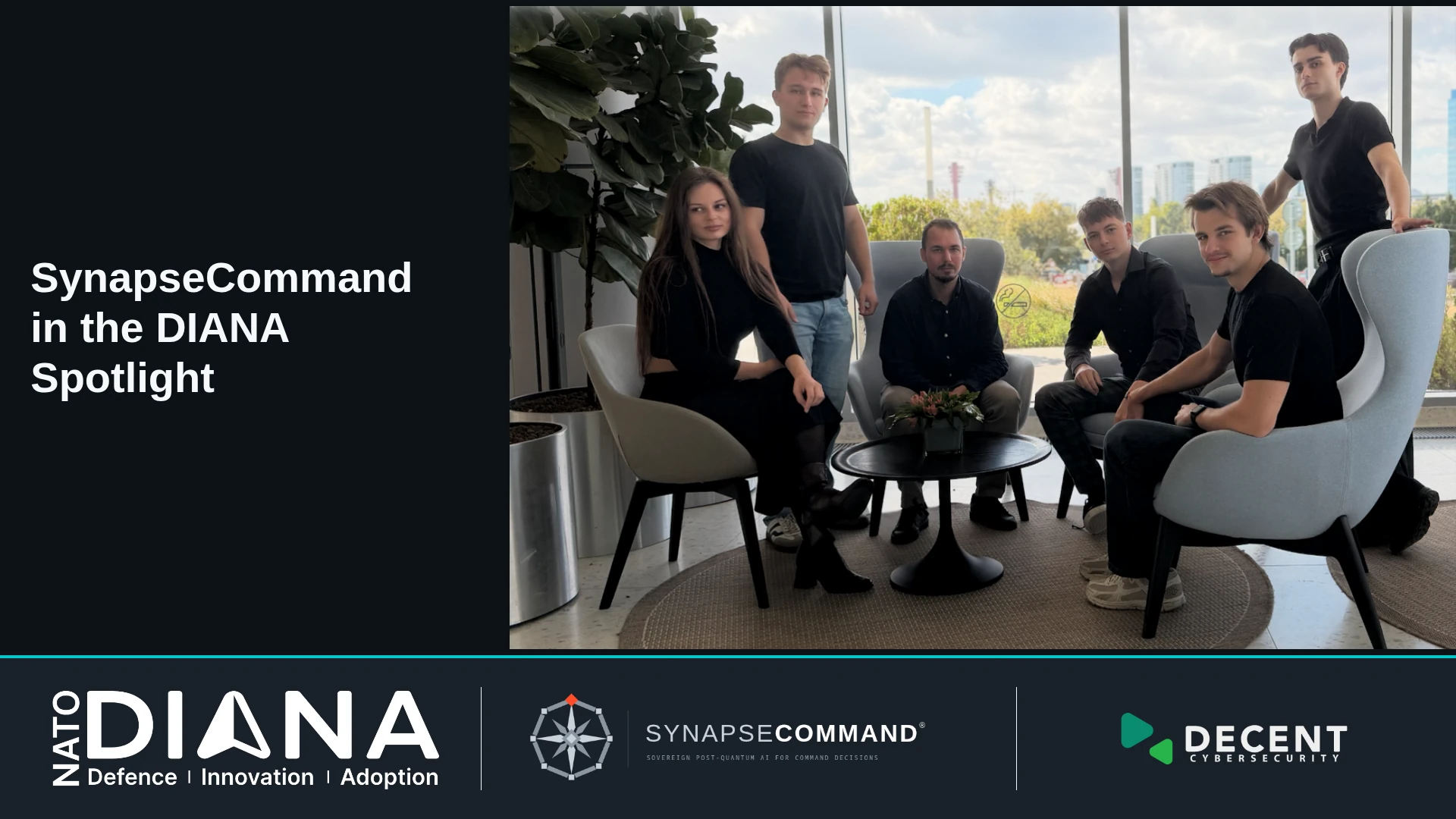
NATO DIANA has published a spotlight on Decent Cybersecurity, highlighting SynapseCommand® and the company’s work in the Decision Superiority for NATO Warfighters Challenge. Published on 12 November 2026, the feature includes an interview with Michaela Abel, Co-Founder and Chief Operating Officer, covering sensor integration, human oversight and cybersecurity.
For SynapseCommand, the engineering priority is clear: help military staff turn operational information into assessments they can inspect, challenge and use within their existing command environment.
Sovereign AI built around human decision authority
The SynapseCommand platform brings specialist AI capabilities into command-and-control, common operating picture and intelligence workflows. Its role is to support staff analysis, planning and the comparison of options, with consequential decisions remaining under human authority.
“Sovereign AI has to earn its place in a headquarters. Staff need to see where an assessment comes from, challenge its assumptions and retain control of the decision. Our focus with SynapseCommand is to make that support useful inside existing command systems, with evidence that end users can examine.”
Matej Michalko, Founder, CEO and Chairman, Decent Cybersecurity
The SynapseCommand workflow connects authorised information to specialist agents, develops assessments and options, and presents outputs for human review. The agents involved, applicable policies and approval requirements depend on the task and deployment.
This makes the quality of the supporting evidence central to the usefulness of an answer. Staff must be able to examine its sources, identify assumptions and judge whether the available information supports the proposed action.
Abel captures the governing principle in the DIANA interview:
“The human decision remains the human's.”
Building on the NATO DIANA Decision Superiority challenge
On 9 July 2026, NATO DIANA named Decent Cybersecurity among ten selected companies in the challenge, delivered in collaboration with Allied Command Operations.
Maven Smart System NATO provides the programme’s foundation. Participating companies work with NATO stakeholders and operational users to integrate and demonstrate technologies in a simulated, mission-relevant environment. Each selected company receives €100,000 in contractual funding to support integration and demonstration.
Our original DIANA selection announcement records that milestone. The November spotlight focuses on the work behind SynapseCommand’s participation, including its assigned Sensor Integration scenario.
Connecting operational information to existing command systems
Integration requires more than moving data between applications. The receiving system needs enough context to interpret the information, while the staff using it need to understand its relevance and limitations.
SynapseCommand’s open-source integration layer provides a public foundation for this work, including data models, schemas, adapters and validation material. Technical teams can inspect the integration contract before connecting their environment.
The defence data interoperability register documents supported standards and the direction of exchange for individual adapters. The separate command and mission system compatibility catalogue explains the integration status of named systems.
These resources help programme teams frame a concrete evaluation: which information will enter the platform, what context will be retained, how outputs will return to the existing workflow and what the receiving organisation must verify.
Post-quantum security and a traceable decision record
SynapseCommand’s sovereign architecture places customer data, configuration, fine-tuned artefacts and the deployment environment under customer control. The platform operates without a mandatory external inference service or hyperscaler control plane.
The architecture also provides a hash-chained, append-only decision record. In assured deployments, records are signed with ML-DSA, a post-quantum digital signature algorithm. Records produced without an active signing key are explicitly marked UNVERIFIED.
These mechanisms support examination of the recorded sequence and its integrity. The assessment itself still requires scrutiny: preserving a recommendation does not establish that its underlying interpretation was correct.
The platform’s trust and assurance framework connects human oversight, traceability and deployment-specific controls. For an organisation evaluating military AI, these are practical questions about accountability: what was presented, what evidence supported it and who authorised the resulting decision.
November demonstrations and end-user evaluation
In the DIANA spotlight, Abel describes plans to support the High North wargame at Oxford Brookes before demonstrating at NATO Headquarters on 24 November 2026. She also describes acceptance criteria agreed with the end user.
These upcoming activities provide the next opportunity to examine SynapseCommand against defined staff needs. For programme teams, the useful evidence will concern how the platform fits the working environment, how its outputs can be reviewed and how its contribution is measured.
Read the full Decent Cybersecurity spotlight on NATO DIANA’s website.
For platform demonstrations, integration discussions and technical evaluation, contact the SynapseCommand team.